
Curtain size guide: length, width and height to choose
How long, wide and high curtains should be, with the three floor finishes, how wide to make the track and how much wall to leave for the stack.
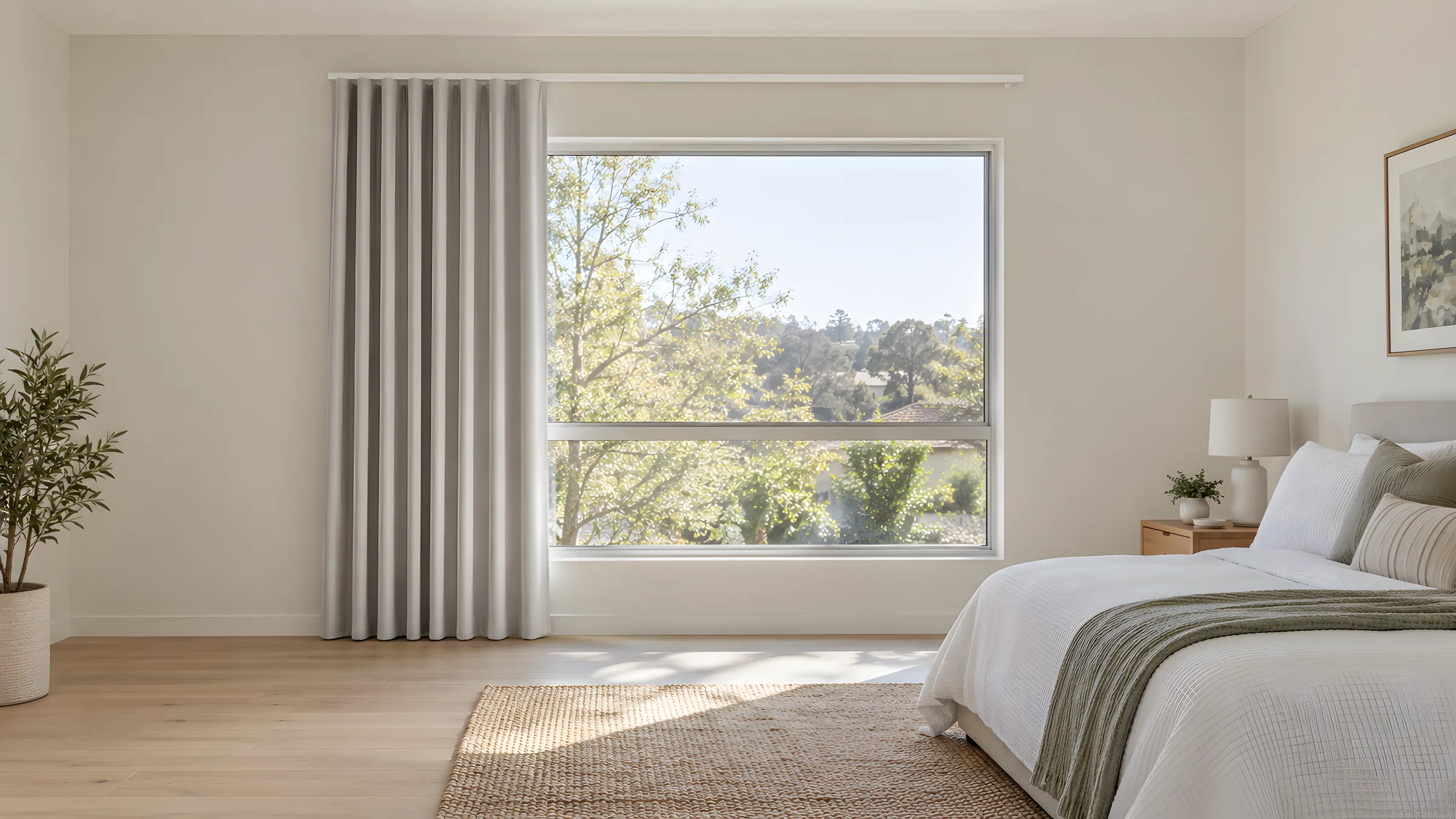
How long should curtains be? For most rooms, long enough to reach the floor, finishing either just off it or lightly touching it. The width comes from the track, which should be wider than the window if you want the curtains to frame the glass, and the height comes from whether you choose a ceiling or a wall fit. With made-to-measure curtains you do not choose a standard size. You give the track width and the drop, and the curtain is made to fit. This guide covers what to decide, and our official guides cover how to measure.
In short
- Length: just off the floor (5 mm to 10 mm short of your drop), touching (skimming by up to 5 mm) or puddled (about 20 mm on the floor).
- Width: you order the track width, not the fabric width. To frame a window, our guide has you add at least 30 per cent to the window width.
- Height: a ceiling fit takes the fabric up to the ceiling; a wall fit puts the track on the wall above the window.
- Leave wall space for the stack: about 30 per cent of the track width for one-way curtains, about 15 per cent each side for centre-opening, on wall-to-wall windows.
- Measure with our curtain measuring guide, not a general method.
How long should curtains be?
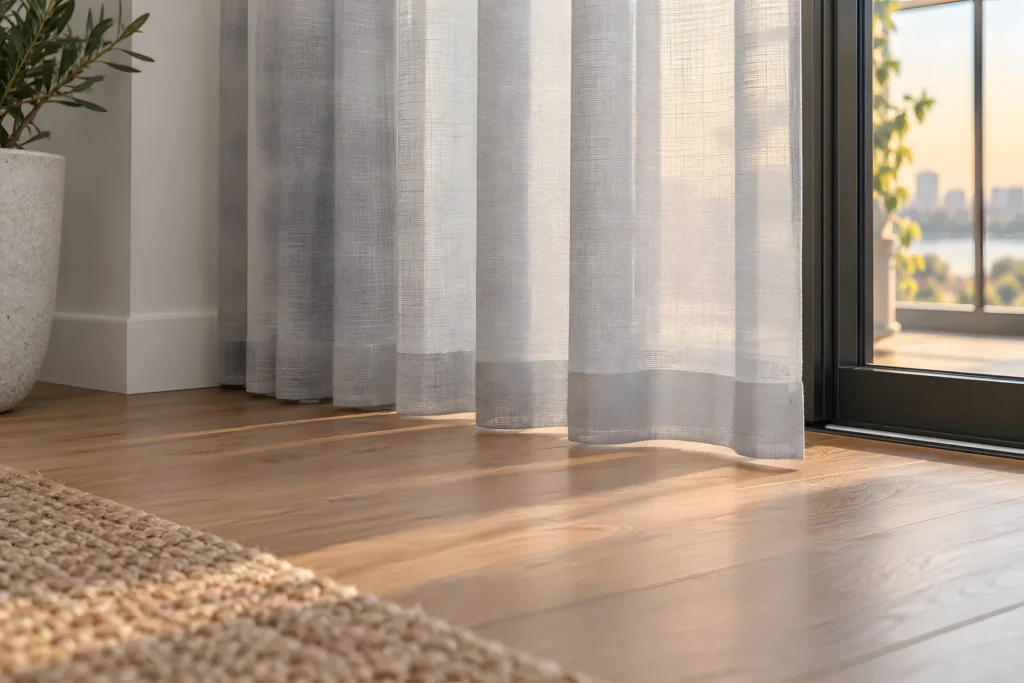
Floor-length is the standard answer, and you choose how the hem meets the floor. You give your drop measurement as the guide describes, and the adjustment for the finish you choose is made for you.
| Finish | What happens at the floor | Best for |
|---|---|---|
| Just off the floor | The curtain ends about 5 mm to 10 mm shorter than your drop measurement and hovers above the floor | A neat, classic look; homes with young children, pets or hard floors, because the hem stays clear of dust |
| Touching the floor | The curtain skims the floor by up to 5 mm, with a slight break in the folds | A relaxed but tailored, made-to-measure look |
| Puddled | The curtain puddles on the floor by about 20 mm | Adding weight and volume with soft drapery fabrics, and hiding a floor or ceiling that is slightly uneven |
Tip: The finish adjustment is made for you, so do not take a gap off your drop yourself. The curtain measuring guide explains what to enter.
Shorter curtains
Some windows sit above a radiator, a desk or a bench, where a floor-length curtain would be in the way. If that is your case, check the drop range in the configurator before you plan around it, and follow the measuring guide for where to measure the drop. If curtains you already own are too long, how to hem or shorten curtains covers the options.
Should curtains touch the floor?
They can, and it is a matter of look and practicality rather than a rule.
- Choose just off the floor if you have young children, pets or hard flooring such as polished concrete, timber or tiles. The hem stays off the floor and collects less dust and dirt.
- Choose touching for a tailored look, where the curtain reaches the floor with no visible gap.
- Choose puddled if the floor or ceiling is slightly uneven. The extra fabric hides the difference. The measuring guide says when puddled is the right choice for uneven drops.
How wide should curtains be?
Two things set the width: the track width you order, and the fullness of the curtain. Fullness is worked out for you.
Track width
You give the track width, not the fabric width. There are two common approaches:
- Wall to wall: the track runs from one wall to the other, or between the cornices, and the curtains cover the whole wall.
- Framing the window: the track is wider than the window, and our guide has you add at least 30 per cent to the window width so the curtains stack beside the glass.
The fabric width is calculated from your track width. The curtain measuring guide explains which of the two approaches to choose on the product page.
Stack-back
Open curtains need somewhere to sit. For wall-to-wall windows, a one-way curtain stack-back takes approximately 30 per cent of the track width, and a centre-opening pair takes approximately 15 per cent on either side. Treat those as planning guides rather than exact figures.
If you want the glass fully clear when the curtains are open, make sure the stack sits beside the frame rather than across it. Extending the track on the stacking side is the simplest way.
Fullness
Fullness is how much fabric is used compared with the finished curtain width, and it changes the look. We offer about 2.0, 2.2, 2.25, 2.4, 2.5 and 2.5 to 2.75 times the finished width.
- About 2.0: the lightest fullness, with flatter folds and a simpler, less bulky look.
- About 2.2 to 2.25: a little more fold and body while still sitting fairly flat.
- About 2.4: noticeably fuller folds, and a good middle-ground for many headings.
- About 2.5: a full curtain with good body and depth of fold.
- 2.5 to 2.75: the fullest option, with the deepest folds and a luxurious drape.
Choose a fullness and the configurator does the rest. Fullness works alongside the heading, which our post on curtain headings explained compares.
Ceiling fit or wall fit
Height is set by where the track goes, and you choose between the ceiling and the wall.
| Ceiling (top) fit | Wall (face) fit | |
|---|---|---|
| Where the track goes | On the ceiling | On the wall above the window |
| Effect | Takes the fabric up to the ceiling and adds height to the room | Frames the window; can run across a whole wall |
| Suits | Straight-edge ceilings with no cornices, and also works inside a cornice | Rooms with a large cornice, where a ceiling-fixed curtain would sit far from the glass |
Extension brackets move the track further out to clear a window handle, sill or another blind. Our curtains installation guide covers fixing the track on either surface.
If you like the idea of fabric running the full height of the wall, read our guide to floor-to-ceiling curtains.
Sizes for different windows and doors
| Situation | What to plan |
|---|---|
| Standard window | Floor-length curtains on a track wider than the window, on a ceiling or wall fit |
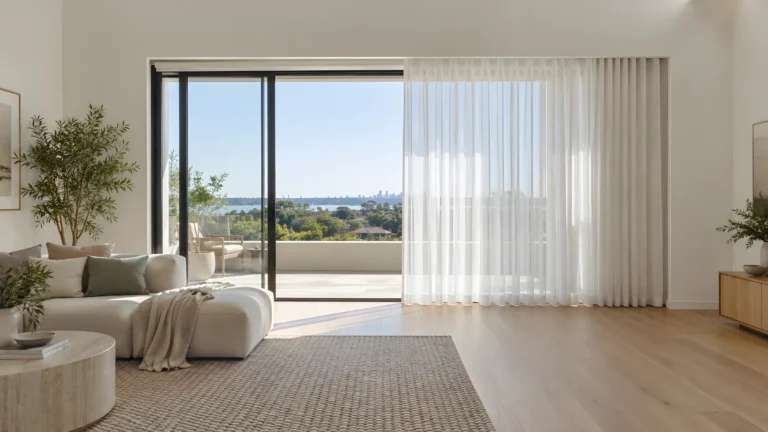
| Sliding or stacker door | Just off the floor so the hem does not drag. Stack beside the doorway rather than across it, and consider splits (up to two) so you can open part of the curtain. See blinds for sliding doors for alternatives |
| Wall of windows or large window | A wall-to-wall track. A centre opening halves the stack on each side |
| Bay, box or corner window | A curved or box and bay track; send a photo and a plan sketch |
| Double curtains | The tracks project 220 mm to 250 mm from the wall, so check handles and sills |
Sizing mistakes to avoid
- Measuring with a general method. Use the official guide for your curtain type, because the track width, drop and finish are entered in a particular way.
- Making the track the same width as the window. The stack then covers the glass.
- Forgetting obstructions. Check handles, radiators and furniture under the window.
- Judging fullness from a photo. Order free samples to see the fabric in your own light.
Which guide to use
Each curtain type has its own measuring and installation guide, so pick the one that matches your order.
| Your curtains | Measuring guide | Installation guide |
|---|---|---|
| Straight, single track | Curtain measuring guide (linked above) | Curtains installation guide (linked above) |
| Double curtains | Double curtains measuring guide | Double curtains installation guide |
| Curved or corner track | Curved curtains measuring guide | Curved curtains installation guide |
| Box or bay window | Box bay curtains measuring guide | Box bay curtains installation guide |
| Lined curtains | Curtain measuring guide (linked above) | Lined curtains installation guide |
Our curtains page has the configurator when you are ready.
Questions
How far off the floor should curtains be?
For a just-off-the-floor finish, the curtain ends about 5 mm to 10 mm shorter than your drop measurement, so it hovers above the floor. You give the exact drop and the adjustment is made for you.
Should curtains touch the floor?
They can. A touching finish skims the floor by up to 5 mm for a tailored look. Just off the floor is more practical with children, pets or hard floors, because the hem stays clear of dust.
How much wider than the window should the track be?
To frame a window, our curtain measuring guide has you add at least 30 per cent to the window width for the track. That lets the curtains stack beside the glass rather than across it.
What size curtains do I need?
With made-to-measure curtains you do not choose a standard size. You give the track width and the largest of three drops, choose a fullness, and the fabric width is worked out for you.
How high should I hang curtains?
A ceiling fit takes the fabric up to the ceiling and makes the room feel taller. A wall fit puts the track on the wall above the window, and our curtains installation guide covers fixing either type.
Build your curtains
Enter your track width and drop, choose your finish and see the price before you order.
Keep reading
 CurtainsFloor-to-ceiling curtains: how to plan ceiling-fixed tracksHow to plan floor-to-ceiling curtains on a ceiling-fixed track, from cornices and fixings to the finish at the floor, choosing sheers and which guides to follow.
 CurtainsCurtain tracks explained: wall, ceiling, curved and motorisedHow curtain tracks work and how to choose one: Designer, Half Moon, curved and motorised, ceiling or wall fit, fixed or free flow, brackets and wands.
 CurtainsCurtains for bay and corner windows: curved and box & bay tracksCurved, box and bay, or straight across the front? How to choose a track for a bay or corner window, and which of our guides to measure it with.