
Curtains for sliding and bifold doors: what to plan
Curtains suit sliding and bifold doors when the track is longer than the opening. Plan the stack-back, hem height and handle clearance before you order.
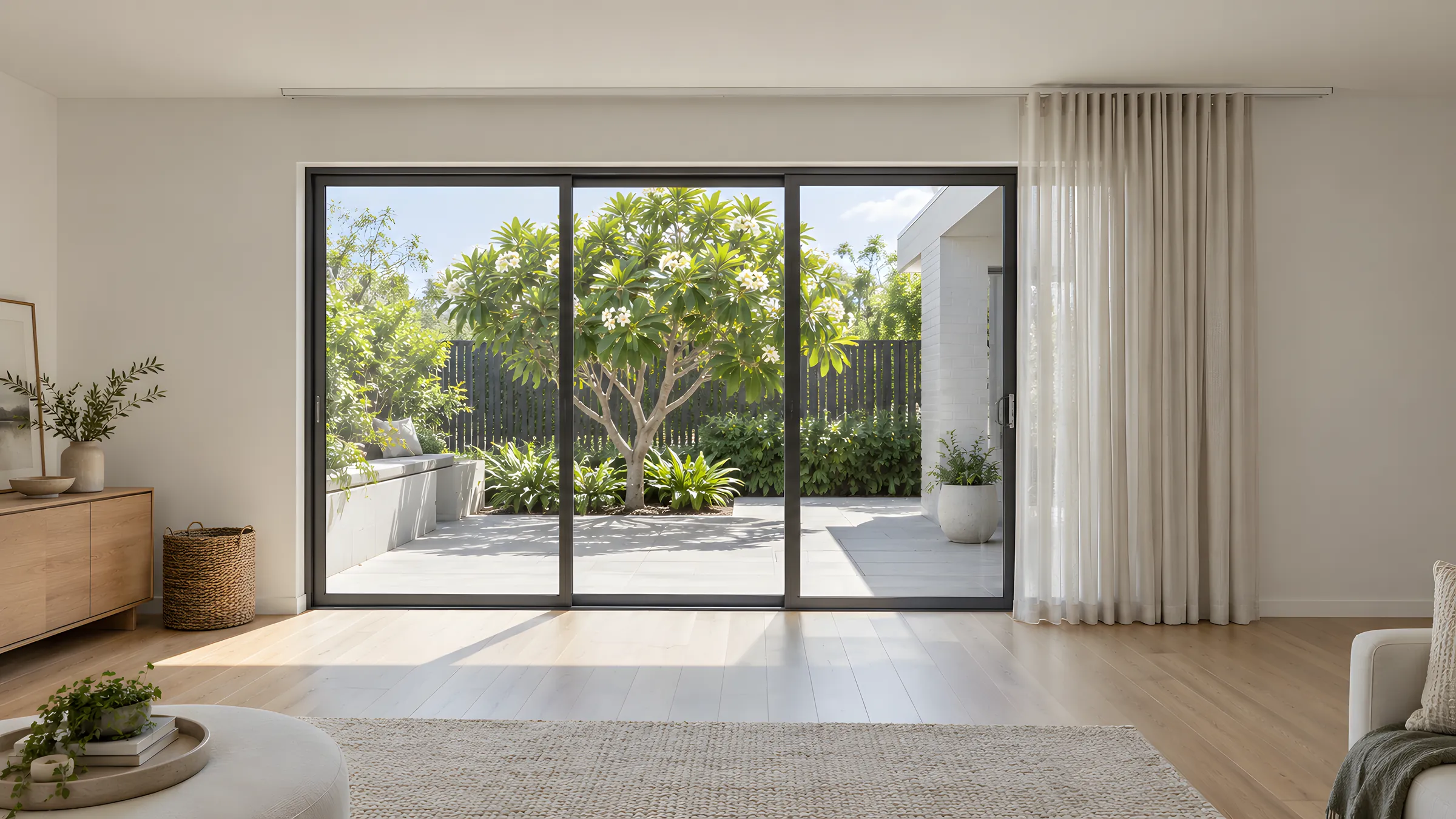
Curtains for sliding doors and bifold doors work well when the track is longer than the opening. For wall-to-wall windows and doors, a one-way curtain stack-back takes about 30 per cent of the track width, and a centre opening about 15 per cent on either side. That stack has to sit beside the door, not in front of it, or the curtains will cover glass you meant to leave clear.
In short
- Make the track longer than the door opening so the stack sits beside the glass, and size it with our curtain measuring guide.
- Choose a hem that finishes just off the floor (5 to 10 mm short) so it clears the door track. Avoid puddled finishes at a doorway.
- S Fold is the most popular heading and pairs well with a sheer at the front and a blockout behind.
- For bifold doors, work out which way the leaves fold and keep the curtain stack outside that space.
- If there is no wall space beside the door, choose panel glide or vertical blinds instead.
Curtains for sliding doors: what to decide first
Five decisions shape a door curtain. Settle them before you open the measuring guide.
- How it opens. Left, right, centre or up to two splits. Choose the side that leaves the door handle clear.
- How far the track extends. This is the stack-back rule below.
- Ceiling fit or wall fit. A ceiling (top) fit hangs the curtain from the ceiling for a full-height look. A wall (face) fit needs wall space above the door.
- Layers. A sheer alone, a blockout alone, a lined curtain, or sheer and blockout on two tracks.
- Control. Hand-drawn, with a wand, or motorised.
How long the track needs to be
Stack-back is the width of curtain that gathers up when fully open. For wall-to-wall windows and doors, our guide puts a one-way stack-back at approximately 30 per cent of the track width and a centre opening at approximately 15 per cent on either side. So the track has to be longer than the opening, with the extra length sitting beside the door. Fullness and heading change the real stack, so treat the percentages as a planning guide.
What matters is the wall space: the extra length has to exist beside the door. The curtain measuring guide explains how to enter your track width, and we apply the fullness for you.
If the wall stops short, you have three choices. Accept that the stacked curtain covers part of the glass. Move to a centre opening so the stack splits either side. Or choose panel glide blinds, which need 300 mm extra on the stack side and 100 mm on the other.
Clearances at a door
A sliding door has a handle, a floor track and a moving leaf. Curtains have to work around all three.
- Hem height. Just off the floor (5 to 10 mm short) clears the door track and threshold. Touching skims by up to 5 mm. Puddled adds 20 mm of fabric and will drag through a track and collect dirt where you walk.
- Handle projection. Hold a tape from the glass to the tip of the handle. Your track projection and heading depth must sit beyond that figure, or the fabric will hook the handle when you draw it.
- Heading depth. S Fold has the deepest heading profile of our five headings, so it needs the most clearance from the wall or frame. Extension brackets move the track farther out where a projecting frame or handle needs it.
- Double curtains. Sheer plus blockout on two tracks projects 220 to 250 mm from the mounting surface. Allow for that beside any door hardware.
- A wand. A 910 mm or 1520 mm wand lets you draw the curtains without dragging the fabric across the handle. You can also choose no wand.
Tip: Open the door fully and mark the handle, the leaf edge and any stacked door panel on the wall with masking tape. Your curtain stack has to sit outside those marks.
Bifold doors: what changes
Bifold doors fold in a concertina and stack to one side or both. That changes three things.
The folded leaves take space. The folded stack of door leaves sits within or beside the opening, with handles at the leaf edges. The curtain track needs to run past both the folded leaves and the curtain stack, or the fabric ends up wedged against door hardware.
The direction of fold matters. If the leaves fold into the room, they sweep the space in front of the glass. Curtains parked in that path will be caught. Check how yours fold and draw the curtains clear before opening the doors. If they fold outward, the curtain only needs to clear the handles.
Wind and traffic. Bifold doors open onto patios, so sheers will move in a breeze. Choose a hem finish that clears the floor and keep the track long enough that the stack sits away from the door leaves.
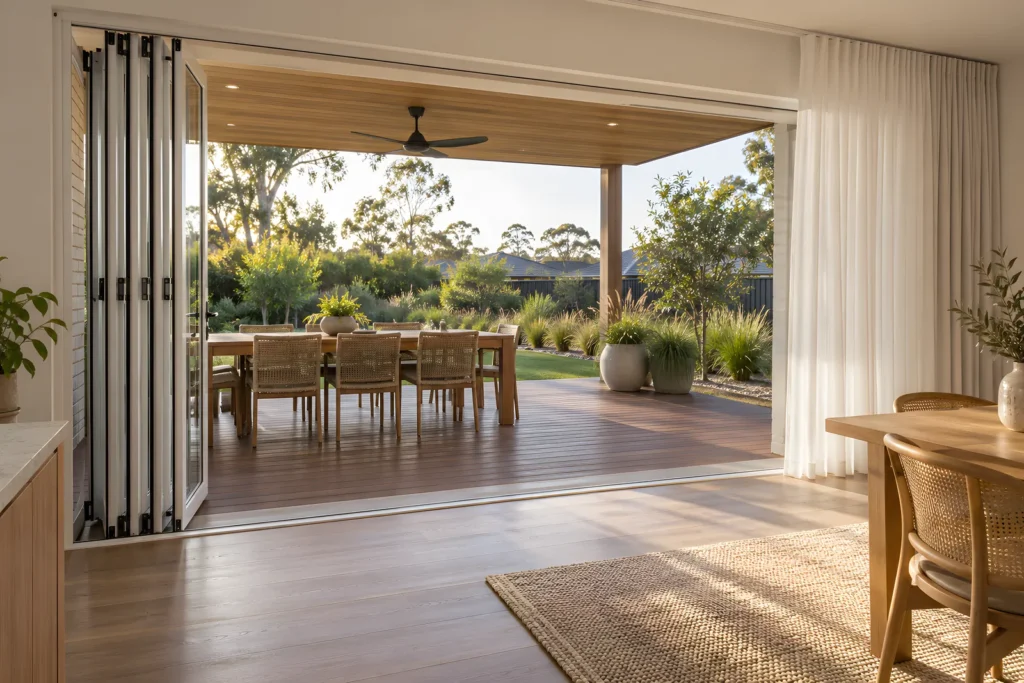
For a very wide bifold wall, motorised curtains save pulling a heavy run by hand. Power is battery or hardwired, remotes are 2-channel or 16-channel, and a compatible smart hub is optional. Motorised tracks are not available with free-flow tracks or multiple openings.
Sheer, blockout or both
The layer you choose decides day privacy, night privacy and light control.
| Option | What it does | Notes |
|---|---|---|
| Sheer curtains | Some privacy by day; soft light | At night with lights on, people outside can see in. Cassis, Cassis Volume and Bali are linen-look polyester |
| Blockout curtains | Coated, opaque; no light through the cloth | Some light at the edges, top and bottom. Many people search for "blackout"; it means the same as blockout |
| Lined curtains | A blockout lining sewn behind a sheer, moving together on one track | One track, one movement |
| Double curtains | Sheer at the front, blockout behind, on two tracks | Drawn separately; projects 220 to 250 mm |
Sliding doors are often the biggest piece of glass in a room, so many people layer. Sheer in the day for softened light and a view, blockout at night for privacy and to stop light spilling out. Sheers outsell blockouts roughly three to one in our range.
For care, sheers are hand wash only in warm water and dry by hanging. Blockout curtains should not go in a washing machine. Door curtains are handled more than most, so check the care instructions before you choose a pale colour.
Which heading suits a door
We make five headings: S Fold, Pencil Pleat, Double Pinch Pleat, Triple Pinch Pleat and Inverted Pleat.
- S Fold is the most popular. It makes regular waves and suits a ceiling-fit track.
- Pencil pleat and pinch pleat give a more traditional gathered look.
- Inverted pleat has a flat front with the fullness folded behind. Pencil and inverted pleats are often used as the rear layer behind an S Fold front.
For most sliding doors, S Fold in a sheer with a pencil pleat or inverted pleat blockout behind is a reliable combination. The curtain size guide covers fullness and drops, and curtain tracks explained covers track types and brackets.
Curtains or blinds for sliding doors
Both work. The deciding factor is usually wall space and how often you use the door.
| Your situation | Better choice |
|---|---|
| Wall space beside the door for the stack | Curtains |
| Little or no wall space beside the door | Panel glide or vertical blinds |
| Door used constantly, hands often full | Blinds, or curtains with a wand or motor |
| Bedroom slider needing day and night layers | Curtains, sheer plus blockout |
| Softest, most layered look | Curtains |
If you are still weighing it up, our guide to blinds for sliding doors lists the blind options.
Measuring for door curtains: use our guide
Use the official guide for your curtains rather than a general method: the curtain measuring guide linked above for a straight track, or the double curtains measuring guide if you want a sheer and a blockout on two tracks. Decide the opening side, how much wall space you have and ceiling or wall fit before you start, as the guide asks for them.
Order free samples and view them at the door in morning and evening light, then build your order at curtains.
Questions
How long should the curtain track be for a sliding door?
Longer than the door opening, so the stacked curtain sits beside the glass. For wall-to-wall windows and doors a one-way stack-back takes about 30 per cent of the track width and a centre opening about 15 per cent on either side. Use our curtain measuring guide to size the track.
Should curtains touch the floor on a sliding door?
No. Choose a finish that is just off the floor (5 to 10 mm short) so the hem clears the door track and threshold. A puddled finish will drag and collect dirt at a doorway.
Are curtains or blinds better for sliding doors?
Curtains suit doors where you have wall space beside the opening and want a soft finish or layered day and night control. Panel glide or vertical blinds suit doors with little wall space beside them.
Can I hang curtains on bifold doors?
Yes, on a track that clears the folded door leaves and their handles. Work out which way the doors fold, mark where they finish when fully open, and keep the curtain stack outside that space.
Can motorised curtains suit a large door?
Yes. Motorised tracks are available with battery or hardwired power, but not with free-flow tracks or multiple openings. A motor saves pulling a wide, heavy curtain by hand.
Build your door curtains
Choose your heading, fabric and track and see the price as you enter your track width.
Keep reading
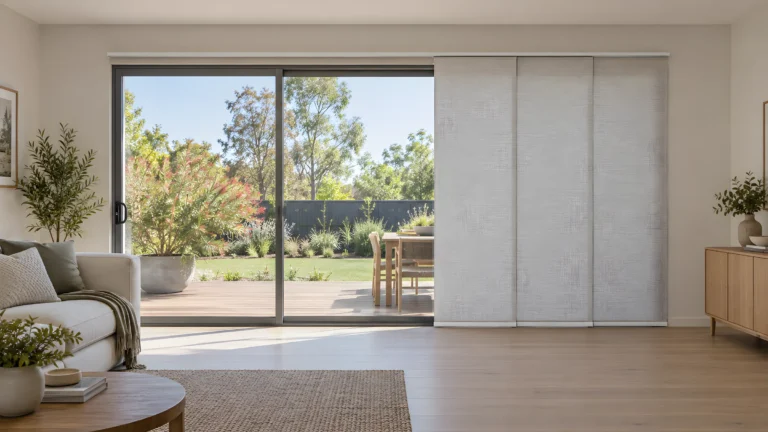 Room ideasThe best blinds for sliding doors and French doorsPanel glide, vertical, linked roller blinds or curtains? Compare the best blinds for sliding doors and French doors, with the clearances that decide what works.
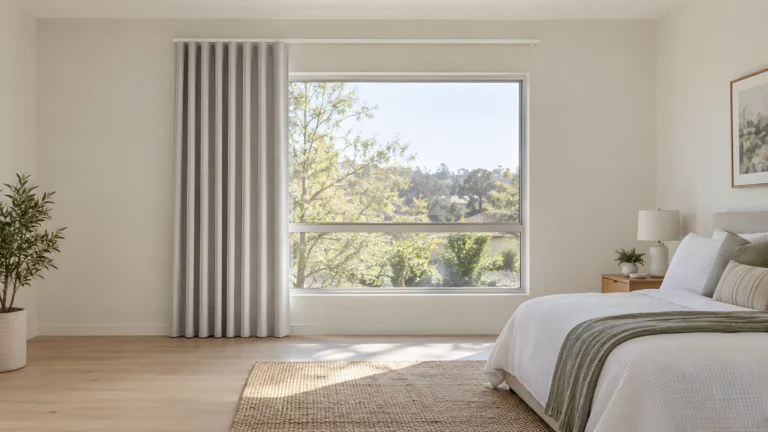 Measuring & fittingCurtain size guide: length, width and height to chooseHow long, wide and high curtains should be, with the three floor finishes, how wide to make the track and how much wall to leave for the stack.
 CurtainsCurtain tracks explained: wall, ceiling, curved and motorisedHow curtain tracks work and how to choose one: Designer, Half Moon, curved and motorised, ceiling or wall fit, fixed or free flow, brackets and wands.