
DIY curtains: make your own or order made to measure?
Sewing your own curtains suits simple, light panels. Fullness, headings, hems and coated blockout are where made to measure earns its place.
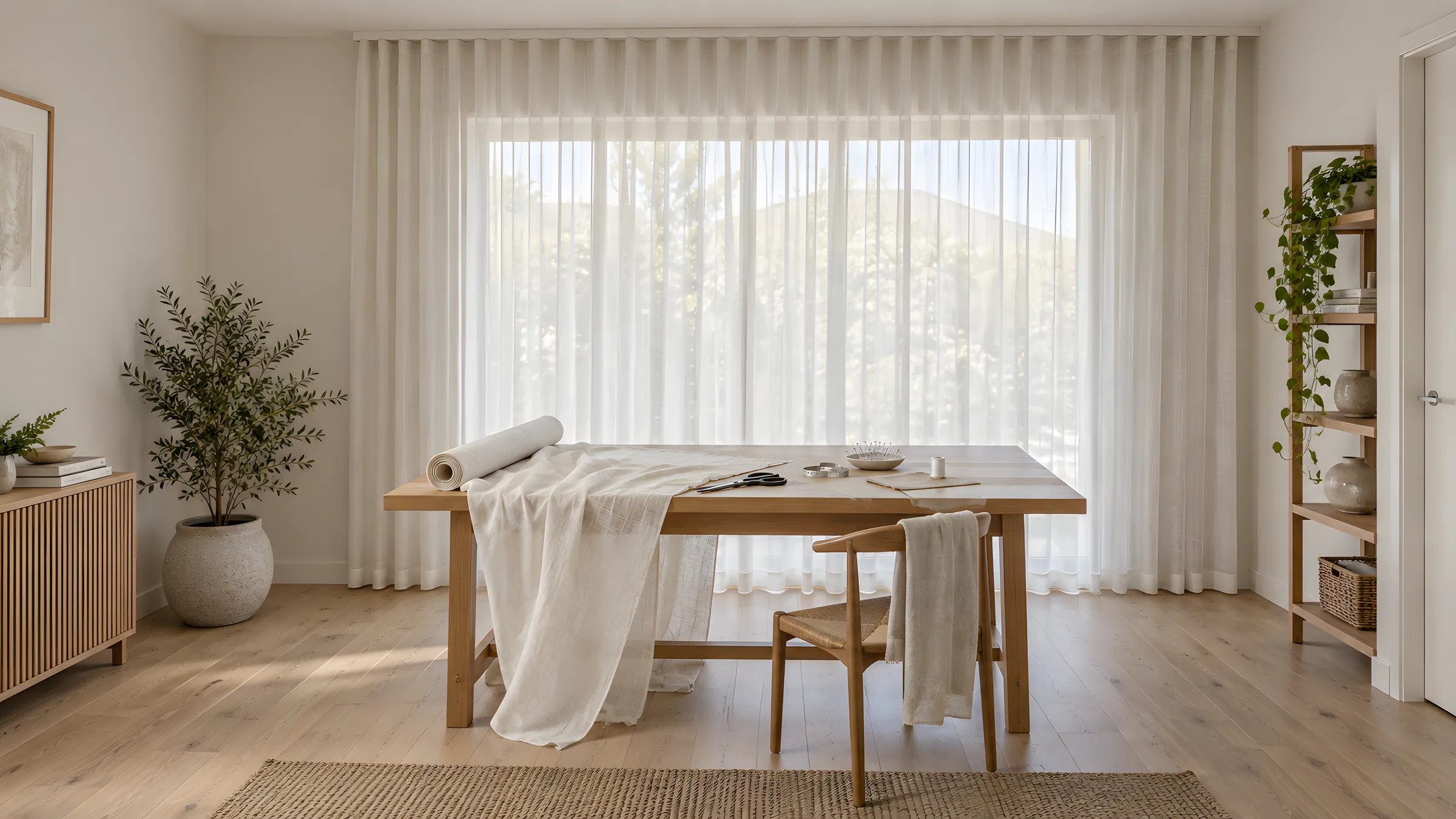
DIY curtains work best as simple, light panels, and get hard once you add width, fullness, headings, blockout coating or an S Fold track. Making your own gives you any fabric you can find. Ordering made to measure gives you accurate drops, even folds and a curtain that arrives ready to hang. Here is how to decide.
In short
- Sewing suits simple panels: light or sheer fabric, a gathering tape and a small window.
- The hard parts are joining fabric widths, getting the fullness right, an even drop and tidy hems.
- Coated blockout is difficult to sew, and S Fold depends on a matched track and carriers.
- Made-to-measure curtains arrive with the heading, fullness and hems done. You give the track width and the drop.
- We do not sell fabric by the metre, heading tape or sewing supplies. We make finished curtains to order.
What goes into DIY curtains
A curtain looks like a rectangle of fabric, but a good one is mostly planning. Before you cut, you need to settle five things.
- Fabric width. Fabric comes on a bolt of fixed width, so anything wider than that needs separate widths joined with seams. Seams on a sheer show against the light, and patterned fabric needs matching.
- Fullness. A gathered curtain uses much more fabric than the track is wide. Our curtains use about 2.0 to 2.75 times the finished width, depending on the heading. Too little looks flat and mean. Too much looks bulky.
- Heading. The top of the curtain decides how it folds and which track fittings it needs. Pencil pleat, pinch pleat, inverted pleat and S Fold all call for different tapes or hand pleating.
- Drop and hem. You need to decide whether the curtain stops just off the floor, touches it or puddles, and then hem to that mark. An uneven floor or sill makes this harder.
- Hardware. The track, brackets and gliders have to suit the heading and carry the weight.
Our guide to curtain headings shows how each heading folds, which helps you choose before you buy fabric.
How to make curtains: the main steps
These are the steps for a simple, unlined curtain. Follow the instructions on your heading tape or pattern for the details, because they vary.
- Settle the track width, the drop and the finish at the floor. The curtain size guide covers the options.
- Work out the fabric. Multiply the track width by the fullness your heading needs. Divide by the usable fabric width to find how many widths you need. Add for the hem and heading on every drop.
- Cut along the grain. Pull a thread, or use the fabric edge as a guide. A crooked cut makes a crooked curtain.
- Join the widths. Sew straight seams with the pattern matched, and press them flat.
- Hem the sides. A narrow double hem keeps the edges neat.
- Add the heading. Attach the tape or form the pleats as directed, and thread the cords or hooks.
- Hang, then hem the bottom. Fix the curtain to the track, let it drop, and mark the hem against the floor before you sew it.
For DIY sheer curtains, use a fine needle, sew slowly and consider a French seam that encloses the raw edge. Fine fabric shifts under the foot, so pins and patience help.
DIY or made to measure: a comparison
| Factor | DIY curtains | Made to measure |
|---|---|---|
| Fabric choice | Any fabric you can source | Cassis, Cassis Volume and Bali sheers, and Galaxy and Epic blockouts |
| Skill and kit | Sewing machine, a large cutting surface and straight seams | You measure the track width and the drop |
| Fullness and heading | You calculate and form them yourself | Applied for you, in S Fold, Pencil Pleat, Double Pinch Pleat, Triple Pinch Pleat or Inverted Pleat |
| Hems and drop | Marked and sewn by you | You choose just off the floor, touching or puddled, and the hem is allowed for |
| Blockout | Coated fabric is hard to sew | Coated blockout, or a blockout lining sewn behind a sheer |
| Track | Bought and matched separately | Chosen in the same configurator |
| Cost | Fabric, tape, lining, hardware and your time | The price shows before you order |
Wide windows, tall drops and sliding doors multiply the work. A DIY curtain for a small window is a modest project. A set for a three-metre sliding door is a very large piece of sewing.
What you still do with made-to-measure curtains
Ordering does not mean you do nothing. You do the measuring and the hanging, and the factory does the sewing.
- Measure with our guide. The curtain measuring guide asks for the track width, not the fabric width, so you do not multiply for fullness. That is applied for you. Choose a finish: just off the floor, touching, or puddled.
- Plan the track length. To frame a window, our guide has you add at least 30 per cent to the window width, so the open curtain stacks beside the window and not across it.
- Hang it. Follow our curtains installation guide to fix the track and hang the curtain.
Why coated blockout is hard to sew
Blockout is the hardest curtain fabric to sew at home. Galaxy and Epic are coated so light does not pass through the cloth, and that coating changes how the fabric behaves at home.
- The coating can drag. The coated back can stick to a standard presser foot, so stitches pucker or skip. Many sewists switch to a different foot.
- Needle holes stay. Each hole can let a pinprick of light through, and unpicking a seam leaves marks.
- Heat damages it. Iron the fabric side only, never the coated side.
- It is heavy to handle. A large panel is awkward to feed through a domestic machine.
A lined curtain has a blockout lining sewn behind a sheer, so both move together on one track. Making one yourself means sewing the coated lining anyway, plus matching two fabrics. Our lined curtains arrive ready sewn. Blockout stops light passing through the cloth, though some can still show around the edges, top and bottom.
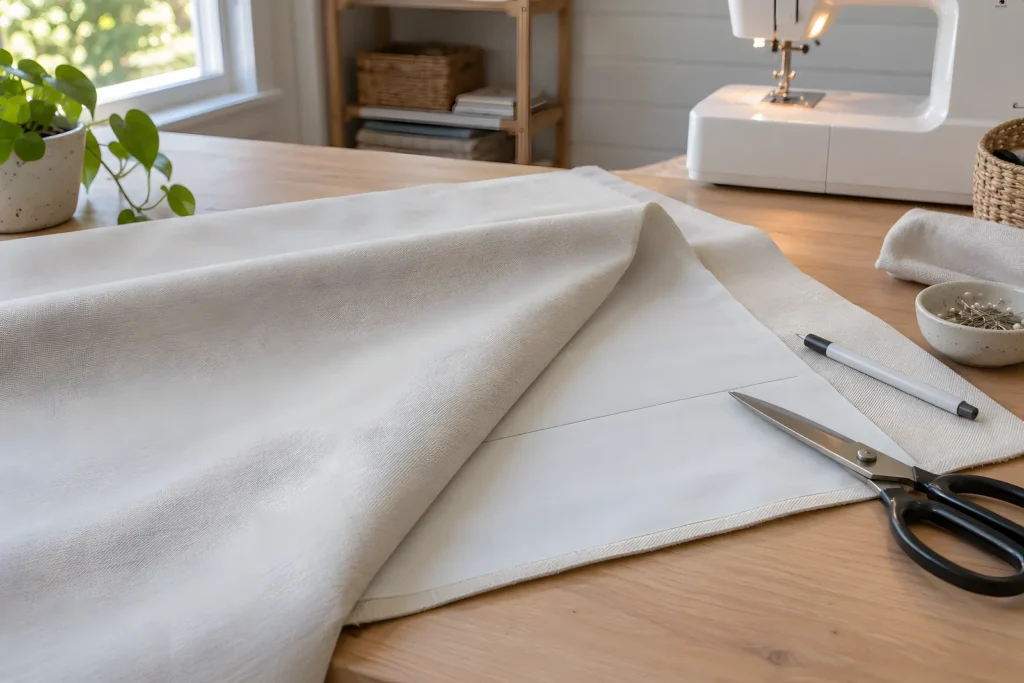
DIY S Fold curtains
S Fold is the most popular heading we make, with regular, even waves. It is also the hardest to copy at home. The waves come from a matched system of fullness, heading and carriers on a track, and the spacing has to be right across the whole curtain, or the waves look uneven. S Fold is used with a ceiling (top) fit.
If you want to know how to make S Fold curtains, buy the track, carriers and heading tape from one supplier and follow their spacing exactly. If you want the look without the sewing, our S Fold curtains come with the heading done. Some sites call the same look ripplefold or wave. Our curtains installation guide covers fitting.
Tip: The middle path is to order made to measure and hang the curtains yourself, following the installation guide. Fitting the track and hanging the curtain is the DIY part. Leave the sewing, fullness and hems to the factory.
How to choose
Make your own if you:
- want a particular fabric we do not offer
- have a small window and a light, unlined curtain in mind
- enjoy sewing and have the space and machine
- are happy to take your time
Order made to measure if you:
- want blockout or lined curtains
- need an S Fold or other regular heading
- have a wide window, a tall drop or a sliding door
- want matched drops across several windows
- would rather spend the time hanging than sewing
DIY drapes follow the same rules, because drapes is simply another word for curtains. Order free samples before you commit to either route, because looking at sheers and blockouts in your own light shows how much body and drape you want from the fabric.
Questions
Is it cheaper to make your own curtains?
It depends. Fabric, heading tape, lining, track and your time all add up, so compare the total with the price shown in the configurator before you order.
How much fabric do I need to make curtains?
Multiply the track width by the fullness your heading needs, then add the drop and hem allowances. Our curtains use about 2.0 to 2.75 times the finished width, depending on the heading.
Can I make S Fold curtains myself?
It is possible, but S Fold depends on a matched track, carriers and heading, with the fullness set by the heading. Ordering them made to measure removes the guesswork.
Can you sew blockout curtains at home?
You can, but coated blockout fabric is harder to sew than ordinary fabric. The coating can drag on the machine, needle holes show, and heat damages it.
Are sheer curtains easy to make yourself?
Sheers are the easiest curtains to make, because they are light and forgiving of the track. Fine fabric still shifts under the needle, so cut and sew slowly.
Skip the sewing
Choose a fabric, heading and track, enter your measurements, and see the price before you order.
Keep reading
 CurtainsCurtain headings explained: S Fold, pencil, pinch and invertedHow S Fold, pencil pleat, pinch pleat and inverted pleat headings look, hang and stack, with a comparison table to help you choose the right one.
 Measuring & fittingCurtain size guide: length, width and height to chooseHow long, wide and high curtains should be, with the three floor finishes, how wide to make the track and how much wall to leave for the stack.
 ComparisonsMade-to-measure vs off-the-shelf curtains and blindsMade-to-measure is cut to your windows; off-the-shelf comes in fixed sizes and is available straight away. Here is how to decide, and what each asks of you.