
Blinds for small windows: fit, style and controls
Roller blinds and venetians suit small windows best. Here are minimum sizes, the fit that works, room-by-room picks and how to make a small window look bigger.
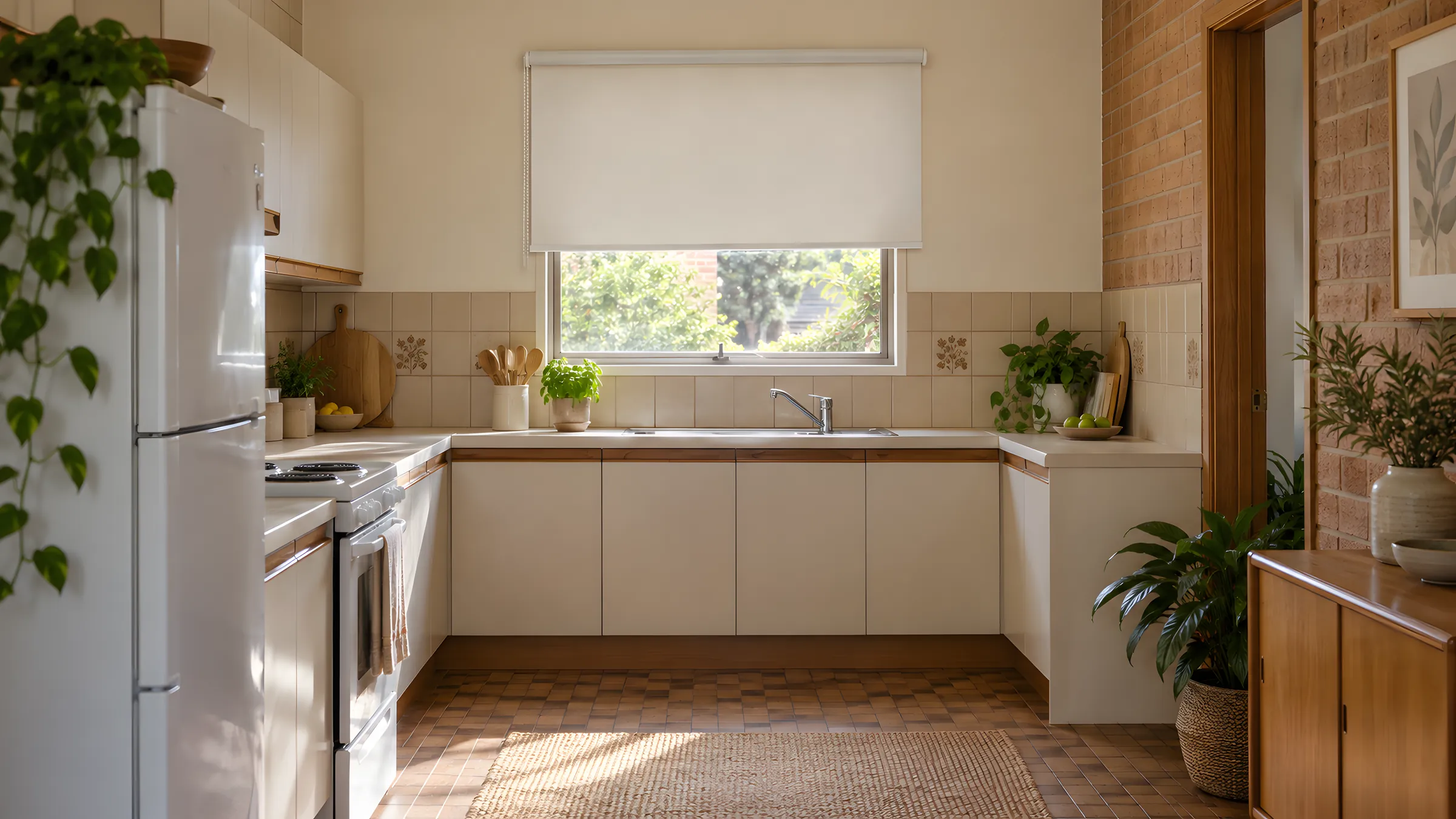
The best blinds for small windows are roller blinds and venetian blinds, because they sit close to the glass and can be made narrow. A roller blind can be made from 250 mm wide with a 300 mm drop, and venetians add tilt control. The right pick depends mostly on the room: a window over a sink needs something different from a bedroom window.
In short
- Roller blinds are the most flexible choice, from 250 mm wide and 300 mm drop. A recess needs 70 mm of depth for an over-roll blind or 45 mm for an under-roll.
- Aluminium or fauxwood venetians and PVC plantation shutters suit kitchens, bathrooms and laundries.
- Face fit covers more of the opening and shrinks light gaps, which are proportionally bigger on a small window.
- Choose the control for how you reach the window: chain, cordless, or a battery motor for high windows.
- Measure carefully. A few millimetres show more on a small window.
What limits blinds for small windows
Small windows are rarely difficult to cover, but they often have awkward features: taps, latches, winders, tiled reveals and shallow frames. Check these numbers before you choose.
| Check | What to know |
|---|---|
| Smallest roller blind | 250 mm wide, 300 mm drop |
| Recess depth for a roller | 70 mm over-roll, 45 mm under-roll |
| Measuring | Use the roller blind measuring guide, including for face fit and tiled reveals |
| Obstructions | Tap handles, latches and winders; a front roll can clear a handle |
The best blinds for small windows compared
| Option | Best for | Watch out for |
|---|---|---|
| Roller blinds in SunScreen, Light Filter or Blockout | Kitchens (if not drenched), bathrooms, laundries, bedrooms | Roller fabric is not waterproof, so keep it out of direct spray |
| Aluminium venetian blinds | Wet areas; tilt control for light | Slats collect dust; wipe them regularly |
| Fauxwood venetians | The timber look in wet areas | Order a sample to check colour against your fittings |
| PVC plantation shutters | Bathrooms and laundries where you want a solid, waterproof look | Inside frames need 60 to 70 mm of depth; interior use only, not continual direct soaking |
| Curtains | Bedrooms and living rooms | Not used in kitchens |
Room by room
| Room | Good choices | Notes |
|---|---|---|
| Kitchen window over the sink | SunScreen, Light Filter, PVC shutters, fauxwood or aluminium venetians | Check taps and handles; a front roll can clear a handle. Not used in kitchens: cassette, curtains, vertical blinds, panel glide |
| Bathroom | Light Filter or Blockout roller, PVC shutters, fauxwood or aluminium venetians | Keep roller fabric away from direct spray. See best blinds for bathrooms |
| Laundry | Light Filter, Blockout, PVC shutters | Keep hinges and metal parts dry |
| Bedroom | Blockout roller; a cassette if you want a darker room | A cassette needs 50 mm of clear depth |
| Nursery | Cordless ZeroGravity, blockout, cassette | Keep chains out of reach; choose cordless or motorised |
For the kitchen and bathroom, our kitchen blinds and bathroom blinds pages list every option.
Common small-window situations
Small windows come in a few awkward shapes.
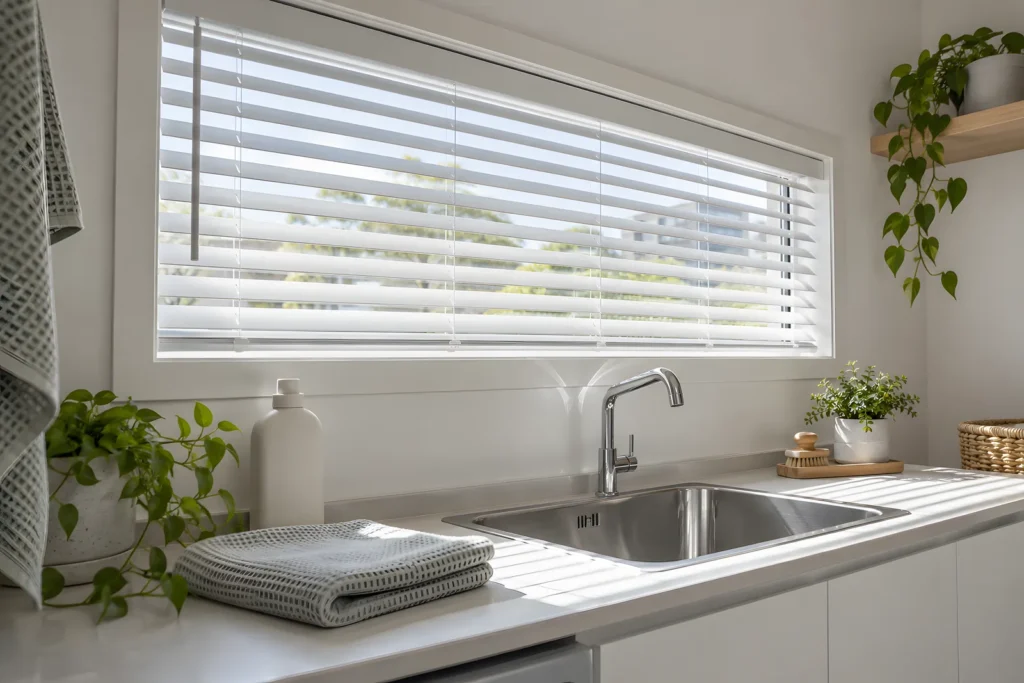
- Wide and short, such as a window over a sink or in a hallway. A roller blind works well, and a front roll can clear a tap or handle. A face fit above the frame adds height.
- Narrow and tall, such as glass beside a door. Rollers are available from 250 mm wide, and Light Filter keeps the hallway bright while obscuring the view.
- High and hard to reach, such as a bathroom or laundry highlight window. Use a battery motor and remote, or a chain positioned where you can reach it.
- A row of small windows. Two or three blinds can be linked on shared brackets, with the join over the mullion. The join gap is about 17 mm, against 30 mm or more for blinds butted side by side, and one control set is neater than three separate ones.
Privacy on a small window
Small windows in bathrooms, toilets and side passages are often about privacy first. The fabric decides how much you get, and when.
- Light Filter diffuses daylight and obscures the view. Silhouettes may show at night when the room is lit.
- Blockout gives night privacy, though a little light can still show around the edges of a conventional blind.
- SunScreen cuts glare and keeps the view. It gives daytime privacy only when it is brighter outside, and it is not a night-privacy fabric.
- Venetians let you tilt the slats closed for privacy and open them for light, which suits a window you use in the morning and evening.
Recess or face fit on a small window
Recess fit looks neat, with the blind inside the frame. The catch is the light gaps. A recess-fit roller leaves small gaps, roughly 20 mm at the chain side and 10 to 20 mm at the pin end, and on a small window those gaps are a larger share of the glass. If privacy matters, as it does in a bathroom, those gaps are the first thing you notice.
Face fit mounts the blind on the wall or ceiling above and beside the frame. It covers more of the opening, cuts the gaps and clears obstructions such as a deep sill or a latch. Under-roll is usually recommended for face fit. Our guide to recess fit or face fit helps you decide.
How to dress a small window
A small window can look bigger with a few choices.
- Mount higher and wider. A face-fit blind hung above the frame makes the window read taller and wider.
- Widen the track. For curtains, use a ceiling-fit track that is at least 30 per cent wider than the window, so the fabric frames the window rather than crowding it.
- Keep the fabric light and plain. Screen in Ice or White Linen, or a sheer in Cassis Volume Snow, keeps the window light and quiet. (White Linen is a colour name only.)
- Hide the hardware. A decorative fascia conceals the roller and has matching brackets and side covers. It is a face-fit system, not a cassette.
- Keep curtain hems tidy. If you use curtains, a finish just off the floor (5 to 10 mm short) looks cleaner than one that stops halfway.
Tip: Order two or three samples and tape them to the wall over the window. A colour that looks small on a swatch often changes the whole feel of a small room.
Keeping blinds clean in damp rooms
Roller blind fabric wants gentle care. Dust it with a soft cloth, wipe with a damp sponge and dry it, and avoid abrasive or solvent cleaners. Do not roll the fabric up while it is damp, which matters in a bathroom or laundry. With PVC shutters, keep the hinges and metal parts dry and clear of cooking heat.
Choosing the control
Small windows are often awkward to reach: over a sink, above a bath or set high on a wall.
- Chain (SunBoss). Easy to reach if the chain hangs to one side. Choose the chain side away from taps and keep chains out of reach of children. A chain safety device is supplied that stops the chain forming a loop over 220 mm.
- Cordless (ZeroGravity). Lifts by the base rail and holds at any height, with no chain. Good in bedrooms and nurseries, but you have to reach the base rail, which is awkward over a deep sink.
- Battery motor. Needs no mains wiring and suits a high window you cannot easily reach, with a remote. See roller blind controls for the comparison.
Mistakes to avoid
- Ignoring the depth. A recess fit needs 70 mm for an over-roll blind or 45 mm for an under-roll, and a cassette needs 50 mm.
- Choosing a chain you cannot reach. Check the chain side against taps, benches and shelves.
- Measuring the glass instead of the opening. Follow the measuring guide for what to measure, because the pane is not the reference.
- Skipping the sample. Small windows show colour differently in a small room, so order free samples first.
Measuring a small window
Note where taps, latches and winders sit, and whether a front roll is needed to clear them. Then follow the guide for your product:
- Roller blinds: the roller blind measuring guide.
- Venetians, shutters and curtains: the guide for that product in our measure guides.
Small windows are quick to measure, and the guides ask you to check each reading, so take your time.
Questions
What is the best blind for a small window?
A roller blind suits most small windows because it sits close to the glass and can be made narrow. In damp rooms, aluminium or fauxwood venetians and PVC shutters handle moisture better.
How small can a roller blind be made?
A roller blind can be made from 250 mm wide with a minimum drop of 300 mm.
Should blinds for small windows go inside or outside the frame?
Inside (recess fit) is neatest if you have enough depth: 70 mm for an over-roll blind or 45 mm for an under-roll. Outside (face fit) covers more of the opening and cuts light gaps, which can make the window look larger.
What blinds suit a small bathroom window?
Light Filter or Blockout roller blinds, PVC plantation shutters, and aluminium or fauxwood venetians. Keep roller blind fabric out of direct spray.
How do I make a small window look bigger?
Mount the blind above the frame with a face fit, or use a curtain track that is at least 30 per cent wider than the window. Choose a light, plain fabric and keep the hardware slim.
Build a blind for your small window
Choose your fabric and fit and see the price as you enter your measurements.
Keep reading
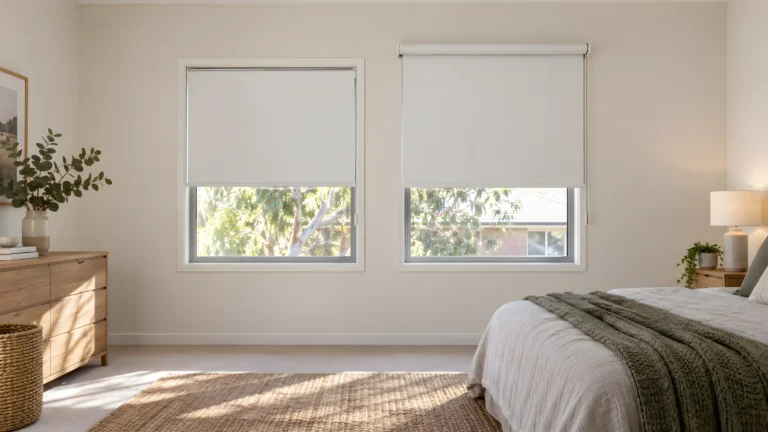 Measuring & fittingRecess fit or face fit? How to decide before you measureRecess fit sits inside the window opening; face fit mounts on the wall or trim around it. Here is how to choose, and what changes when you measure.
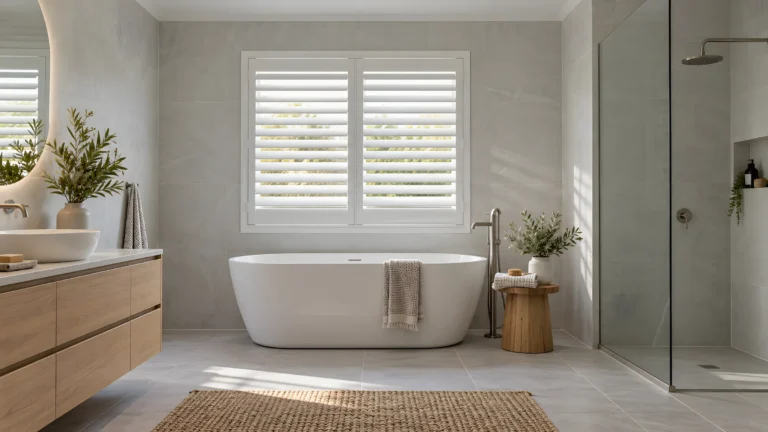 Room ideasThe best blinds and shutters for bathroomsPVC shutters, fauxwood venetians and aluminium venetians suit bathrooms best, with roller blinds for windows out of the spray. Privacy, moisture and fit explained.
 BlindsChain, cordless or motorised: choosing roller blind controlsChain, cordless or motorised? How each roller blind control works, what limits apply and which suits a bedroom, nursery, home theatre or wide window.