
Blinds or curtains for louvre windows: what works
Louvre windows have winders, tilting blades and shallow frames. Here is what clears them: face-fit roller blinds with a front roll, venetians or curtains on a wide track.
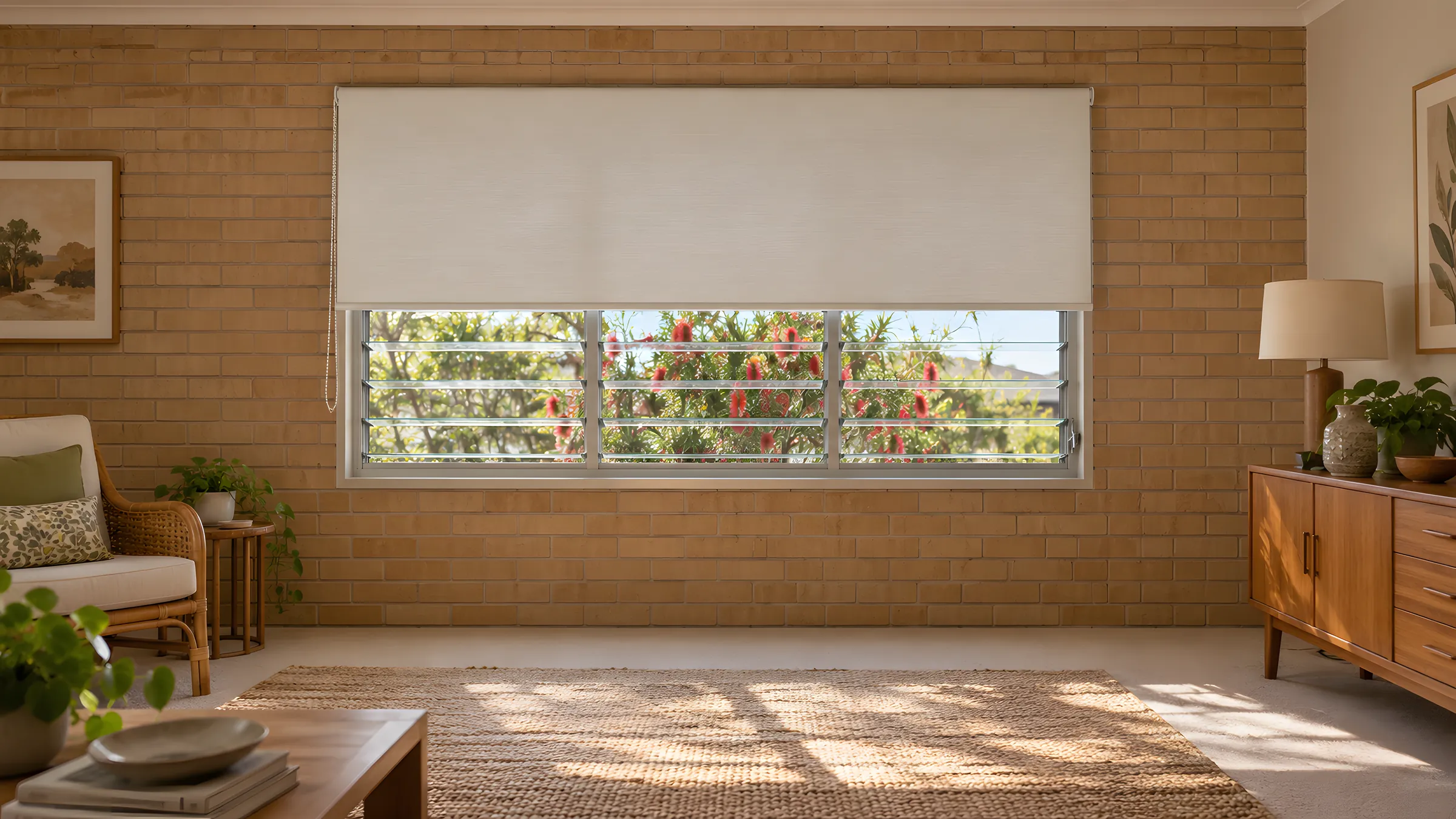
Curtains or blinds for louvre windows both work, provided they clear the winder and the tilting blades. A face-fit roller blind with a front roll, or curtains on a track wider than the frame, usually beats a blind fitted inside the frame. The reason is the hardware: louvre windows have a winder or lever, blades that tilt open and often a shallow frame, and whatever you choose has to clear all three.
In short
- A face-fit roller blind with a front roll is the simplest answer. It hangs above the frame and clears the winder or lever.
- Curtains on a ceiling-fit track suit bedrooms and living rooms, as long as the track projects past the winder.
- Recess fit needs 70 mm depth (over-roll) or 45 mm (under-roll), which many louvre frames do not have.
- Put the chain on the side away from the winder.
- Check the blades fully open before you measure. A blind hung close to the glass can foul them.
Why louvre windows are awkward
Louvre windows vary, but most share a few features that ordinary windows do not have. Check yours against this list.
- A winder or lever. The handle projects into the room, usually near the bottom or side of the frame. A blind or curtain hanging close to the glass can catch on it.
- Tilting blades. Open blades pivot, so part of each blade moves towards the room. A blind hung tight to the glass can foul them.
- Shallow frames. Many louvre frames have little depth, which rules out a recess fit for most blinds.
- Ventilation. People leave louvres open for air, so a blind or curtain in front will move in a draught.
- Gaps. Louvres do not seal like a fixed pane, so air moves past the blade edges whatever you fit.
Curtains or blinds for louvre windows
| Situation | Best choice | Why |
|---|---|---|
| Handle projects into the room and you want a simple fix | Face-fit roller with a front roll | The fabric sits farther from the glass and clears handles and winders |
| Shallow frame with no recess depth | Face-fit roller or curtains | A recess needs 70 mm or 45 mm of depth |
| Bedroom needing a darker room | Blockout roller (face fit), curtains over the top | Face fit cuts the light gaps at the edges |
| Bathroom or toilet | Light Filter or Blockout roller (face fit), or aluminium or fauxwood venetians | Venetians handle moisture; keep roller fabric out of direct spray |
| Kitchen | Roller, aluminium or fauxwood venetians | Curtains are not used in kitchens |
| Living room or bedroom where you want a soft look | Curtains on a ceiling-fit track | The track can project well past the winder |
| Louvres open all night for air | Curtains or a blind you can leave partly open | Expect movement in a draught |
Roller blinds on louvre windows
A roller blind is the most common choice, and the fit and roll direction do most of the work.
Choose face fit. A face fit mounts the blind on the wall or ceiling above and beside the frame. It covers more of the opening, cuts light gaps and clears obstructions. Face fit under-roll is usually recommended, but a louvre winder is the exact situation where a front roll earns its place.
Choose a front roll if the winder projects. A front roll drops from the front of the tube and hides it, and it clears handles and winders. It sits farther from the glass than a standard roll, so measure how far the winder projects and check the fabric will pass in front of it. Our standard roll or reverse roll guide explains the difference.
Measure with the guide. Face fit overlaps the wall rather than hanging in the frame, and the roller blind measuring guide covers face fit with and without architraves.
Position the chain. Put the chain on the side away from the winder so the two never tangle. If children use the room, keep the chain out of reach and use the safety device supplied with SunBoss chain blinds, or consider cordless or motorised control.
Venetian blinds on louvre windows
Aluminium venetian blinds are useful when you want to control light without lowering fabric across the whole window. Tilt the slats to let air and light in, or close them for privacy. A face-fit venetian hangs above the frame, away from the blades. Check the depth and fit rules in our 25 mm aluminium venetian blinds measuring guide before you order.
Aluminium and fauxwood venetians both suit kitchens and bathrooms. Slats may move or click together in a draught, which is worth knowing if you sleep with the louvres open. Our aluminium venetian blinds page lists the colours.
Curtains on louvre windows
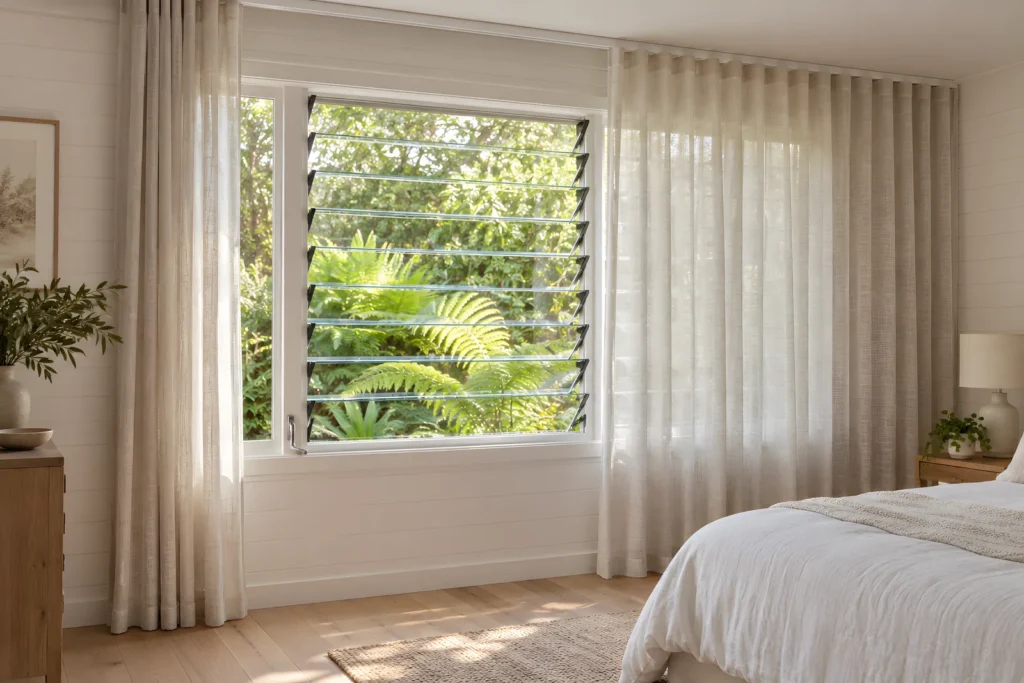
Curtains suit bedrooms and living rooms, and a ceiling-fit track gives you the most flexibility.
- Clear the winder. Hold a tape from the glass to the tip of the winder and make sure your track projection and heading depth sit beyond it. S Fold has the deepest heading profile of our headings, so it needs the most room.
- Go wider than the frame. Add at least 30 per cent to the track width to frame the window, so the stacked curtain sits beside the glass and the winder stays reachable.
- Choose a wand. A 910 mm or 1520 mm wand lets you draw curtains without dragging them across the handle.
- Finish just off the floor. A hem 5 to 10 mm short of the floor hangs clear and moves easily in a breeze.
- Layer for privacy. A sheer gives some privacy by day. At night with lights on, people outside can see in, so add a blockout on a second track. Double curtains project 220 to 250 mm, so allow for that in front of the winder.
If you leave louvres open in the evening, sheers will move. Keep them away from candles, heaters and stovetops. Our curtains page lists the fabrics, and free samples will show you the colour and drape in your own light.
Hardware and finishes
Louvre windows are common in coastal and older homes, so hardware choices matter. Stainless steel chain is recommended for coastal homes. Bracket colours are white, grey, ivory, latte and black, and the deluxe oval base rail comes in Anodised, White, Black or Cream, so you can match an aluminium window frame. If the winder is chrome, a stainless or metal chain will sit better beside it than a bright white one.
Close the louvre blades before you lower a blind that hangs near them. That stops the blades pushing against the fabric.
Light, privacy and airflow
Blockout fabric stops light passing through the cloth, though a little light can still get past the blade edges and around a conventional blind. A face fit reduces the edge gaps, and curtains over the top reduce them further.
For privacy, Light Filter diffuses daylight and obscures the view, but silhouettes may show at night when the room is lit. Blockout gives night privacy. A tilted venetian gives privacy by day while still letting air move.
Mistakes to avoid
- Measuring for a recess without checking depth. Many louvre frames are shallower than the 70 mm or 45 mm a roller needs.
- Using a standard roll where the winder projects. A standard roll sits closer to the glass and can catch the handle.
- Putting the chain next to the winder. The two tangle, and the chain can knock the handle.
- Letting a curtain hem brush the handle. Check the projection of the track and the heading against the winder.
How to check clearances before you order
- Open the blades fully and note how far they project into the room.
- Measure how far the winder or lever projects from the glass, and where it sits on the frame.
- Measure the frame depth. If it is under 70 mm (or 45 mm for an under-roll), use a face fit.
- Decide on face fit and check for architraves.
- Choose the chain side away from the winder.
- Order samples and check the fabric against the frame and walls.
Measure with the guide for your product from our measure guides. Read recess fit or face fit and window depth for blinds if you are unsure about the depth. Bathroom louvres have their own considerations, covered on our bathroom blinds page.
Questions
Are curtains or blinds better for louvre windows?
Both work if they clear the winder and the blades. A face-fit roller blind with a front roll suits most louvre windows, and curtains on a ceiling-fit track are the softer choice in bedrooms and living rooms.
Can I fit a roller blind inside a louvre window frame?
Only if the frame is deep enough: 70 mm for an over-roll blind or 45 mm for an under-roll. Louvre frames are often shallow and the blades tilt into the space, so a face fit is usually easier.
How do I stop a blind hitting the louvre winder?
Use a face fit above the frame and a front roll, which sits farther from the glass and clears handles and winders. Put the chain on the side away from the winder.
Which blinds suit a louvre window in a bathroom or kitchen?
Light Filter or Blockout roller blinds in a bathroom, and SunScreen, Light Filter, aluminium or fauxwood venetians in a kitchen. Keep roller fabric out of direct spray.
Will a blind stop light coming through louvre windows?
Not completely. Louvre blades and frames leave gaps, and a conventional blind lets some light past its edges. A face fit reduces the gaps, and curtains over the top help further.
Build a blind for your louvre window
Choose a face-fit roller blind with a front roll and see the price as you enter your measurements.
Keep reading
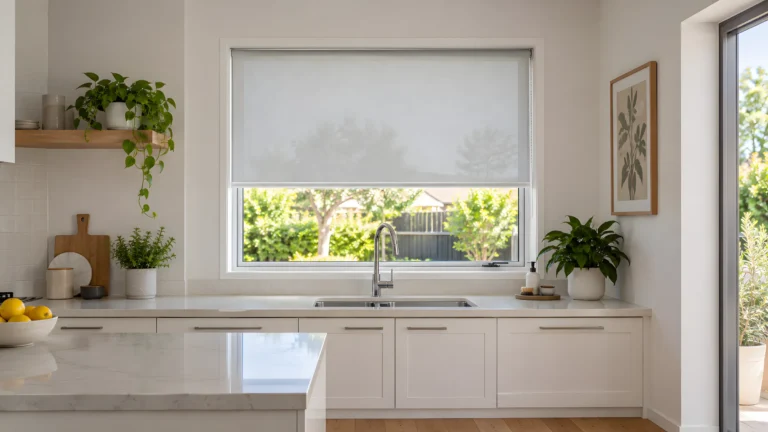 ComparisonsStandard roll or reverse roll: which way should your blind roll?Standard (under) roll blocks more light and needs less depth. Reverse (front or over) roll hides the tube and clears handles. Here is how to choose.
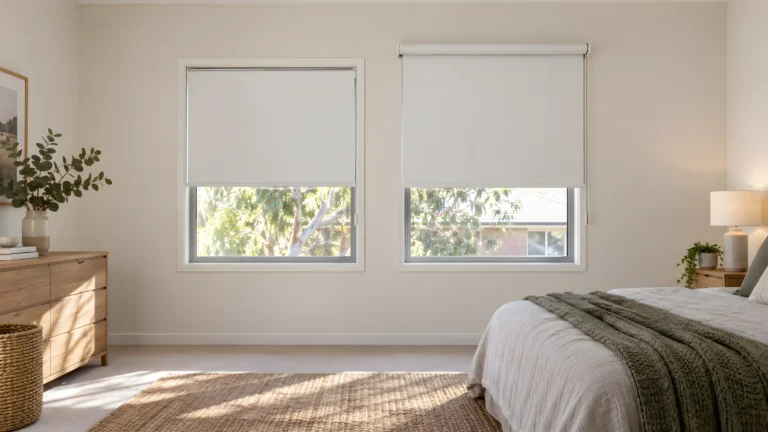 Measuring & fittingRecess fit or face fit? How to decide before you measureRecess fit sits inside the window opening; face fit mounts on the wall or trim around it. Here is how to choose, and what changes when you measure.
 Measuring & fittingHow much window depth do you need for recess blinds?A single roller blind needs 70 mm of clear depth or 45 mm with a standard roll. Here are the depths for every product and which guide measures it.