
How to clean rubber-backed curtains without peeling
The backing on rubber-backed curtains peels when it meets heat, rubbing or itself while wet. Here is how to clean them safely and what to avoid.

If you are wondering how to wash rubber backed curtains, the short answer is: not in the washing machine. The backing on these curtains is a layer bonded to the fabric, and it lifts when it meets heat, hard rubbing or another wet coated surface. Vacuum and spot clean for everyday care, then choose a professional wet clean or a careful hand wash at 40°C at most for a full clean.
In short
- Rubber-backed curtains, like our coated blockouts, should never go in a domestic washing machine or a tumble dryer.
- Peeling is caused by heat, rubbing, wringing, tumbling and wet coated sides sticking together.
- Hand wash in cool to warm water at 40°C at most, with a mild detergent, in sections and without soaking.
- Hang open by the hooks. Never use pegs or fold the curtain over a line.
- Iron the fabric side only. If the backing is already flaking or tacky, stop washing and plan to replace.
Our care instructions for coated blockout curtains
You can clean these curtains, but the domestic washing machine is out. The list below is the care advice shown in the fabric details for our coated blockouts, Galaxy and Epic, and it is a sound guide to other backed curtains too. On curtains from elsewhere, your own label comes first.
- Spot clean with care, and test it on a hidden part first.
- Do not use a washing machine. Professional wet cleaning with a mild detergent, such as a wool wash, is recommended.
- If you hand wash, use cool to warm water (40°C at most). Curtains are heavy when wet.
- Do not bleach, soak, rub or wring, and do not tumble dry.
- Hang the curtains by their hooks to drip dry in the shade, so the coated sides do not touch. Do not use pegs or fold them over a clothes line.
- Iron the fabric side only, never the coated side.
- Fabrics can shrink by up to 3 per cent after cleaning.
A lined curtain is cleaned as one piece, so follow the same list for its coated lining. Ask a cleaner for wet cleaning rather than solvent dry cleaning.
What rubber-backed curtains are and why they peel
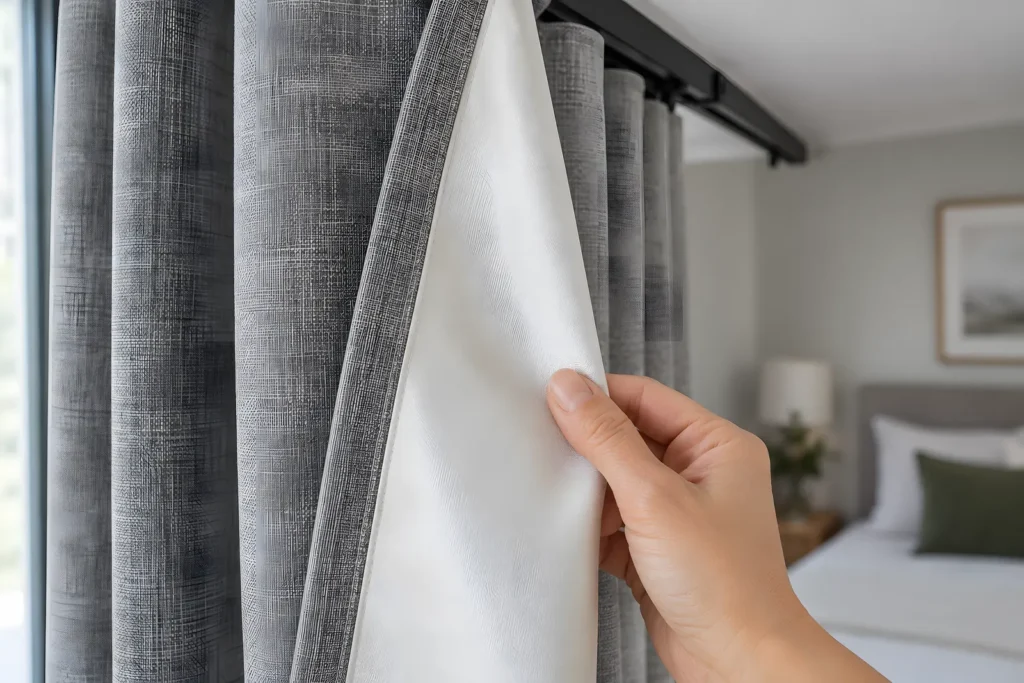
"Rubber backed" is the name many people use for a curtain with a layer on the back that stops light passing through. Depending on the maker, the backing may be foam, latex or acrylic. Ours are coated blockout fabrics: Galaxy is polyester with an acrylic coating, and Epic is polyester with an acrylic backing, coated in three layers. If you own curtains from us, you have a coated fabric, and the same care applies as to any backed curtain.
The layer is bonded to the cloth, and it is that bond that fails when the curtain is mistreated. The usual causes are:
- Heat: hot water, a tumble dryer, or an iron on the coated side.
- Agitation: the drum of a washing machine, or a long, fast spin.
- Rubbing and wringing: stretching and twisting break the bond.
- Contact while wet: wet coated surfaces can stick to each other and tear apart when separated.
- Age and sun: older coatings become stiff, and long exposure to strong sun is hard on any fabric.
Everything in this guide is about avoiding those five things.
How to wash rubber backed curtains without peeling
Start with the least invasive method and only go further if it fails.
Step 1: vacuum and air
Use a soft brush attachment on low suction, top to bottom, then hang the curtains open in a breezy room for a few hours. Many stale-smelling curtains just need this.
Step 2: spot clean
- Test a hidden area first with a little mild detergent in water.
- Mix a few drops of mild detergent into a cup of cool water.
- Blot the mark on the fabric side with a cloth wrung almost dry. Do not scrub.
- Blot with a cloth dampened in plain water to lift the soap.
- Press dry with a towel, and leave the curtain open to air.
Keep the coated back dry where you can, and never push the cloth hard against the backing.
Step 3: hand wash if it is needed
- Take the curtains down, remove hooks, rings and trims, and vacuum both sides.
- Lay the curtain fabric side up on a clean cotton sheet on a flat, shaded surface.
- Mix a wool wash or other mild detergent into cool to warm water, 40°C at most.
- Press a soft sponge onto one section at a time, with light pressure. Do not rub, soak or wring.
- Sponge each section again with clean water until the suds are gone.
- Press out water with a dry towel, lift the curtain with two people, and hang it by its hooks in the shade.
For very large, long or lined curtains, a professional wet clean is easier and lower risk. Lined curtains have a coated lining and are cleaned as one piece. Our full step-by-step for these fabrics is in how to clean blockout curtains at home, and the general hand washing method is in how to wash curtains without damaging them.
Dry them so the backing does not stick
Drying is where most peeling starts, because a wet coating can grab itself.
- Hang the curtain open by its hooks on a rail or line so no part touches another.
- Do not fold it over a line, and do not use pegs.
- Choose shade and moving air. Direct sun and heat are hard on the coating.
- Check the curtain is completely dry, front and back, before you rehang or store it.
Tip: If the curtain feels slightly tacky when it comes off the line, do not press or fold it. Let it hang for longer in a well-ventilated room, and keep the coated sides apart until the tackiness has gone.
Ironing and steaming
Use a warm iron on the fabric side only. The coated side must not touch a hot iron, and a thin cotton cloth between the iron and the fabric adds protection. Keep the iron moving and finish in sections.
If you use a steamer, treat it with caution. Test a hidden area, hold it away from the fabric, and keep the steam off the coated side. Often the easiest fix for creases is to rehang the curtain, draw it open and let gravity work for a few days.
Signs the backing is failing
Before every wash, look closely at the coating along the edges and hem. If you can turn back an edge and see the backing, run a fingertip lightly over it.
| Sign | Likely cause | What to do |
|---|---|---|
| Sticky or tacky feel when dry | Coating breaking down, or damp storage | Stop washing. Keep coated sides apart and air the curtain |
| White or grey flakes on the floor or sill | Coating shedding | Stop washing. Spot clean only |
| Bubbles, blisters or lifting at the edge | Layers separating | Do not iron. Plan to replace |
| Stiff, crackly feel or visible cracks | Age, heat or sun | Avoid folding sharply. Plan to replace |
| Pinpricks of light through the cloth | Coating worn thin | Consider a replacement blockout |
Home repairs rarely work. Glue and paint tend to leave the fabric stiff and can mark the front. If your curtains are quite new and the coating is failing, contact us with photos and the care history so we can advise you.
Storing coated curtains
If you take curtains down for a season, store them clean and completely dry. Roll them loosely rather than folding them hard, do not squash them under heavy items, and keep them somewhere cool and dry, not a hot roof space or a damp shed. A cotton pillowcase or sheet around them lets air move.
See our blockout curtains and lined curtains if you are choosing a new set, and our overall curtain cleaning guide for sheers and general routines.
Questions
Can you wash rubber backed curtains in the washing machine?
No. Coated and backed curtains should not go in a domestic washing machine. Agitation, heat and spinning can crack or lift the backing. Use professional wet cleaning, or hand wash in cool to warm water at 40°C at most.
Why do rubber backed curtains peel?
The backing is a bonded layer, so it can lift when it is exposed to heat, scrubbing, wringing, or when wet coated surfaces press together. It also ages over time.
Can I repair peeling on rubber backed curtains?
There is no reliable home repair. Glue and paint tend to leave the fabric stiff and can mark the front. Once the backing is flaking, stop washing, spot clean only, and plan to replace the curtains.
Can I iron rubber backed curtains?
Only with a warm iron on the fabric side, never the coated side. Most creases relax if you rehang the curtain and leave it for a few days.
How do I stop the backing sticking together?
Hang the curtain open by its hooks so coated sides do not touch, and never fold it over a line or use pegs. Let it dry completely before you rehang or store it.
Choose coated blockout curtains
Compare Galaxy and Epic side by side with free samples.
Keep reading
 Care & cleaningHow to clean blockout curtains at homeBlockout fabric is coated, so it needs gentler care than a sheer. Here is how to clean blockout curtains, what to avoid and when to call a professional.
 Care & cleaningHow to clean curtains the right waySheers, coated blockouts and lined curtains each need a different method. Here is how to clean curtains at home, from vacuuming to a full wash.
 Care & cleaningHow to wash curtains without damaging themCheck the care label, wash by hand where you can, dry in the shade and never tumble dry. A step-by-step guide to washing curtains safely.