
How to clean curtains the right way
Sheers, coated blockouts and lined curtains each need a different method. Here is how to clean curtains at home, from vacuuming to a full wash.

The right way to clean curtains depends on the fabric, so start by working out what you have. Sheer curtains are hand washed in warm water, coated blockout curtains are never machine washed, and lined curtains follow the blockout rules because the lining is a coated blockout fabric. This guide shows how to clean curtains at home, from a regular vacuum to a full wash, and when a professional is the safer choice.
In short
- Identify the fabric first: sheer, coated blockout or lined. The method is different for each.
- Vacuum gently and regularly with a soft brush attachment. It prevents most of the build-up that makes a wash necessary.
- Our sheers are hand wash only, in warm water. Our blockouts are not for the washing machine: use a professional wet clean, or hand wash at 40°C at most.
- Never bleach, rub, wring or tumble dry, and hang curtains to drip dry in the shade.
- Spot clean with care and always test a hidden area first.
Our care instructions for sheer and blockout curtains
These are the same care instructions shown in the fabric details on our product pages for sheer, blockout, lined and double curtains. Work out which fabric you have, then follow its list. The steps below build on them.
| Curtain | How to recognise it |
|---|---|
| Sheer (Cassis, Cassis Volume, Bali) | Light, see-through linen-look polyester |
| Blockout (Galaxy, Epic) | Opaque and coated, with a white backing |
| Lined curtains | A sheer with a blockout lining sewn behind it |
| Double curtains | A sheer and a blockout on two tracks, each cleaned by its own fabric |
Sheers: Cassis, Cassis Volume and Bali
- Vacuum gently and regularly with a soft brush attachment.
- Take off hooks, rings and trims before cleaning.
- Hand wash only, in warm water. Do not bleach, rub or wring.
- Hang the curtains by their hooks straight away to drip dry in the shade.
- Warm iron, no hotter than 150°C.
Blockouts: Galaxy and Epic
- Spot clean with care, and test it on a hidden part first.
- Do not use a washing machine. Professional wet cleaning with a mild detergent, such as a wool wash, is recommended.
- If you hand wash, use cool to warm water (40°C at most). Curtains are heavy when wet.
- Do not bleach, soak, rub or wring, and do not tumble dry.
- Hang the curtains by their hooks to drip dry in the shade, so the coated sides do not touch. Do not use pegs or fold them over a clothes line.
- Iron the fabric side only, never the coated side.
Lined curtains and shrinkage
A lined curtain is cleaned as one piece, so follow the blockout list for its coated lining. Fabrics can shrink by up to 3 per cent after cleaning.
Many people search for "blackout curtains". It means the same thing as blockout, and the blockout list applies to either name.
Check the care label on curtains from other suppliers. The label sewn into a seam or hem overrides this guide. If it is missing or faded, treat the curtain as hand wash only until you know more. Australian care labels use a numbered code, such as 4 on polyester sheers and 6W on acrylic-backed or coated fabrics. Silk, velvet, cotton and heavily embellished fabrics need very different treatment, and if the label says dry clean only, take it at its word.
Everyday care: how to clean curtains while hanging
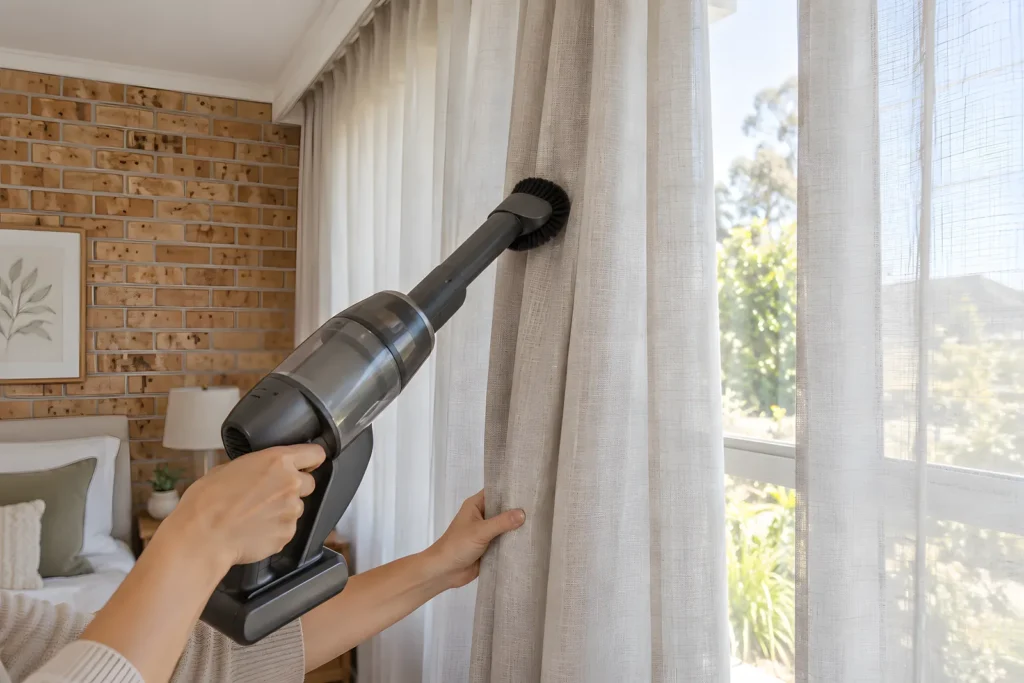
Most curtains never need washing if the dust is kept off them. Dust settles at the top, in the folds and along the hem, and it works into the fabric if it is left for months. A regular vacuum removes it in a few minutes and does no harm to any of our fabrics.
To clean curtains while hanging:
- Fit the soft brush attachment and set the suction to low.
- Start at the top, around the heading and the hooks, where dust collects first.
- Work down in long strokes that follow the folds, holding the fabric lightly with your other hand so it is not pulled into the nozzle.
- Do the room side and the window side. Sheers are open weave, so dust passes through them.
- Wipe the track and the sill with a dry cloth, then vacuum the floor beneath, or the dust will settle back onto the hem.
On a dry, breezy day, open the windows and let the curtains air. It clears stale smells from cooking and pets without any water at all.
Spot cleaning marks
Treat a mark as soon as you see it, because fresh marks lift far more easily than old ones. Spot clean with care, and be more cautious on a coated blockout, where rubbing can damage the coating.
- Test first. Dab a hidden area, such as the back of a hem, with a little mild detergent in water. Wait a few minutes and check for colour change or damage.
- Mix a few drops of mild detergent into a cup of cool water. Skip bleach and anything with brighteners.
- Blot the mark with a clean, soft cloth dipped in the solution and wrung almost dry. Work from the edge of the mark towards the centre so it does not spread.
- Blot again with a cloth dampened in plain water to lift the soap.
- Press dry with a clean towel and leave the curtain to air dry fully before you close it against anything.
Do not scrub. On a blockout, work from the fabric side and keep the coated back dry where you can.
Tip: Water rings can appear if you wet one small patch and let it dry on its own. Blot slightly beyond the edge of the mark, then blend the damp area outwards with a clean cloth so it dries without a hard edge.
Common marks and what to do
Not every mark needs a wash. This table covers the ones that turn up most often. Always test a hidden area first.
| Mark | What usually works |
|---|---|
| Dust and cobwebs | Vacuum with the soft brush attachment. Shake the curtain gently outdoors if it is light enough |
| Cooking grease or hand marks near the hem | Blot with a few drops of mild detergent in cool water, then blot with plain water |
| Pet hair | Vacuum, or run a clean, dry lint roller lightly over a blockout. Take care on sheers, which can snag |
| Water rings or condensation marks | Blot lightly, then blend the damp patch outwards so it dries evenly |
| Stale or smoky smell | Air the curtains on a dry, breezy day, out of direct sun. A wash or wet clean is the next step if that fails |
| Black or green speckles at the hem or folds | Probably mould. Read how to remove mould from blinds and curtains before you touch it |
Lint rollers, sponges and cloths can all leave fibres behind on a dark fabric, so finish with a quick vacuum.
How to take curtains down and put them back
Taking curtains down is where hooks get lost and pleats get muddled, so a few minutes of preparation saves time at the other end.
- Photograph the curtains hanging closed and open, as a reference for hook spacing and how the heading sat.
- Mark the left and right panels with a scrap of masking tape on the hem.
- Lift the curtain off its gliders or carriers, supporting the weight as you go, because a heavy curtain can drop suddenly.
- Remove hooks, rings and trims and put them in a labelled bag, one per panel.
- Carry the curtain folded loosely over your arm, not dragged across the floor.
- When it is clean and dry, refit the hooks in the same order and hang the panel back on the gliders with the heading square to the track.
- Draw the curtain fully open, then closed, and dress the folds by hand. Coated curtains must be completely dry before they are rehung.
Our curtain installation guide shows how the curtains are meant to hang on the track.
Can you wash curtains?
Yes, but the method depends on the fabric, and a domestic washing machine is not an option for ours. Take the curtains down carefully and remove the hooks, rings and trims, as the care instructions above say. Curtains are heavy when wet, so have a second person help you lift.
Washing sheer curtains
Our sheers are linen-look polyester, and the care instructions are to hand wash only, in warm water. Use a mild detergent, do not bleach, and never rub or wring the fabric. Rinse until the water runs clear, then hang the curtains straight away by their hooks to drip dry in the shade. The full method is in how to wash sheer curtains, including the small number of cases where a machine might be an option for sheers from elsewhere.
Washing blockout and lined curtains
Coated fabric is more fragile than it looks. Our care instructions say not to use a domestic washing machine, and to choose professional wet cleaning with a mild detergent such as a wool wash. If you prefer to hand wash, use cool to warm water at 40°C at most, and do not bleach, soak, rub or wring.
Lined curtains are cleaned as one piece by the same rules, because the lining is a coated blockout fabric. You cannot wash the sheer separately from the lining. Step-by-step instructions are in how to clean blockout curtains at home, and if you have heard them called rubber backed, see how to clean rubber-backed curtains without peeling.
What to avoid on every curtain
- Washing machines. Our sheers are hand wash only, and coated blockouts and lined curtains must never go in one.
- Tumble dryers, on anything.
- Bleach, soaking, rubbing and wringing.
- Direct sun while drying, which can fade the colour.
- Pegs and folding coated curtains over a line, where the coated sides press together.
For a fuller comparison of hand washing methods, temperatures and drying, read how to wash curtains without damaging them.
Drying, ironing and rehanging
Drying is where most damage happens, and the rule is the same for every fabric: no tumble dryer.
- Sheers: hang by the hooks straight away to drip dry in the shade. They dry quickly, and most creases drop out under their own weight once the curtain is back on the track.
- Blockouts and lined curtains: hang by the hooks so that the coated sides do not touch. Use a rail or line that lets the curtain hang open, not folded over, and let it dry completely before it goes back on the track.
To press creases out, use a warm iron. Sheers should not go above 150°C. On blockouts, iron the fabric side only and never let the iron touch the coated side. If you use a steamer, test a hidden area first and keep the steam off the coated side.
Plan for shrinkage. Fabrics can shrink by up to 3 per cent after cleaning, which on a 2.4 m drop is roughly 70 mm. That is enough to turn a just-off-the-floor finish into a visible gap, so measure from the hem to the floor before you wash. Fitting the hooks back in the same order helps the heading sit as it did.
When to use a professional curtain cleaner
Professional wet cleaning is the recommended route for coated blockouts and lined curtains, and it is the sensible choice for any curtain that is too big, too heavy or too grubby for you to handle safely at home. A specialist also has the space to dry a full-length curtain flat or hanging without folds.
Before you hand curtains over, say what they are made of and ask for wet cleaning, not solvent dry cleaning. Coated fabric should also be returned hung, not folded, so the coated sides do not stick together.
Consider a professional if:
- the curtains are heavily stained, smoky or greasy
- there is mould, which needs careful handling
- they are long, lined or too heavy for you to lift when wet
- you have nowhere shady and airy to dry them
How often to clean curtains
These are rough guides. Adjust them for your home: pets, open windows, cooking smells and a busy road all shorten the gaps.
| Task | How often |
|---|---|
| Vacuum with soft brush attachment | About once a month |
| Spot clean marks | As soon as you see them |
| Air the curtains on a dry, breezy day | Every few months |
| Hand wash sheers | About once a year, or when they look dull |
| Wet clean blockouts and lined curtains | Only when needed, often every year or two |
Keep curtains clean for longer
A few habits cut the number of washes you need:
- Wipe condensation off the glass on cold mornings. Damp curtains resting against wet glass are where musty smells and mould start.
- Let air move. Open the window a little on dry days and avoid drying wet washing right beside the curtains.
- Keep hems clear. Pet bowls, plants and floor vents near the hem all leave marks or move dust onto the fabric.
- Wash your hands before you draw them. Most marks at leading edges and eye level are hand marks from opening and closing the curtains. A wand on the track, if you have one, keeps hands off the fabric.
- Choose a colour that suits your habits. Very pale fabric shows marks and very dark fabric shows dust. Order free samples and hold them against your floor and walls to see which you can live with.
Cleaning blinds as well? Our guide to how to clean blinds covers every type.
Questions
How often should I clean my curtains?
Vacuum them roughly once a month with a soft brush attachment, more often with pets, open windows or a busy road nearby. A full wash is only needed when they look dull or smell stale, which for many homes is about once a year.
Can you wash curtains in the washing machine?
Not ours. Our sheers are hand wash only and our coated blockouts must not go in a domestic washing machine. If you have curtains from elsewhere, only machine wash them if the care label says you can.
How do I clean curtains without taking them down?
Vacuum them in place with a soft brush attachment on low suction, and spot clean marks with a barely damp cloth after testing a hidden area first. This handles most everyday dust and small marks.
Can I iron or steam my curtains?
Sheers take a warm iron, no hotter than 150°C. Blockouts take a warm iron on the fabric side only, never the coated side. If you steam, test a hidden area first and keep the steam off the coated side.
Will curtains shrink when I clean them?
They can. Allow for shrinkage of up to 3 per cent, which on a 2.4 m drop is roughly 70 mm. Measure the gap between the hem and the floor before you wash so you know what to expect.
Choose curtains that suit how you live
Order free samples to compare colour and texture in your own light before you buy.
Keep reading
 Care & cleaningHow to wash curtains without damaging themCheck the care label, wash by hand where you can, dry in the shade and never tumble dry. A step-by-step guide to washing curtains safely.
 Care & cleaningHow to clean blockout curtains at homeBlockout fabric is coated, so it needs gentler care than a sheer. Here is how to clean blockout curtains, what to avoid and when to call a professional.
 Care & cleaningHow to clean blinds: every type, step by stepFabric blinds, slatted blinds and shutters each need a different method. Here is how to clean blinds of every type, without damaging them.