
How to remove mould from blinds and curtains
Mould on blinds and curtains usually starts with condensation. Here is how to clean it safely, when to replace instead, and how to stop it returning.

If you are wondering how to clean mould off blinds and curtains, put on gloves and a mask, take the item outside if you can, then wipe or hand wash it with a mild detergent and dry it completely. Mould nearly always starts with moisture, so cleaning only helps if you also deal with the condensation or damp behind it. If the growth is widespread, has soaked through, or leaves staining, replacing the item is often simpler.
In short
- Wear gloves and a mask, ventilate the room and do not shake or dry brush mouldy fabric indoors.
- Use a mild detergent and a barely damp cloth or sponge. Avoid bleach, abrasive pads and solvent cleaners, which our care instructions rule out.
- Curtains: sheers are hand washed in warm water. Coated blockouts need a wet clean or a careful hand wash at 40°C at most, never a machine.
- Dry everything completely before you close, roll up or rehang it.
- Fix the cause: wipe condensation, ventilate and keep air moving behind blinds and curtains.
Our care instructions to follow while you remove mould
Removing mould is still cleaning, so our care instructions apply. They are the same ones shown in the fabric details on our product pages, and the mould steps below sit under them.
| Product | What our care instructions say |
|---|---|
| Roller blind fabrics (Shade, Lakeside, Screen), also used for vertical and panel glide blinds | Dust with a soft cloth. Wipe with a damp sponge and dry (Lakeside: remove surface dust with a soft cloth). Avoid abrasive products and solvent cleaners. Do not roll the fabric while it is damp |
| Sheer curtains (Cassis, Cassis Volume, Bali) | Hand wash only, in warm water. Do not bleach, rub or wring. Drip dry by the hooks in the shade |
| Blockout curtains (Galaxy, Epic) and lined curtains | No washing machine. Professional wet cleaning is recommended, or hand wash in cool to warm water (40°C at most). Do not bleach, soak, rub, wring or tumble dry. Drip dry by the hooks, coated sides apart, with no pegs |
| Plantation shutters | Dust regularly with a soft cloth. Avoid abrasive cleaning. Do not soak hinges or other metal components. PVC is for interior use only, not continual soaking |
That is why the steps below use a mild detergent and a barely damp cloth, never bleach or hard scrubbing. Where a step goes beyond these lines, test a hidden spot first.
Is it mould or just dirt?
Dirt is even and usually washes away with a damp cloth. Mould tends to look different.
- Speckled patches in clusters of black, green, grey or brown dots, often growing outwards.
- A fuzzy or powdery surface that smears when touched.
- A musty smell that returns after a clean.
- Location: at hems, folds, the bottom of a blind, the edges that touch glass, or anywhere that stays damp.
Look at both sides of the fabric and, on a roller blind, at the outside layers of the roll, because mould can begin where you cannot see it. If you cannot tell whether it is mould, treat it as mould: wear protection and do not brush it dry.
Why mould grows on blinds and curtains
Mould needs moisture and time. In many homes, the moisture comes from condensation on cold glass and from rooms with poor ventilation.
| Cause | What happens | What helps |
|---|---|---|
| Condensation on cold glass in winter | Fabric touching or close to the glass stays damp | Wipe the glass in the morning and let air move behind the covering |
| Steamy bathrooms, laundries and kitchens | Steam settles on nearby surfaces | Use the extraction fan or open a window, and dry splashes promptly |
| Drying washing indoors | Extra moisture in the air | Ventilate, or dry clothes elsewhere |
| A blind rolled up while damp | Moisture is trapped in the roll | Let it dry lowered before rolling it up |
| Rooms shut up for days | Air stagnates | Open windows on dry days |
| A leak or damp wall | A constant source of moisture | Fix the leak. Cleaning alone will not solve it |
Before you clean: keep yourself safe
How much mould matters depends on the person and how much there is. Sensible precautions cost very little.
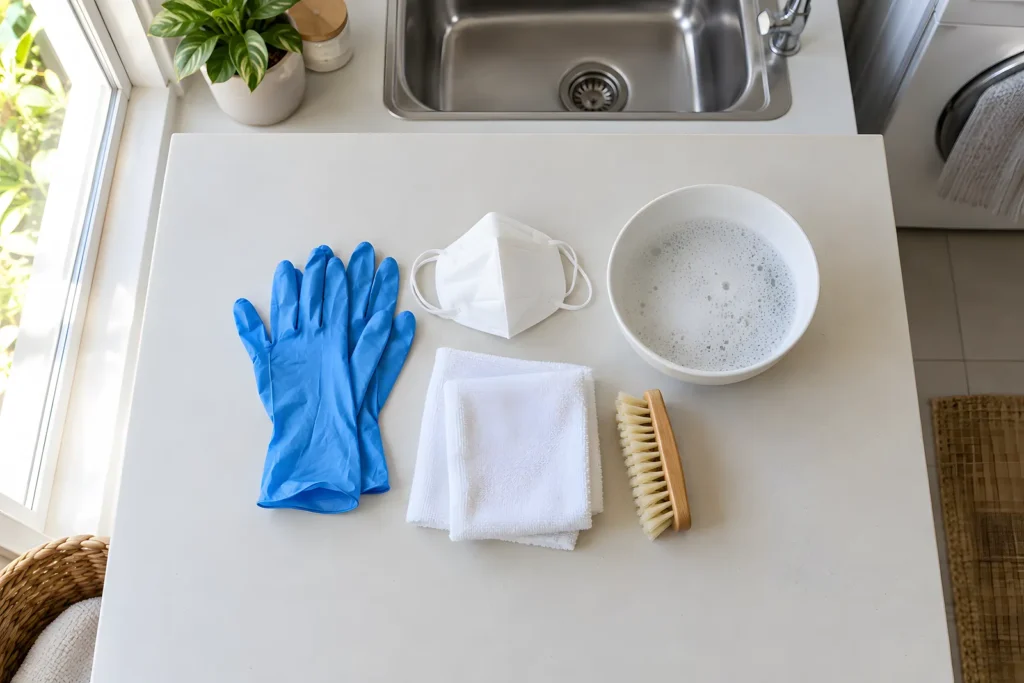
- Wear disposable gloves, long sleeves and a close-fitting dust mask, preferably rated P2.
- Open windows and doors so air moves through the room.
- Work outdoors where you can, in the shade.
- Do not shake, flap or dry brush mouldy fabric indoors, which sends spores into the air.
- Put used cloths in a bag and wash your hands afterwards.
- Never mix cleaning products, and do not use bleach on our fabrics.
Consider having a professional do the cleaning if the mould covers a large area, keeps returning, or you suspect a leak or damp in the wall.
How to clean mould off blinds
Start with the gentlest method for the blind you have. General care is in how to clean blinds.
Mould off roller blinds
Follow the roller fabric line above. The full routine is in how to clean roller blinds.
- Lower the blind fully. If you can, take it outside on a dry day. Otherwise, open the window and protect the sill with a towel.
- Do not dry brush it. If your vacuum has a HEPA filter, run the soft brush attachment lightly over the fabric on low suction; otherwise skip this step.
- Mix a few drops of mild detergent into cool water and test a hidden spot, such as the bottom edge.
- Wipe the fabric with a barely damp sponge, from the top down, rinsing the sponge often.
- Wipe again with a sponge in plain water, then dry with a clean cloth.
- Leave the blind lowered with the window open until it is completely dry.
If dark staining remains after a careful clean, do not scrub harder. The fabric may be stained through, and replacing the blind is often the better result.
Vertical blinds and mould
Vertical blinds hang close to sliding doors and windows, so vanes near the glass can pick up condensation and mould. Fabric vanes are Lakeside or Shade, and how to clean vertical blinds covers taking them off the track.
- Close the vanes so that the flat faces are exposed.
- Do not dry brush the vanes. If your vacuum has a HEPA filter, use the soft brush attachment lightly on low suction; otherwise skip this step.
- Wipe each vane with a barely damp cloth and mild detergent, from top to bottom, then dry.
- Rotate the vanes the other way and repeat.
- Wipe the track and clips, keeping liquid away from the moving parts.
For Lakeside, test the damp cloth on the bottom edge of a vane first, because its care advice covers dusting rather than wiping.
Venetian blinds
The general method is in how to clean venetian blinds.
- Aluminium and fauxwood: both are waterproof. Tilt the slats, wipe each face with a cloth dampened in warm water and mild detergent, dry straight away, and finish with the headrail and brackets.
- Timber: use a barely damp cloth, dry it immediately and never soak the slats. Mould that has worked into the timber may need professional advice or replacement.
Plantation shutters
PVC shutters are waterproof, but they are for interior use and should not be continually soaked, and hinges and other metal parts should never be soaked. Wipe mould with a lightly damp cloth and mild detergent, dry the blades and hardware, and keep hinges dry. For timber shutters, use the cleaning method approved for timber, avoid saturating joints, and improve ventilation in the room. More is in how to clean plantation shutters.
How to remove mould from curtains
Curtains are heavy and hold moisture, so treat them thoroughly but gently. Take the curtains outdoors, avoid shaking or dry brushing them, and then follow the care for the fabric, as in the table above and in how to clean curtains the right way.
- Sheers: hand wash in warm water with mild detergent. Do not bleach, rub or wring. Rinse until clear, and hang by the hooks in the shade. See how to wash sheer curtains.
- Blockouts and lined curtains: do not use a domestic washing machine. Professional wet cleaning is recommended. If you hand wash, use cool to warm water at 40°C at most and wash in sections. Do not soak, bleach, rub or wring. See how to clean blockout curtains at home.
- Drying: never tumble dry. Hang open in the shade until completely dry. A curtain that is damp when rehung will simply grow mould again.
- Test first: dab a hidden area with your detergent solution and check for colour change.
Mould that leaves staining on a sheer can be permanent, and mould that has reached the coated back of a blockout is hard to remove completely.
Is mould on curtains dangerous?
It depends on the person and the amount. Treat any visible mould with care: protect yourself, ventilate the room and clean it promptly. If anyone at home has breathing problems or allergies, or you are unsure, ask a doctor. A large or recurring area is best left to a professional.
When to replace instead of clean
| Sign | What it means | What to do |
|---|---|---|
| Dark staining remains after a careful clean | The mould has stained the fibres | Replace the covering |
| The musty smell keeps returning | Growth remains deeper in the fabric or roll | Replace, and fix the moisture |
| Mould on both sides of the fabric | It has grown through | Replace |
| The coating on a blockout is flaking or tacky | The coating is damaged | Replace. See how to clean rubber-backed curtains without peeling |
| Mould keeps coming back within weeks | The cause is still there | Fix the moisture source first |
Stop mould coming back
Cleaning gives you a fresh start. Airflow and dry glass keep it that way.
- Wipe condensation off glass and sills each morning in cold weather.
- Open blinds and curtains for part of the day so the glass can dry.
- Ventilate. Run extraction fans, open windows on dry days, and use a dehumidifier if the room stays damp.
- Leave a little space. A front (over) roll sits farther from the glass than a standard roll. See standard roll or reverse roll for how each behaves.
- Choose materials for the room. Our bathroom blinds page lists Light Filter, Blockout and PVC shutter options. PVC plantation shutters use a waterproof material suited to humid rooms, though they are for interior use and should not be continually soaked.
- Fix leaks and cold spots. If mould returns in the same spot, check the wall, the window frame and the seals.
Tip: Photograph the patch before you clean it. If mould reappears in the same place, the photo shows it is a cold spot or a leak rather than bad luck, and that is where to focus.
Questions
Can you remove mould from blinds?
Often, yes, if it is on the surface and has been caught early. Wear gloves and a mask, avoid dry brushing it into the air, then wipe with a barely damp cloth and mild detergent and dry the blind fully. If staining or a musty smell stays, replacing the blind is usually simpler.
Is mould on curtains dangerous?
It depends on the person and how much there is. Take care with ventilation and protection when you clean it, and if anyone at home has breathing problems or allergies, or you are worried, ask a doctor. A large or recurring area is a job for a professional.
Can I use bleach or vinegar on mouldy blinds and curtains?
Not on our fabrics. Our care instructions rule out bleach on curtains and abrasive or solvent cleaners on roller blind fabric, and vinegar is best avoided too. A mild detergent solution, wiped on and dried straight away, is the safer option.
Why does mould grow on blinds and curtains in winter?
Warm, moist indoor air condenses on cold glass, and fabric that touches or sits close to the wet glass stays damp. Wiping the glass, ventilating the room and letting air move behind the blind or curtain all help.
Can I wash mouldy curtains in the washing machine?
Not ours. Our sheers are hand wash only and our coated blockouts must not go in a domestic washing machine. Follow your curtain's own care label for any others.
Choose blinds and shutters for damp rooms
See the fabrics and materials we suggest for bathrooms, laundries and kitchens.
Keep reading
 Care & cleaningHow to clean blinds: every type, step by stepFabric blinds, slatted blinds and shutters each need a different method. Here is how to clean blinds of every type, without damaging them.
 Care & cleaningHow to clean curtains the right waySheers, coated blockouts and lined curtains each need a different method. Here is how to clean curtains at home, from vacuuming to a full wash.
 Room ideasThe best blinds and shutters for bathroomsPVC shutters, fauxwood venetians and aluminium venetians suit bathrooms best, with roller blinds for windows out of the spray. Privacy, moisture and fit explained.