
Wooden blinds: timber, fauxwood or aluminium venetians
Real timber, fauxwood or aluminium? Compare slat sizes, wet-room suitability and care so you can choose the right venetian blind for each room.
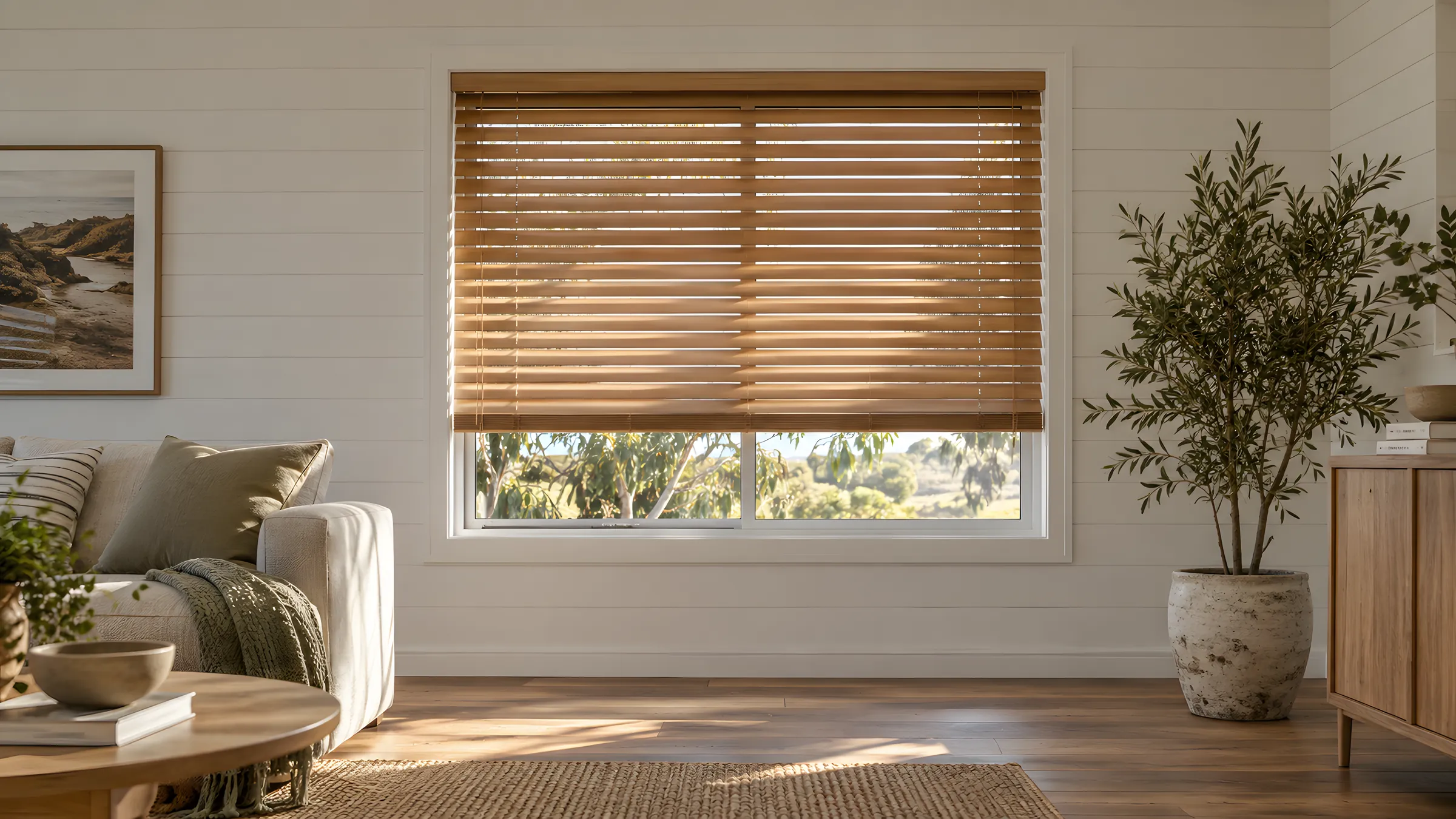
Wooden blinds are venetian blinds with timber or timber-look slats, and we make three versions: Timber Venetians in real timber, Fauxwood Venetians that give the timber look in a faux wood slat, and Aluminium Venetians with a slimmer slat. Choose timber for warmth in dry rooms, fauxwood when you want the timber look in a kitchen or bathroom, and aluminium for a crisp, slim-slat finish in wet areas or a home office.
In short
- Timber Venetians have 50 mm slats and suit dry rooms such as living rooms, bedrooms and studies.
- Fauxwood Venetians give the timber look in a faux wood slat and suit kitchens and bathrooms.
- Aluminium Venetians have 25 mm slats, come in five sample colours and suit kitchens.
- All venetians tilt for light and lift for the view. None blocks light the way a blockout roller blind does.
- Look at samples in your own light, and check the slat width for your product before you build.
Wooden blinds: what your three options are
The word "wooden" covers more than real timber. Shoppers searching for wooden venetian blinds usually want the timber look and the tilting slats, and there are three ways to get it.
- Timber Venetians are made from real timber, with 50 mm slats.
- Fauxwood Venetians give the timber look in a faux wood slat.
- Aluminium Venetians have 25 mm slats and a metal finish, in Cool White, Brilliant White, Warm Pure Silk, Ebony and Sterling.
All three work the same way. Tilt the slats to steer light and privacy, or lift the blind to open the window and clear the view. The full range sits on our venetian blinds page.
Timber, fauxwood and aluminium compared
| Timber | Fauxwood | Aluminium | |
|---|---|---|---|
| Look | Natural timber, with variation from slat to slat | Timber look, consistent slat to slat | Slim, crisp metal slat |
| Slat width | 50 mm | Check the product page | 25 mm |
| Kitchens | Not recommended near the sink or cooktop | Suits | Suits |
| Bathrooms | Not recommended | Suits | Waterproof slat |
| Care | Dust and wipe with a barely damp cloth, never soak | Wipe clean | Wipe clean |
| Colours | See samples | See samples | Cool White, Brilliant White, Warm Pure Silk, Ebony, Sterling |
| Best for | Living rooms, bedrooms, studies | Kitchens and bathrooms where you want the timber look | Kitchens, home offices, modern interiors |
Note: Of the three, only fauxwood and aluminium are waterproof. Real timber can swell, mark or warp with steam and splashes, so leave it out of wet areas and check the care guidance for your finish.
Timber venetians: when real timber is worth it
Real timber gives you natural variation in tone and grain that a manufactured slat does not, and 50 mm slats give bold horizontal lines. It is the closest thing to the warmth of a timber floor or exposed beams, which is why it works in living rooms, main bedrooms and studies.
Timber is the right choice when:
- the room is dry and well ventilated
- you want the blind to look like a piece of furniture rather than a utility item
- the window is medium to large, where a 50 mm slat is in proportion
It is the wrong choice above a kitchen sink, in a bathroom or in a steamy laundry. If you like the timber look but the room has moisture, use fauxwood.
If you like the timber look but want something more substantial, plantation shutters use tilting blades in a hinged frame. The plantation shutters vs blinds guide compares the two.
Fauxwood venetians: the timber look in wet areas
Fauxwood suits kitchens and bathrooms because it is waterproof, so it is the practical answer when you want a timber look where timber itself is a risk. Splashes from a sink and steam from a shower are far less of a concern for a faux wood slat than for real timber.
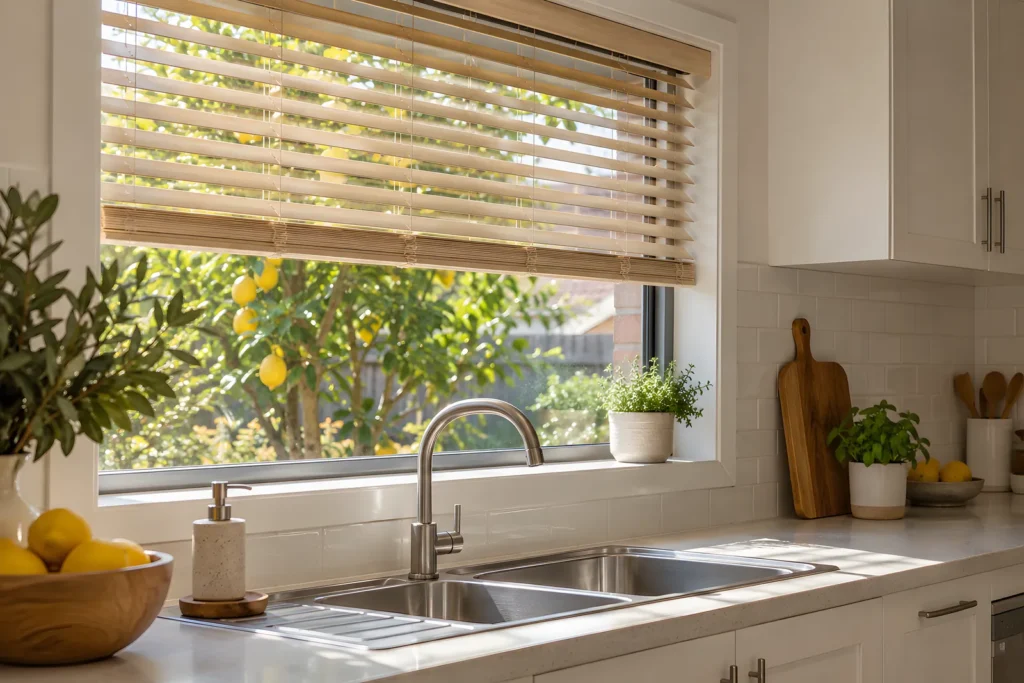
Faux wood blinds vs real wood
The practical differences come down to four things.
- Moisture. Fauxwood copes with wet areas. Timber does not.
- Look. Timber varies naturally from slat to slat. Fauxwood is more consistent along the blind.
- Care. Fauxwood can be wiped. Timber needs a lighter touch. Our venetian blind cleaning guide covers both.
- Feel. Real timber has a warmth that no substitute matches completely. Some people notice, and some do not.
In a kitchen, check clearance around taps and handles before you choose recess or face fit. Our kitchen blinds page lists the options that suit a working kitchen, and the best blinds for kitchens guide walks through the choices.
Aluminium venetians: slim slats and crisp lines
Aluminium venetians have 25 mm slats, so more slats stack up across the same drop, and the look is finer and more precise than a 50 mm timber slat. They are waterproof, they suit kitchens, and they are the option we list for a home office, where tilting the slats controls glare on a screen without darkening the room.
The five sample colours are Cool White, Brilliant White, Warm Pure Silk, Ebony and Sterling. Cool White and Brilliant White are the two whites and Ebony is the dark option, so it is worth looking at a sample to see how Warm Pure Silk and Sterling behave in your own light.
How to choose blind slat size
Slat size changes both the look and how the blind behaves at the window:
- 25 mm slats give a finer, denser look. As a rule of thumb they suit smaller windows and modern, tailored interiors.
- 50 mm slats give bolder lines and fewer of them. They suit larger windows and rooms where the blind is meant to be seen.
Two practical points apply whichever you choose. Wider slats cut more of the view when they are tilted partway open. And when a venetian is raised, the slats stack at the top of the window, so decide how much glass you are willing to lose there.
Timber Venetians have 50 mm slats and Aluminium Venetians have 25 mm slats. Check the slat width shown for the exact product you are building.
Venetian blinds vs roller blinds
| Venetian blinds | Roller blinds | |
|---|---|---|
| Light control | Tilt the slats to steer light, or lift for the view | Fabric is raised or lowered, with blockout, light filter or SunScreen options |
| View | Partial view is possible through tilted slats | Clear when raised, or filtered through SunScreen |
| Darkness | Some light gets past the slats and edges | Blockout fabric stops light through the cloth |
| Look | Textured, architectural | Flat and clean |
| Best for | Glare control, kitchens, home offices | Bedrooms, media rooms, minimal interiors |
For a bedroom that needs to be dark, choose a blockout roller blind instead. Venetians are better where you want to keep some light and some view at the same time.
Tip: Colour and finish can look quite different in your own light than on a screen. Look at samples where they are offered, and hold them against your window frame, floor and walls. You can order free samples from our sample library.
Choosing by room
- Living room: Timber for warmth, or aluminium if you prefer a crisper finish.
- Bedroom: A venetian gives privacy and adjustable light, but choose a blockout roller blind, a cassette or a double roller if you need real darkness.
- Kitchen: Fauxwood or aluminium, both waterproof.
- Bathroom: Fauxwood. See bathroom blinds for the other options.
- Home office: Aluminium, for glare control that you can adjust through the day.
Keep any cords out of reach of young children. For a nursery or a child's room, a cordless or motorised roller blind is the better choice.
Mistakes to avoid when choosing venetians
- Putting real timber in a wet area. A kitchen window over the sink and a bathroom window are fauxwood or aluminium territory.
- Choosing slat width on looks alone. Hold the sample up and picture the slat against the height of the window. A 50 mm slat on a very small window can look heavy, and a 25 mm slat on a large window can look busy.
- Forgetting the stack. When the blind is raised, the slats bunch at the top of the window. Decide whether that is acceptable for the view before you order.
- Mixing products along one wall. Windows in the same room usually look best in the same product and colour, even if the sizes differ.
- Ignoring handles and obstructions. Recess fit sits inside the frame for a neat finish. Face fit sits outside the opening, covers more and can clear handles, taps or winders that would foul the blind.
Each venetian type has its own official guides, so use the one that matches your blind rather than a general method. For Timber Venetians, see the timber venetian blinds measuring guide and the timber venetian installation guide. For Aluminium Venetians, see the 25 mm aluminium venetian measuring guide and the aluminium venetian installation guide. For fauxwood, start from the measure guides. Our venetian blind repairs article explains cords, tilt and common faults.
Questions
What is the difference between timber and fauxwood venetian blinds?
Timber Venetians are real timber, while Fauxwood Venetians give the timber look in a faux wood slat. Fauxwood suits kitchens and bathrooms, and timber is best kept to dry rooms.
Can wooden blinds go in a bathroom?
Fauxwood venetians suit bathrooms and kitchens. Real timber can react to steam and splashes, so keep it to dry rooms.
What slat sizes do venetian blinds come in?
Our Timber Venetians have 50 mm slats and our Aluminium Venetians have 25 mm slats. Check the slat width shown for the product you are building.
Are venetian blinds better than roller blinds?
Neither is better for every window. Venetians let you tilt for light and lift for the view, while roller blinds give you blockout fabric and a cleaner look when lowered.
Which venetian blinds suit a kitchen?
Fauxwood and aluminium venetians both suit kitchens because they are waterproof.
Choose your venetian blind
Compare timber, fauxwood and aluminium venetians, then order free samples to see the finish in your own light.
Keep reading
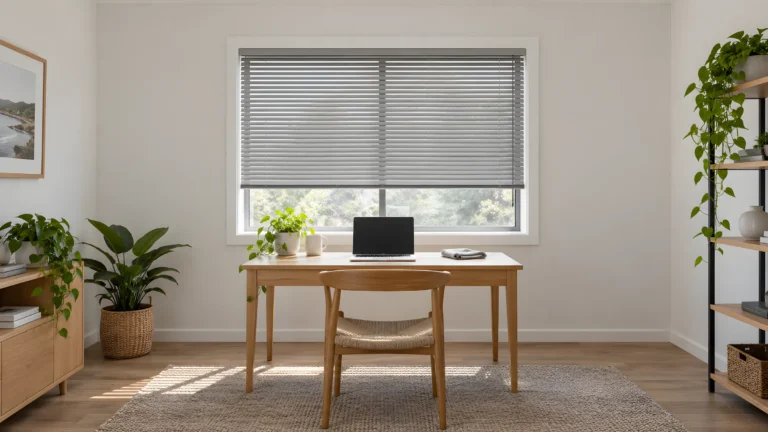 Care & cleaningHow to clean venetian blinds: aluminium, timber and fauxwoodA step-by-step guide to cleaning venetian blinds, with the right method for aluminium, timber and fauxwood slats and what to avoid, including vinegar.
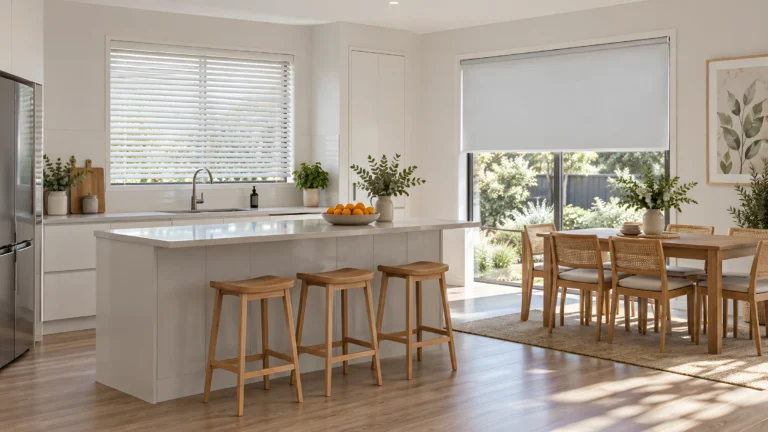 Room ideasWhat are the best blinds for a kitchen?PVC shutters, fauxwood and aluminium venetians suit kitchens best, with roller blinds for windows out of the splash zone. Here is how to choose, fit and clean them.
 Plantation shuttersPlantation shutters vs blinds: which is better for your home?Shutters and blinds each win in different rooms. Compare light control, darkness, privacy, wet areas and depth, then choose room by room.