
Curtain tracks explained: wall, ceiling, curved and motorised
How curtain tracks work and how to choose one: Designer, Half Moon, curved and motorised, ceiling or wall fit, fixed or free flow, brackets and wands.

A curtain track is the rail fixed to your ceiling or wall that the curtain slides along. You choose it by answering four questions: where it fixes (ceiling or wall), what shape it is (straight or curved), how it is operated (by hand, by wand or by motor), and how the curtain moves along it (fixed flow or free flow). The track is chosen separately from the fabric and the heading.
In short
- Designer is a plain, straight profile. Half Moon has a curved front edge and costs a little more. Motorised is built for a motor.
- Fix the track to the ceiling (top fit) or the wall (face fit). S Fold is used with a top fit.
- Curved tracks, in Designer and Motorised profiles only, follow corner, box and bay windows.
- Fixed flow keeps the curtain to the opening you choose. Free flow lets you reposition it, but cannot be motorised.
- Extension brackets, three track colours and a 910 mm, 1520 mm or no wand finish the choice.
How curtain tracks work
A track is a simple system with four parts:
- Brackets fix the track to the ceiling or wall and hold it at a set distance out.
- The track is the rail itself, fixed horizontally above the window.
- Gliders slide along the track.
- The curtain attaches to the gliders through its heading.
You open and close the curtain by hand, with a wand clipped to the leading edge, or with a motor. The curtain gathers at one or both sides, which is called the stack.
What are curtain track gliders?
Gliders, sometimes called runners or carriers, are the small parts that travel inside the track. The top of the curtain attaches to them with hooks or, for S Fold, with carriers. If a curtain feels stiff, compare your track against our curtains installation guide.
Types of curtain tracks
We make three track profiles, plus curved and double options built from them.
| Track | Profile | Good to know |
|---|---|---|
| Designer | Plain, straight profile | Fixes to the ceiling or wall. Also made curved. Works with S Fold |
| Half Moon | Curved front edge | Fixes to the ceiling or wall. Costs a little more than Designer. Not made curved |
| Motorised | Built for a motor | Choose whenever a motor, not a wand or your hand, will operate the curtain. Also made curved |
| Curved | Designer or Motorised profile | For corner, box and bay windows, with up to two 90 degree bends online |
| Double | Two tracks, front and rear | Carries a sheer at the front and a blockout at the rear. Projects 220 mm to 250 mm |
Ceiling fit or wall fit?
Every straight track can be fixed to the ceiling or to the wall. The choice changes how the curtain looks and how you measure, so decide it before you open the measuring guide.
| Ceiling (top) fit | Wall (face) fit | |
|---|---|---|
| Effect | Takes the fabric up to the ceiling and adds height | Frames the window; can run across a whole wall |
| Suits | Straight-edge ceilings, and inside a cornice | Rooms where a large cornice would leave a big gap to the glass |
Our guide to floor-to-ceiling curtains covers the ceiling fit in detail.
Fixed flow or free flow?
- Fixed flow. The curtain stacks only to the side or sides you choose. A left stack always gathers to the left, and a centre opening always stacks to both sides.
- Free flow. You can stack and open the curtain wherever you like, and adjust its position along the track at any time.
Fixed flow is tidier and more predictable, and it is required if you want motorisation. Free flow suits a window where you want to change the stack, for example to clear a door on some days. Motorisation is not available with free flow tracks or curtains with multiple openings.
Brackets, colours and wands
Three small choices finish the track.
Brackets. A standard bracket holds the track at its usual distance from the wall or ceiling. An extension bracket moves the track further out to clear an obstruction such as a window handle, a sill or another blind.
Colour. The track comes in silver, black or white, chosen separately from the fabric. White recedes against light walls and ceilings and keeps the focus on the fabric. Black gives a bolder, more visible line and suits dark window frames. Silver sits well beside other silver fittings.
Wand. A 910 mm wand suits a standard drop, and a 1520 mm wand keeps the handle within easy reach on a taller drop. You can also choose no wand and draw the curtain by hand. Choose a length you can reach comfortably from the floor.
Tip: Match the track colour to the ceiling or the window frame, not to the fabric. A track that blends with what is behind it looks lighter and more finished.
Which track suits which heading?
You pick the track and the heading separately, but they work together.
- S Fold. Choose S Fold with a Designer or a Motorised track. It is used with a ceiling (top) fit and is the most popular heading in our configurator. See our page on S Fold curtains.
- Pencil pleat, pinch pleat and inverted pleat. These flat-stitched headings suit a double track, where pencil and inverted pleat are often the rear layer behind an S Fold front. Our post on curtain headings explained compares all five.
- Half Moon. Check which headings it is offered with in the configurator before you plan around it.
Measuring the track
You give the track width, not the fabric width, and the fabric is calculated from your track width and the fullness you choose. Two approaches are common:
- Wall to wall: the track runs between your walls or cornices, so the curtain covers the whole wall.
- Framing the window: the track is made to your exact measurement, and you add at least 30 per cent to the window width so the curtains stack beside the glass.
Tracks that meet at a corner
Where a curtain runs along each of two walls that meet at 90 degrees, one track runs into the corner and the other stops short so its curtain clears the first. Our curtain measuring guide sets out how to size each track, so follow it rather than a general rule.
Use the guide for your curtains: the curtain measuring guide for single tracks, the double curtains measuring guide for layered tracks, and the curved curtains measuring guide for curved tracks.
Fitting a curtain track and hiding it
For fixing the track, brackets and fixings, follow our curtains installation guide. It covers how to fit the track to the ceiling or wall, and the ceiling-or-wall choice above only changes where it goes.
How to install a curtain rod: why we use tracks
If you searched for how to install a curtain rod, note that we make curtains on tracks rather than rods, so our installation guide covers tracks. A track keeps the gliders inside the rail so the curtain draws smoothly with one hand or a wand, takes curved and bay shapes, can be motorised, and can be fixed to the ceiling so the fabric rises to the ceiling line. Our post on curtain rods vs curtain tracks compares the two, and the installation guide above takes you through fitting a track.
Curtain track parts
| Part | What it does |
|---|---|
| Brackets | Fix the track to the ceiling or wall. Standard, or extension to clear a handle, sill or blind |
| Track | The rail itself: Designer, Half Moon or Motorised, in silver, black or white |
| Gliders | Slide inside the track and carry the curtain through hooks or carriers |
| End stops | Stop the gliders running off the end |
| Wand | Clips to the leading edge so you can draw the curtain without touching the fabric. 910 mm, 1520 mm or none |
Where to put curtain tracks
Fixed to the ceiling, a track takes the fabric to the ceiling line and makes the window look taller. Fixed to the wall, it sits above the window and suits rooms where a large cornice would leave a gap to the glass. Either way, let the track run wider than the glass so the open curtain stacks beside the window rather than across it. Our guide has you add at least 30 per cent to the window width to frame it. Use extension brackets where the track has to stand further out to clear a window handle, sill or another blind.
Hidden and recessed tracks
A track does not have to be on show. There are three common ways to hide it:
- Behind a pelmet. A box pelmet or a fabric-covered Bonded Pelmet hides the track and the heading. Check the projection clears both. Our guide to what a pelmet is explains the options.
- Inside a cornice or pelmet cavity. A ceiling fit can sit inside a cornice, and a builder can leave a cavity in the ceiling for the track. Double curtains need a cavity 250 mm deep.
- Blended in. A white track against a white ceiling recedes more than any other combination.
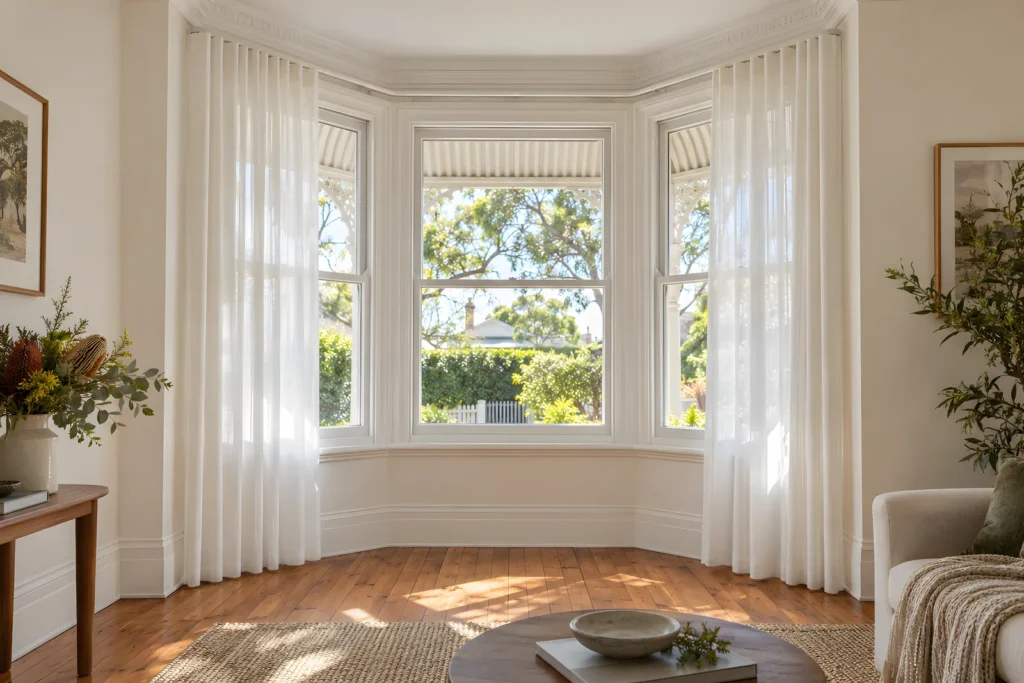
Curved tracks for corner, bay and box windows
If the window turns a corner, a curved track follows it so the curtain does too. Curved tracks come in the Designer and Motorised profiles only, because Half Moon is not made curved. Online you can order up to two 90 degree bends, and at each bend you choose whether the curtain fits into the corner (an internal bend) or wraps around it (an external bend). Box and bay windows use 45 degree and 90 degree tracks, and we ask for a photo and a plan sketch of the window.
Curved tracks take S Fold, pencil pleat or pinch pleat headings. See our pages on curved curtains and box and bay curtains for the details.
Motorised tracks
A motorised curtain uses a Motorised track in place of a Designer track, with a gear drive on each side. You choose a battery or hardwired motor and a remote, and can add a smart hub. Motorisation is not available with free flow tracks or multiple openings. Read motorised curtains explained to plan power and controls before you order.
How to choose your track: a checklist
- Decide the fit. Ceiling or wall, based on your cornices, fixings and the look you want.
- Decide how you will operate it. By hand, with a wand, or by motor. If motorised, choose fixed flow.
- Choose the profile. Designer for a plain, straight profile, Half Moon for a curved front edge, Motorised for a motor.
- Check the shape of the window. Corner, box or bay windows need a curved track.
- Check clearances. Window handles, sills, radiators and other blinds may need extension brackets.
- Choose the colour and wand. Match the ceiling or frame, and pick a wand you can reach.
Questions
What is the difference between a Designer and a Half Moon track?
Designer has a plain, straight profile. Half Moon has a curved front edge and costs a little more. Both fix to the ceiling or the wall, and only Designer and Motorised tracks are made curved.
Do S Fold curtains need a special track?
You choose the track separately from the heading. S Fold is used with a ceiling (top) fit and can be ordered with a Designer or a Motorised track.
What is a free flow track?
A free flow track lets you stack and open the curtain wherever you like and adjust its position at any time. It cannot be motorised.
Can a curtain track go around a corner?
Yes. Curved tracks in the Designer and Motorised profiles follow corner, box and bay windows, with up to two 90 degree bends online.
How do I stop curtains catching on a window handle?
Choose extension brackets. They move the track further from the wall or ceiling than a standard bracket, which clears a handle, sill or another blind.
Build your curtains
Choose your track, fabric and heading together, and see the price before you order.
Keep reading
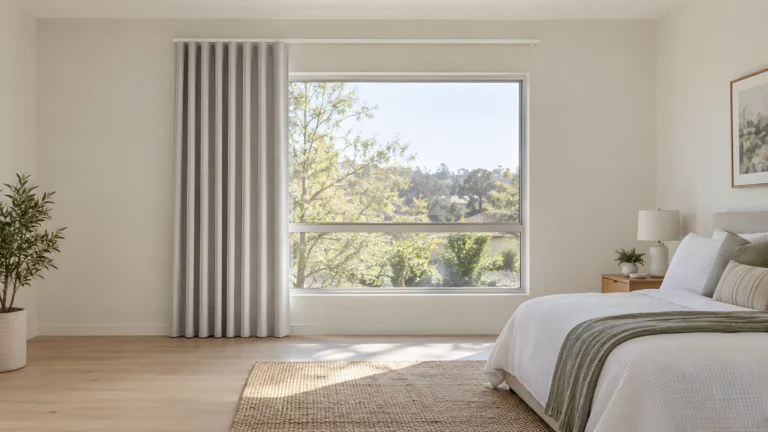 Measuring & fittingCurtain size guide: length, width and height to chooseHow long, wide and high curtains should be, with the three floor finishes, how wide to make the track and how much wall to leave for the stack.
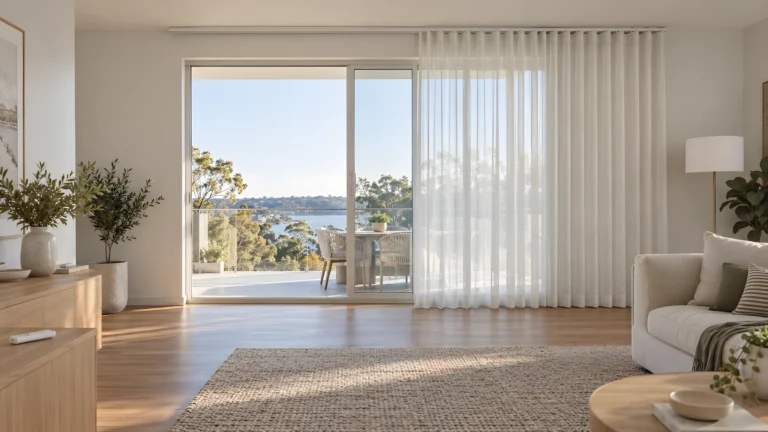 CurtainsMotorised curtains: how they work and what to planHow motorised curtains work, battery or hardwired power, remotes and smart hubs, the limits to know about and what to plan before you order.
 CurtainsCurtain rods vs curtain tracks: which is better?Curtain rod or curtain track? Compare look, glide, weight, double layers, bay windows and motorising, and see which suits your window.