
PVC or timber plantation shutters: which suits your room?
PVC suits wet rooms and painted finishes, while timber suits dry rooms where you want grain or a stain. Compare the two room by room.
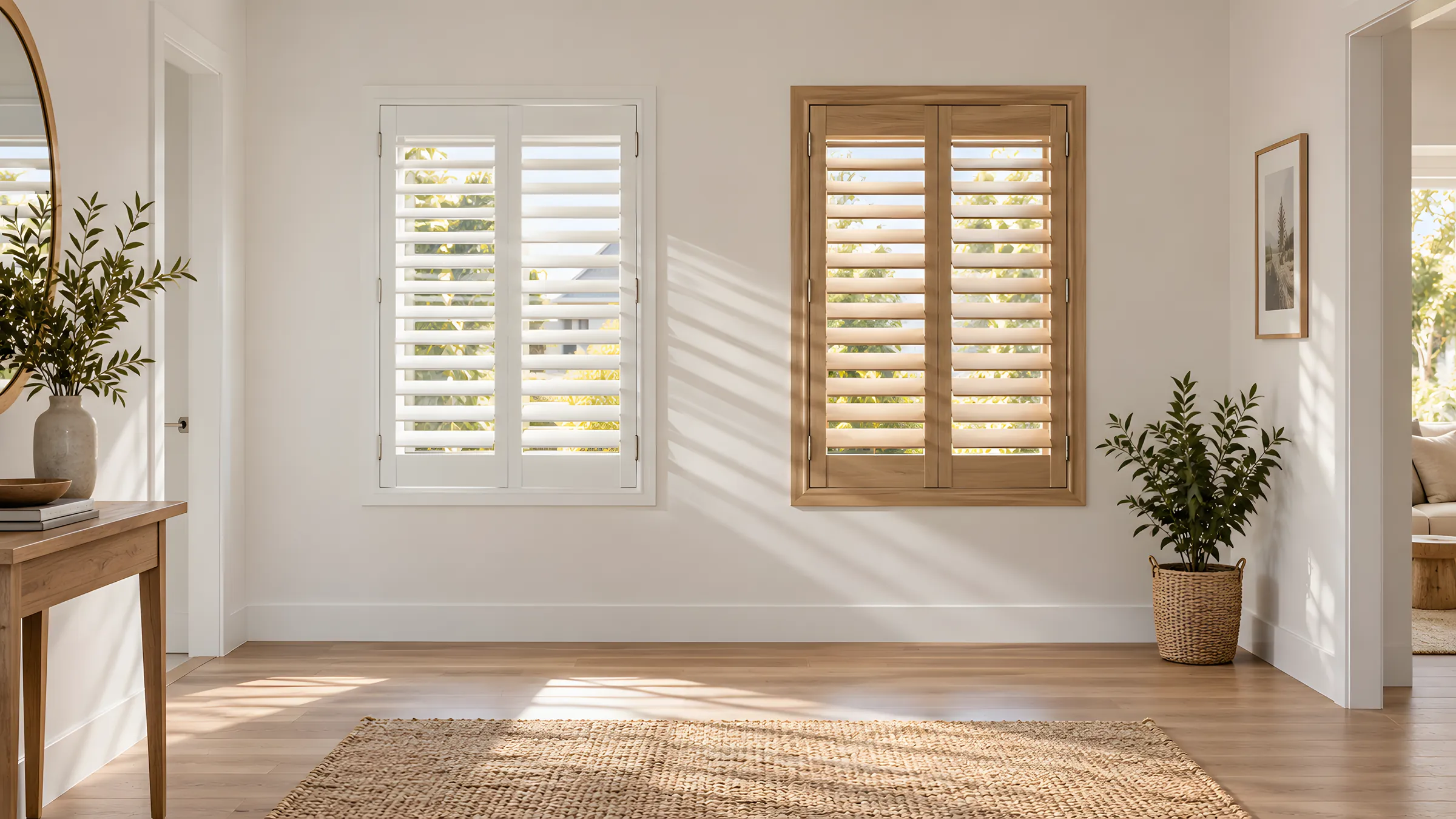
PVC vs timber shutters comes down to the room. Choose PVC, an aluminium-reinforced polymer, for kitchens, bathrooms and laundries, and for a painted finish anywhere. Choose timber, which for us is paulownia, when you want a visible grain or a stained colour in a dry room. This guide compares the two on moisture, look, care, cost and fit, so you can pick the best material for each window.
In short
- PVC suits wet rooms because the material is waterproof. It is for interior use only, and should be kept out of continual direct soaking.
- Timber (paulownia) suits dry rooms and gives you visible grain or a stain. Check its care needs before using it in a humid room.
- Frames, panel layouts, the D-mould and made-to-measure sizing are the same for both materials.
- PVC comes in Glacial White, Shell and Antique. Timber finishes include Blanc, Natural, Walnut and more.
- Order samples of both: finishes look different in your own light.
PVC vs timber shutters at a glance
| PVC | Timber | |
|---|---|---|
| What it is | Aluminium-reinforced polymer | Paulownia, a light timber |
| Finish | Painted, with a VOC-free painted finish | Stained or painted; the grain shows when stained |
| Colours | Glacial White, Shell, Antique | Sample names include Blanc, Natural, Walnut, Cordovan, Storm and Grey |
| Wet rooms | Suits kitchens, bathrooms and laundries | Check the care needs in humid rooms; best kept for dry rooms |
| Best when | You want waterproof, painted shutters | You want the grain or a stain |
PVC shutters are sometimes called polymer or poly shutters. If you have seen poly shutters vs wood compared elsewhere, that is the same choice as PVC vs timber here.
PVC plantation shutters: what they are and where they suit
Our PVC shutters are made from an aluminium-reinforced polymer with a painted finish and a concealed tilt mechanism. The PVC material is waterproof, which is why it is the material we point to for kitchens, bathrooms and laundries.
What waterproof does and does not mean
PVC as a material is waterproof, so splashes and damp do not harm it. The finished shutter is still an interior product with hinges and metal parts, so a few sensible limits apply:
- Keep it out of continual direct soaking, for example directly in a shower spray.
- Keep the hinges and other metal parts dry where you can.
- Keep it clear of cooking heat, so allow distance from a cooktop.
Colours and finish
PVC comes in three painted colours: Glacial White, Shell and Antique. If you want a painted shutter, PVC gives you a painted finish in a material that suits any room. The trade-off is that you choose from those colours, while timber offers a wider range of sample names and the option of a stain.
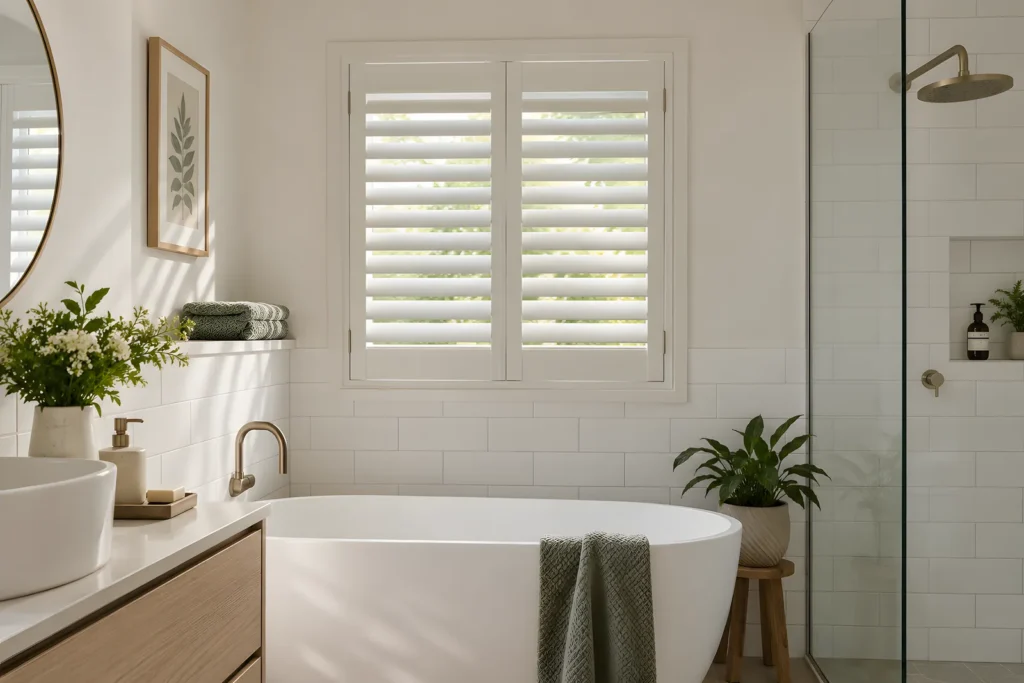
For the full range and current finishes, see our PVC plantation shutters page.
Timber plantation shutters: what they are and where they suit
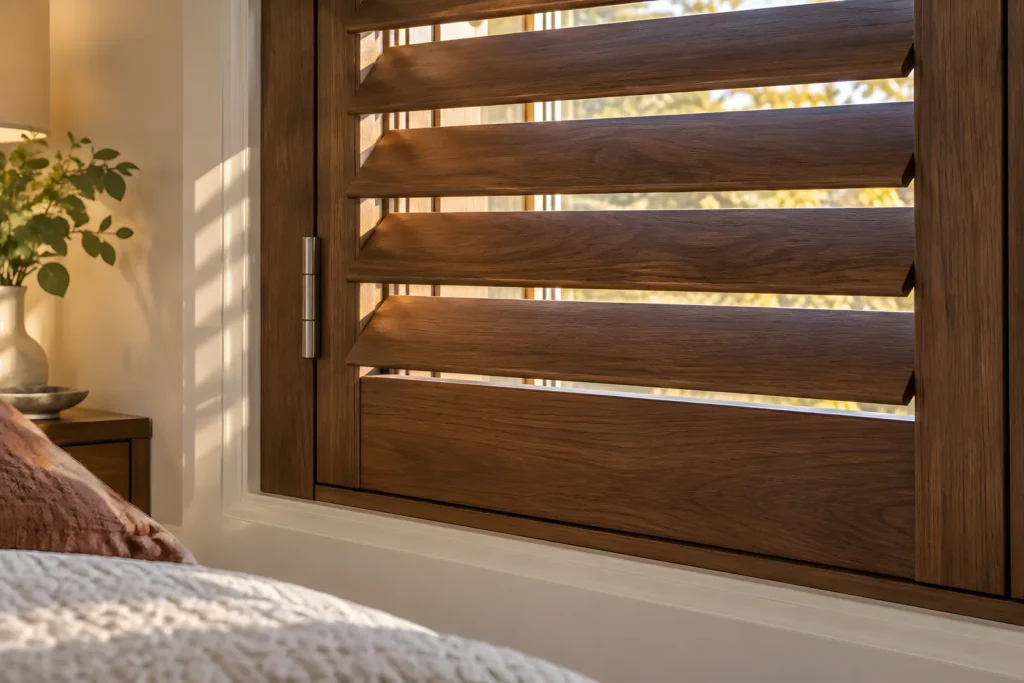
Our timber plantation shutters are made from paulownia, a light timber. You can have them stained, which shows the grain, or painted. If the look of real wood is the reason you want shutters, timber is the material to choose.
Finish names
Timber sample names include Blanc, Natural, Walnut, Cordovan, Storm and Grey, along with others such as Verdeo, Rivera, Noir and Moroccan Leather. Order samples and hold them against your floor, walls and window frame, because stains and paints look different in morning light and at night.
Care and humid rooms
Timber reacts to moisture and humidity more than PVC does, so check its care needs before using it in a humid room. For kitchens, bathrooms and laundries we recommend PVC, and we suggest keeping timber for bedrooms, living rooms and dining rooms where the air stays dry. The timber plantation shutters page lists the current finishes.
The best material for plantation shutters, room by room
The best material follows the room, not a general ranking. This table gives a starting point for each.
| Room | Start with | Why |
|---|---|---|
| Kitchen | PVC | Waterproof material; allow distance from cooking heat and check clearance to taps and handles |
| Bathroom | PVC | Waterproof material; keep hinges and metal dry and out of direct soaking |
| Laundry | PVC | The same reasons as a bathroom |
| Bedroom | PVC or timber | Timber for grain or a stain |
| Living and dining | PVC or timber | Choose on look; timber adds warmth if you like the grain |
| Study or hallway | PVC or timber | Choose on look and budget |
Rooms with a mix of needs, such as an open-plan kitchen and living area, can use both. PVC by the kitchen and timber at the far end is one option, though it is worth ordering samples of both to check that the tones sit well together.
Look, finish and cost
Painted or stained
The bigger visual decision is often painted or stained, not PVC or timber. A painted finish gives a clean, uniform surface, and PVC delivers it in three colours. A stained timber finish shows the grain of the wood, which varies from panel to panel and gives a natural, warmer look.
If you are torn, put a PVC sample and a painted timber sample side by side with your window frame and walls. Judge them at different times of day, and again with the room lights on. Our free samples service lets you compare finishes at home before you commit.
Cost
As a general guide, PVC is the more affordable of the two, and a stained timber finish typically costs more than a painted PVC shutter. Neither material changes the fact that shutters are made to your measurements, so window size, frame and panel layout also move the price. Our guide to how much plantation shutters cost explains each driver.
If you are comparing polymer shutter quotes from other Australian suppliers, our Price Beat Guarantee may apply to eligible like-for-like quotes; check the terms on the shutter product page.
Care and tricky spots
Caring for each material
Both materials are easy to look after.
- PVC. Dust the blades regularly, wipe marks with a lightly damp cloth, dry the surface and keep the hinges and metal parts dry.
- Timber. Dust regularly, wipe marks with a lightly damp cloth and dry straight away. Avoid soaking, and keep the room ventilated.
- Both. Test any cleaner on a hidden spot first, and move the blades gently rather than forcing a stiff panel.
Our step-by-step guide to cleaning plantation shutters covers both materials.
Tricky spots
A few positions deserve a second look before you order:
- A window inside the shower recess or in direct spray. The shutter is not designed for continual direct soaking. If the window is sprayed every day, talk to our team before you order.
- A window beside the cooktop. Keep the shutter clear of cooking heat, and check clearance to taps and handles.
- A humid room with little ventilation. PVC is the right material, and good ventilation helps any window covering last.
- An open-plan room that mixes materials. Order samples of both and view them together, because tones that look close on a screen can differ in person.
What stays the same whichever you choose
Once you have picked a material, almost everything else is the same:
- Made to your measurements. Measure with our plantation shutters measuring guide and enter what it asks for.
- Frames. Inside Z-frame, inside L-frame or outside L-frame, with the same depth requirements.
- Panel layout. Panels up to about 900 mm wide, T-posts in custom positions, up to two midrails, hinges left or right.
- D-mould. Standard on every panel, at no extra charge.
- Light. Neither material is blackout, so add a blockout blind or curtains where a room must be very dark.
- Support. Expert Review is a paid check by the team, and SureFit is a separate measurement protection with its own conditions.
How to decide
Use this short process for each window:
- Is it a wet room? If it is a kitchen, bathroom or laundry, choose PVC.
- Do you want to see the grain? If yes and the room is dry, choose timber.
- Do you want painted white or a soft neutral? PVC in Glacial White, Shell or Antique will do it, and painted timber is an option in dry rooms.
- Order samples of both materials and check them in your own light.
- Price it. Enter the same measurements for each material in the configurator and compare.
Tip: Order samples for every material and colour you are considering, then leave them on the sill for a few days. Morning and evening light will show you which one you actually prefer.
For the wider picture on frames, panels and measuring, read our plantation shutters guide.
Questions
Are PVC or timber shutters better?
Neither is better in every room. PVC is better for kitchens, bathrooms and laundries because the material is waterproof, and timber is better in dry rooms where you want visible grain or a stained finish.
What are poly shutters?
Poly shutters is another name for polymer or PVC shutters. Ours are made from an aluminium-reinforced polymer with a painted finish and a concealed tilt mechanism.
Can I use timber shutters in a bathroom?
We recommend PVC for bathrooms, laundries and kitchens. Timber is best kept for dry rooms, and you should check its care needs before using it anywhere humid.
What timber are your plantation shutters made from?
Our timber plantation shutters are made from paulownia, a light timber. They can be stained to show the grain or painted.
Are PVC plantation shutters waterproof?
The PVC material is waterproof, but the finished shutter is for interior use only. Keep it out of continual direct soaking, keep the hinges and metal parts dry, and keep it clear of cooking heat.
Choose your shutter material
Order free samples of PVC and timber finishes, then price each window in the configurator.
Keep reading
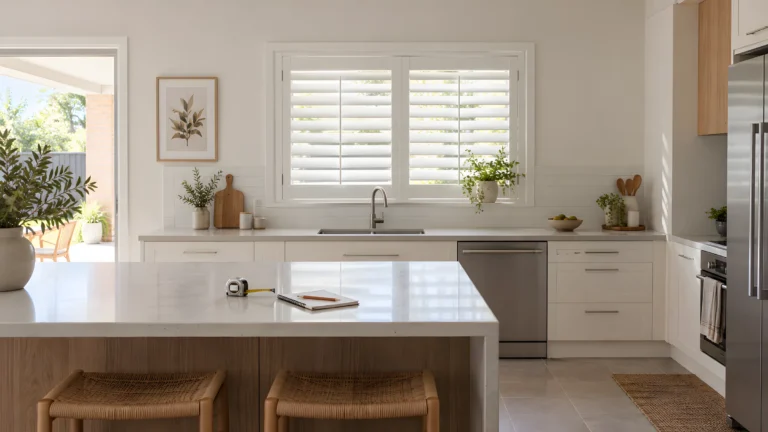 Plantation shuttersHow much do plantation shutters cost? What sets the priceThere is no single price per window. Here is what sets the cost of plantation shutters and how to price your own home, window by window.
 Plantation shuttersDo plantation shutters block light, heat and noise?Plantation shutters control light and glare very well, but they are not blackout. Here is what to expect for light, heat and noise, and how to fill the gaps.
 Plantation shuttersPlantation shutters: the complete guideWhat plantation shutters are, how they work, what they are made of and how to plan frames, panels and measuring before you order made-to-measure shutters online.