
Plantation shutters: the complete guide
What plantation shutters are, how they work, what they are made of and how to plan frames, panels and measuring before you order made-to-measure shutters online.
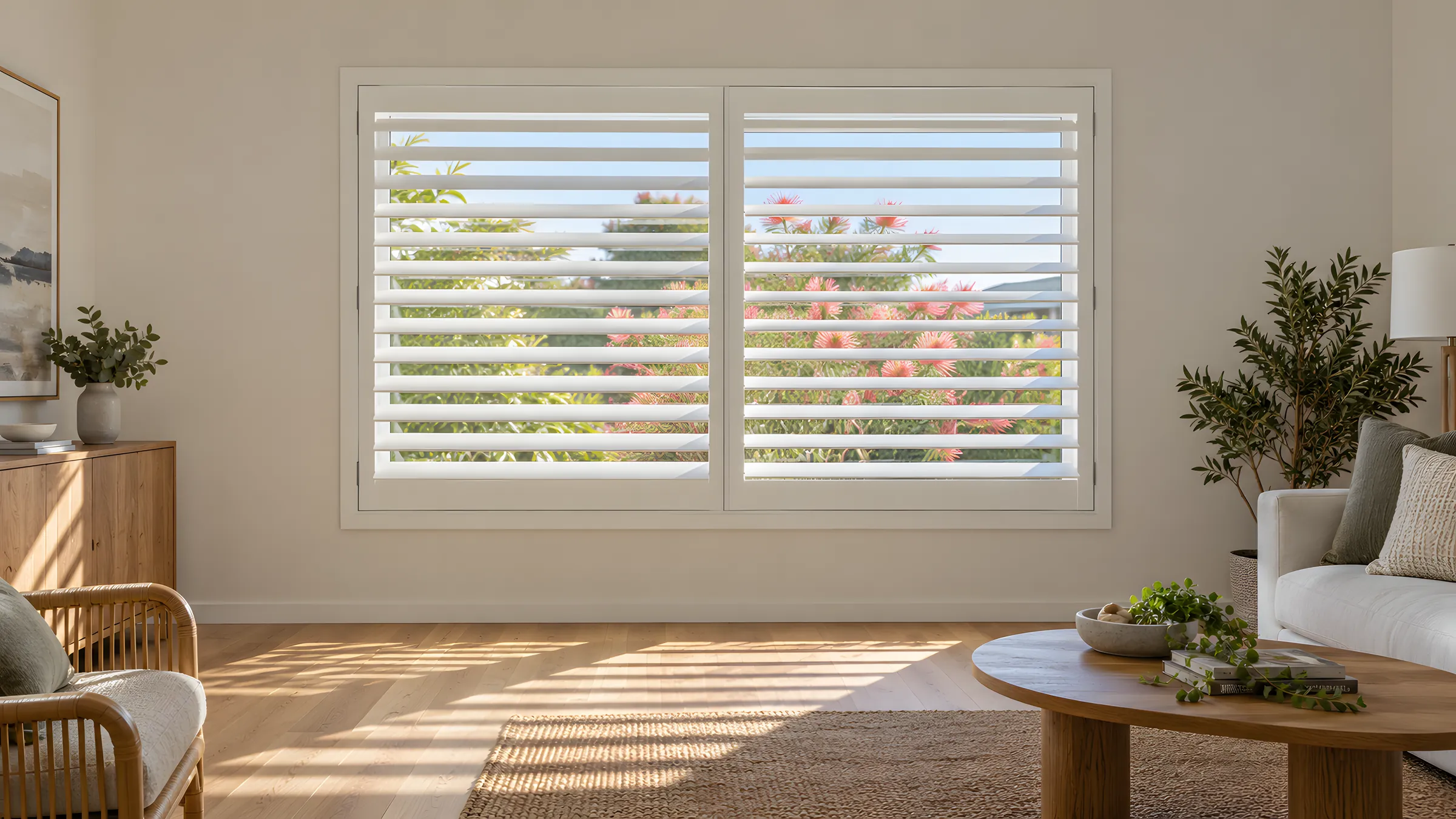
Plantation shutters are framed window panels with wide, tilting blades. You angle the blades to control light, privacy and airflow, and swing the panels open when you want the window itself. This plantation shutters guide explains how they work, what they are made of, how frames and panels are planned, and what to check before you order made-to-measure shutters online.
In short
- A plantation shutter is a set of hinged panels of tilting blades in a frame. It stays fitted in the window rather than lifting or rolling away.
- We make two materials: PVC (aluminium-reinforced polymer) for kitchens, bathrooms and laundries, and timber (paulownia) for dry rooms where you want visible grain or a stain.
- Choose the frame first: inside Z-frame, inside L-frame or outside L-frame. It decides the depth you need and how the shutter sits in the window.
- Tilting the blades gives fine control of light. Where a bedroom needs to be very dark, add a blockout blind or curtains.
- Every shutter is made to your measurements, so measure carefully. Expert Review is a paid check where the team looks over your photos and measurements before production.
What are plantation shutters?
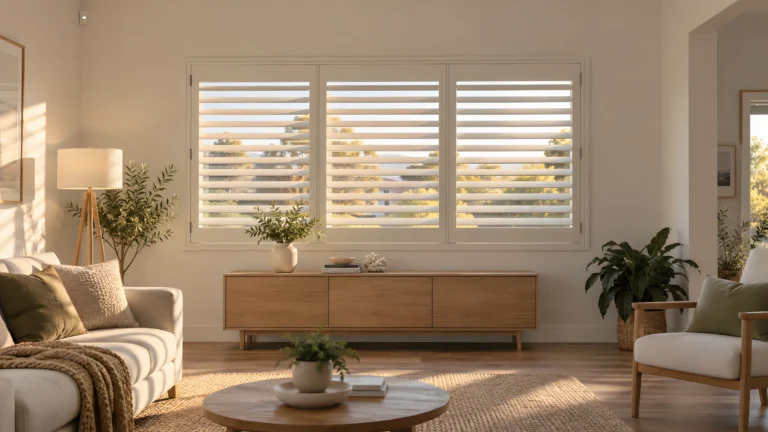
A plantation shutter is a set of hinged panels fitted inside a frame that sits in or around your window opening. Each panel holds a row of wide, horizontal blades (also called louvres or slats) that tilt together. The blades are generally wider than the slats of a venetian blind, which gives shutters their solid, architectural look and lets more of the view through when they are open.
Unlike a blind, a shutter does not lift, roll or stack away. It stays in the window as a fitted feature. You use it in two ways: tilt the blades to adjust light, privacy and airflow, or swing the panels open to reach the window, the handle or the view.
Because a shutter is rigid and framed, it has to be made to a specific size. That is why every shutter we sell is made to your measurements, and why measuring carefully matters more than it does with a fabric blind.
Why are they called plantation shutters?
The name is usually traced to the large plantation houses of the American South, where wide-bladed wooden shutters shaded rooms and let air move through in hot, humid weather. The exact history is debated, and the name now simply describes a style: wide blades in a hinged, framed panel. It says nothing about the material a shutter is made from or where it is used.
How do plantation shutters work?
Every plantation shutter is built from the same handful of parts, and knowing them makes the ordering options easier to follow.
| Part | What it does |
|---|---|
| Frame | Holds the shutter in your window opening (inside frames) or on the wall or trim around it (outside frame). |
| Panels | The hinged sections that swing open and closed. Hinges can be on the left or the right. |
| Blades | The horizontal louvres that tilt to let light in or close off the view. |
| Tilt mechanism | Links the blades in a panel so they move together. On our PVC shutters it is concealed. |
| T-post | A vertical post between panels that lets you decide where the panel joins fall. |
| Midrail | A horizontal rail across a panel. Up to two can be added. |
| D-mould | An overlap lip on the panel edge that blocks the view through the gap between panels. It is standard on every panel we make, at no extra charge. |
Day to day, a shutter takes two movements. Tilt the blades open to let daylight in and see out, or close them for privacy. When you need to open the window, clean the glass or get to a handle, swing the panel open on its hinges.
Panel size is limited. A single panel is about 900 mm wide at most, and an opening wider than about 950 mm needs more than one panel. A 1,500 mm window, for example, is normally divided into at least two panels, with the join falling where you choose.
What are plantation shutters made of?
We make plantation shutters in two materials. Both use the same frame options and panel layouts, so the choice comes down to the room and the finish you want.
| PVC | Timber | |
|---|---|---|
| Material | Aluminium-reinforced polymer | Paulownia, a light timber |
| Finish | Painted, with a VOC-free painted finish | Stained or painted, with the grain visible when stained |
| Colours | Glacial White, Shell, Antique | Timber sample names include Blanc, Natural, Walnut, Cordovan, Storm and Grey |
| Wet areas | Suits kitchens, bathrooms and laundries | Check the care needs before using it in humid rooms |
PVC is a waterproof material, which is why it is the one we point to for kitchens, bathrooms and laundries. The complete shutter is still an interior product: keep the hinges and metal parts dry, keep it out of continual direct soaking, and keep it clear of cooking heat.
Timber is the material to consider when you want a visible grain or a stained finish. You can also have timber painted. If you want plain white and the room is humid, PVC is usually the simpler choice. Our guide to PVC or timber plantation shutters compares them room by room, and the product pages for timber plantation shutters and PVC plantation shutters show the current finishes.
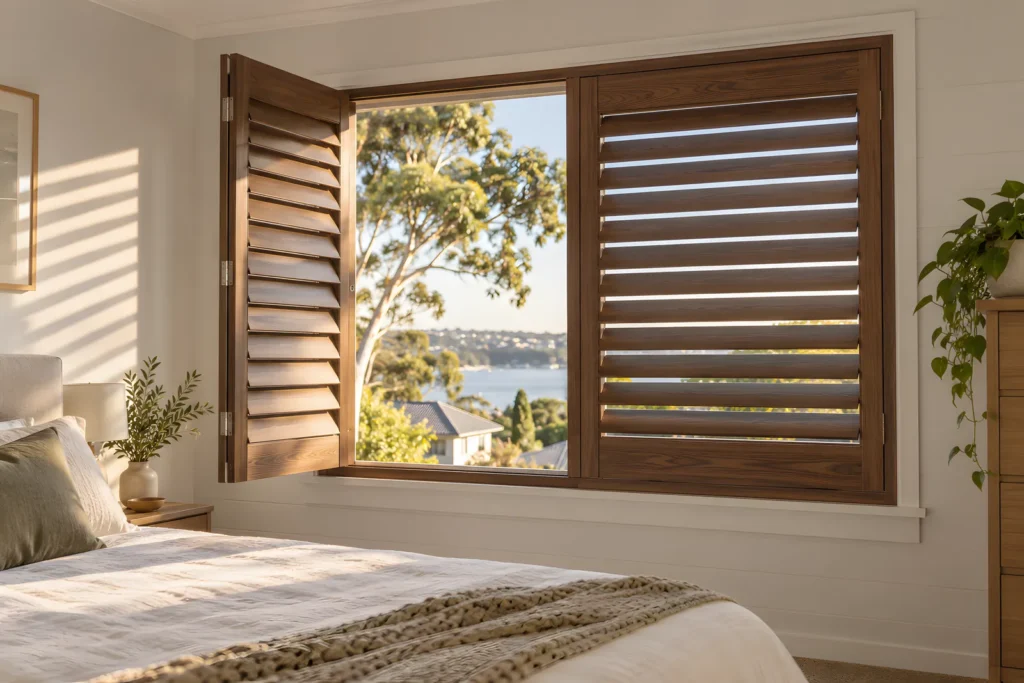
Tip: Finishes look different on a screen than on a wall. Order free samples and look at them in the room, in morning and evening light, against your walls, floor and window frame.
Frame types: Z frame vs L frame, inside vs outside mount
The frame decides how deep the shutter is and how it sits in the window, so settle it window by window before you configure your order. We offer three: an inside Z-frame, an inside L-frame and an outside L-frame. The two inside frames are an inside mount, fitted within the recess. The outside L-frame is an outside mount, fixed to the face of the wall or trim. (Recess fit and face fit mean the same as inside and outside mount.)
| Frame | Where it sits | Depth it needs | Good to know |
|---|---|---|---|
| Inside Z-frame | Inside the recess, with a front lip | Blades need 60 mm of clear depth | Copes with more variation in the opening than an inside L-frame |
| Inside L-frame | Inside the recess | Blades need 70 mm of clear depth | A neat fit within the recess, but the least forgiving of an uneven opening |
| Outside L-frame | On the face of the wall or trim (face mount) | About 65 mm projection into the room | Suits windows without enough recess depth, or with obstructions |
Z frame vs L frame
Both inside frames sit in the recess, so the difference comes down to depth and how forgiving each is of an uneven opening.
- Inside Z-frame. It has a front lip, and the blades need 60 mm of clear depth. It copes with more variation in the opening than an inside L-frame, up to 12 mm.
- Inside L-frame. It needs 70 mm of clear depth and gives a neat fit within the recess, but it is the least forgiving. More than 6 mm of variation in the opening rules it out.
If the recess is a little shallow or the opening is not quite square, the Z-frame is the inside frame to look at first.
Inside vs outside mount
An inside mount keeps the shutter within the reveal and looks neat, but it needs enough clear depth and a reasonably square opening.
An outside mount, the outside L-frame, sits on the face of the wall or trim and projects about 65 mm into the room. It suits windows without enough recess depth or with obstructions in the recess, and it is the option left when the variation across an opening is more than 12 mm.
How to choose a frame
Four checks decide the frame for each window:
- Clear depth. How much room is there from the front of the recess to the nearest obstruction, such as a handle or winder?
- Variation. More than 6 mm of variation rules out an inside L-frame, and more than 12 mm rules out a Z-frame.
- Obstructions. Choose the outside L-frame when an obstruction sits in the recess or the depth is under 60 mm.
- Photos when in doubt. An Expert Review check is worth considering on older homes or renovated windows.
Our guide to shutter frame types explains each frame in full, and the measuring guide in step 3 below shows how to measure for each one.
Panels, T-posts and layout
Layout is where a shutter looks either designed or accidental, so plan it around the window rather than leaving it to a default.
- Panel width. Keep each panel to about 900 mm at most. Anything over about 950 mm needs multiple panels.
- T-posts. You choose their positions. Line them up with the window's own divisions, such as a mullion or glazing bar, so the joins in the shutter follow the lines behind it.
- Midrails. Up to two can be added to a panel. They are useful on tall windows and where you want a horizontal line to match part of the window.
- Hinges. Choose left or right so panels open towards where you have space, and away from furniture, a door or a tap.
- Bay and corner windows. Bay (45 degree) and corner (90 degree) shutters are confirmed with our team before manufacture, so send photos and measurements early.
What we make
Our shutters are hinged panels. Sliding, bifold and track shutters, French-door cutout shutters and shaped shutters are not available yet. For sliding and French doors, blinds and curtains are the better fit: see blinds for sliding doors and blinds for French doors.
Which rooms suit plantation shutters?
Shutters work in most rooms, but the material should follow the room:
| Room | Material to lean towards | What to check |
|---|---|---|
| Kitchen | PVC | Clearance to taps and handles, and distance from cooking heat |
| Bathroom | PVC | Keep hinges and metal parts dry; not for continual direct soaking |
| Laundry | PVC | The same care as a bathroom |
| Bedroom | PVC or timber | Timber for visible grain or a stain, PVC for plain white; the hinge side against furniture |
| Living and dining | PVC or timber | A panel layout that lines up with the window's divisions |
Our kitchen blinds page shows how shutters sit alongside the other waterproof options for kitchen windows.
Light, privacy, heat and noise
The blades give you fine control over daylight. Tilt them partly closed to soften glare while keeping some view, or close them for privacy. The D-mould on each panel stops people seeing through the gap between panels.
Shutters are not blackout: light shows around the blades and at the edges, so a bedroom that needs to be as dark as possible works best with a blockout blind or curtains as well. For what to expect on light, heat and noise, read do plantation shutters block light, heat and noise.
How shutters compare with blinds and curtains
Shutters are one option among several, and the best window often mixes coverings. This table shows where each is strongest.
| Plantation shutters | Roller blinds | Venetian blinds | Curtains | |
|---|---|---|---|---|
| Strongest at | Fine light control, a fitted look, wet rooms in PVC | A clean look and a choice of blockout, light filter or SunScreen fabric | Tilting for light and lifting for the view; fauxwood and aluminium suit wet rooms | Softness, and darker rooms when blockout or lined |
| Watch out for | Needs recess depth or projection | Small light gaps at the edges | Light shows between slats and at the edges | Not used in kitchens; needs room to stack back |
Is a plantation shutter right for you?
Shutters suit you if you want a solid, fitted look, fine control of light and privacy, and a covering for wet rooms that does not rely on fabric. They also suit anyone who would rather not have a chain or cord to manage.
Look at blinds or curtains instead, or as well, if you need a very dark room, have very wide openings, or have a window recess that is too shallow for a frame. Our comparison of plantation shutters vs blinds walks through the trade-offs room by room, and are plantation shutters worth it covers value and lifespan.
Plantation shutters guide to measuring, ordering and installing
You measure and install, and we deliver the shutters with practical guidance and support. The steps follow the same order as the rest of our range: decide, sample, measure, order, install. Only our official guides give the measuring and fitting instructions.
- Decide on material and frame for each room, using the sections above.
- Sample. Order samples and check the finish in your own light.
- Measure with our plantation shutters measuring guide, and use the shutter guide for bay windows, corner windows and out-of-square openings. Measure one window at a time and label each.
- Order. Enter your measurements in the shutter configurator to see the price. Ordering then runs through a quote and Expert Review, where you share window photos and measurements and the team checks fit, clearances and panel layout before production and talks through any changes.
- Install. Shutters arrive as bulky, separately packaged frames and panels, and the delivery amount is shown for your actual order. Follow our plantation shutters installation guide for the fitting.
Expert Review, SureFit and price
Two services support the process. Expert Review is a paid check by the team before production; the alternative is a self review, where you check your own figures against the guide. SureFit is a separate measurement protection: it applies when you follow the product guide and meet its eligibility requirements, and if a covered measuring error occurs it provides a defined remake pathway. It has its own conditions and is separate from the product-defect warranty. Read the warranty and SureFit page before you order.
Price depends mainly on window size, material, frame and panel layout. We explain each driver in how much plantation shutters cost. Spend & Save discounts apply automatically on eligible orders, and you can check the current terms on the Spend & Save page.
Tip: Take photos of each window straight on and from the side, showing the handle, the trim and the depth of the recess. Clear photos make it much easier for the team to spot a clearance problem before it becomes a remake.
Caring for shutters and avoiding common mistakes
Caring for plantation shutters
Shutters are easy to live with, but a few habits protect the finish and the hardware.
- Dust the blades regularly with a soft cloth or duster, working along the blades.
- Wipe marks with a lightly damp cloth and dry the surface afterwards. Avoid soaking, and test any cleaner on a hidden spot first.
- On PVC shutters, keep hinges and other metal parts dry, especially in bathrooms and laundries.
- Handle the blades and tilt mechanism gently rather than forcing a stiff panel.
Our step-by-step guide to cleaning plantation shutters covers PVC and timber in more detail.
Mistakes to avoid
- Choosing timber for a steamy room. Use PVC in bathrooms, laundries and kitchens, and check timber care needs before using it anywhere humid.
- Using a generic measuring method. Measure with our official shutter guides, because the method differs by frame and window type.
- Ignoring what sits in the recess. Window handles, winders and blind or curtain hardware can foul the blades, so check the clear depth against the frame you choose.
- Ignoring the window's own lines. Put T-posts and midrails where they echo the glazing bars, not where they cut across them.
- Forgetting swing space. Panels open into the room, so check the hinge side against furniture, doors and taps.
- Skipping photos on unusual windows. Bay, corner and out-of-square openings are where a second pair of eyes helps most.
Questions
What are plantation shutters made of?
We make them in PVC, an aluminium-reinforced polymer with a painted finish, and in timber, which is paulownia. PVC suits kitchens, bathrooms and laundries, and timber suits dry rooms where you want visible grain or a stain.
Why are they called plantation shutters?
The name is usually traced to the large plantation houses of the American South, where wide-bladed wooden shutters shaded and ventilated the rooms. Today it simply describes the style: wide blades in a hinged, framed panel.
Do plantation shutters block out light?
They control light very well by tilting the blades, but they are not blackout. Some light will show around the blades and the edges, so add a blockout blind or curtain if the room needs to be as dark as possible.
Can I install plantation shutters myself?
Yes. You measure and install, and we deliver the shutters with practical guidance and support. Follow the official shutter installation guide closely, because the shutters are made exactly to your measurements.
Are plantation shutters suitable for bathrooms?
PVC plantation shutters are a good fit for bathrooms because the material is waterproof. They are for interior use only, so keep them out of continual direct soaking and keep the hinges and metal parts dry.
Price your plantation shutters
Enter your measurements in the shutter configurator and see the price before you order.
Keep reading
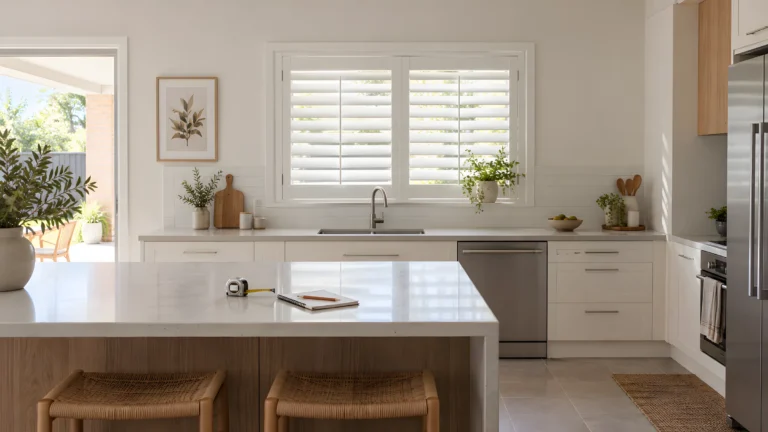 Plantation shuttersHow much do plantation shutters cost? What sets the priceThere is no single price per window. Here is what sets the cost of plantation shutters and how to price your own home, window by window.
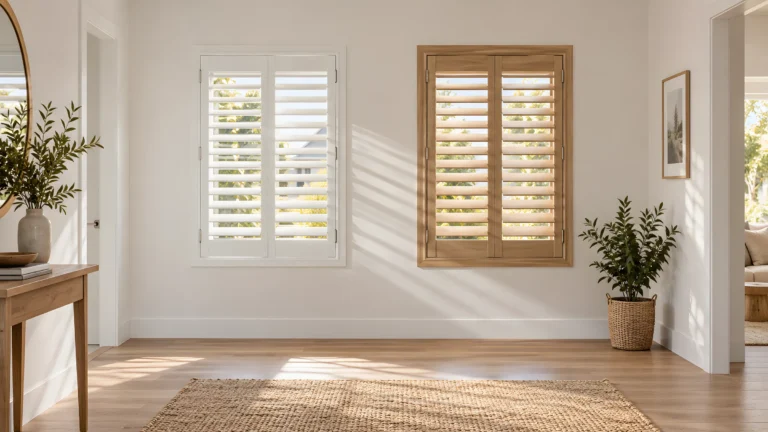 Plantation shuttersPVC or timber plantation shutters: which suits your room?PVC suits wet rooms and painted finishes, while timber suits dry rooms where you want grain or a stain. Compare the two room by room.
 Plantation shuttersAre plantation shutters worth it? Value, lifespan and resalePlantation shutters suit some windows far better than others. Weigh where they earn their keep, how long they last and what to check before you buy.