
How to hem or shorten curtains (with or without sewing)
Hem curtains with tape or by sewing, shorten them from the top, and treat sheers and coated blockout with care. Plus how made-to-measure curtains skip the job.
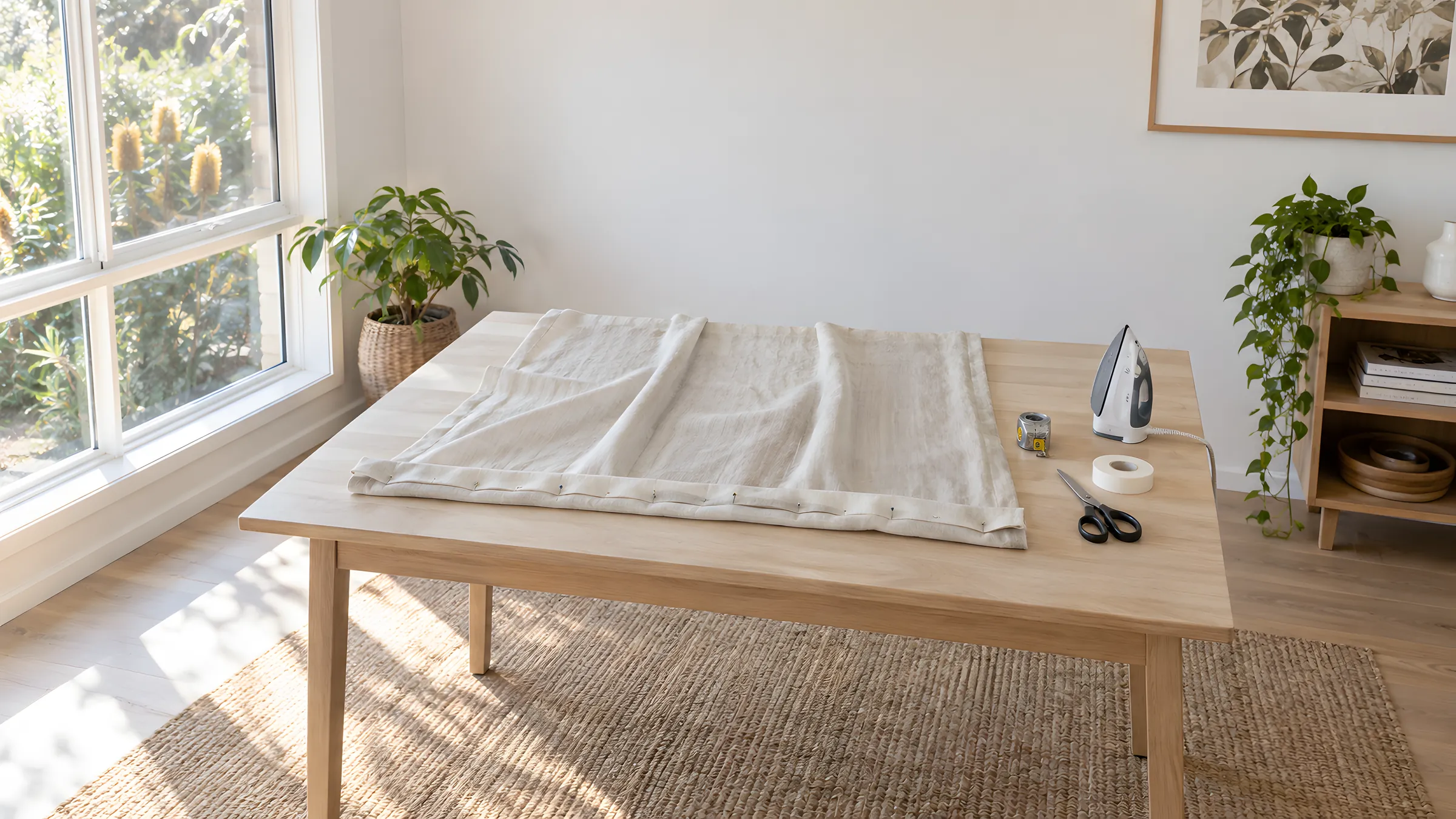
To hem curtains, hang them first to find the finished length, mark the new bottom edge, then fold the extra up into a double hem and fix it with hemming tape or stitches. Tape is quick and needs no sewing. A sewn hem is stronger and kinder to fine fabric. Sheers and coated blockout need extra care, and curtains made to measure arrive at your drop, so there is nothing to hem.
In short
- Hang the curtains and mark the length first. Never hem a curtain while it is lying flat and you are guessing the length.
- Hemming tape needs no sewing but needs an iron. Test it on an offcut, because heat can mark delicate or coated fabric.
- A double-turn sewn hem is the sturdier option, and the best choice for sheers.
- Coated blockout is the hardest fabric to alter. Iron the fabric side only, and avoid pin holes where you can.
- Made-to-measure curtains are made to the drop you give, with the hem allowed for.
Decide the finished length first
The most common hemming mistake is cutting or folding before the length is settled. Hang the curtains from the track with all the hooks in, let them settle for a day or two, then mark the length.
Pick the finish you want before you mark it:
| Finish | Where the curtain ends | Notes |
|---|---|---|
| Just off the floor | 5 to 10 mm short of the floor | Keeps the hem clear of dust, a practical choice with children, pets and hard floors |
| Touching | Skims the floor, up to 5 mm | A tailored look, with no gap at the bottom |
| Puddled | About 20 mm of extra fabric on the floor | Suits soft fabrics and hides a floor that is slightly uneven |
These are the three finishes we use on made-to-measure curtains, and they are good targets for a home hem as well. Check the floor at several points along the window. If the gap varies by more than 10 mm, a puddled finish hides it better than a precise hem.
Then add the hem. A double-turn hem uses the folded depth twice, so the fabric you fold up is twice the finished hem depth. Match the depth of the existing hem if you want the curtain to look the same.
What you need
- A metal tape measure and a long straight edge
- Dressmaker's pins or clips, and chalk or removable marker
- Sharp fabric scissors
- An iron and ironing board, or a clean towel on a table
- Hemming tape, or a needle and matching thread, or a sewing machine
- A spare offcut or a hidden corner to test on
Read the care label before you start. It tells you how hot the fabric can be pressed, and whether it can be washed. Anything you plan to wash should be washed once before hemming, because it may shrink.
How to hem curtains without sewing
Curtain hemming tape is a thin strip of fusible adhesive that bonds the folded hem when heat is applied. It is the quickest option and suits many medium-weight fabrics.
- Mark the finished length. Pin or chalk the hem line across the curtain at the length you chose.
- Deal with the excess. Either cut it off, leaving enough to turn a double hem, or fold the extra length up behind the curtain at the hem depth you want.
- Press the fold. Use the iron setting the care label allows, and press the fold flat before the tape goes in.
- Place the tape. Slip the hemming tape between the layers along the whole width, a little way in from the fold.
- Bond the hem. Press with the iron, following the instructions on the tape for heat, steam and time. Work in sections and let each one cool.
- Check the bond. Gently pull the hem apart at the corners. If it lifts, press again.
Hemming tape suits curtains you will rarely wash. If you wash often, a sewn hem lasts better. Tape that uses no iron, such as self-adhesive tape or fabric glue, is an option, but it is generally less durable.
Always test first. Heat-activated tape needs more heat than some synthetic fabrics can take. Test it on an offcut or a hidden corner for marks, shine and a firm bond before you tape the whole hem.
How to hem or shorten curtains by sewing
A sewn double-turn hem is the standard finish, and it works for most fabrics.
- Take the curtains down and lay them flat on a table or the floor.
- Remove the old hem if you are shortening, by unpicking the stitches and pressing the fold out.
- Mark the new hem line straight across the curtain, using the length you chose.
- Fold the edge up to the line, then fold it again to enclose the raw edge, as the diagram shows. Pin or clip the fold every 10 cm or so.
- Press the fold with the iron on a suitable setting.
- Stitch the hem. Use a hand slip stitch for an invisible finish, or a straight machine stitch close to the top of the fold.
- Press again and rehang the curtains. Check that the bottom edge is level across the window.
For lined curtains, hem the outer fabric and the lining as separate layers. The lining normally sits slightly above the outer fabric's bottom edge, so it does not show.
Shortening curtains from the top
Sometimes you can shorten curtains without a hem at all.
- Raise the hooks. If the curtains hang from hooks in a heading tape with more than one row of pockets, you may be able to move the hooks into the higher row.
- Move the track. A curtain track fixed a little higher or lower changes the finished length. This only suits a window where the track position is flexible.
Both options leave the fabric uncut, which keeps your choices open if you move house.
How to hem sheer curtains
Sheers are fine and light, so they need a gentle hand.
- Use a fine needle and fine thread to avoid puckering the fabric.
- Sew a narrow double hem. A deep, bulky hem looks heavy on a light curtain.
- Pin at right angles to the hem. Check that the edge is straight, since a crooked edge shows against the window.
- Press at a low heat. Our sheers take a warm iron, no hotter than 150°C. For any other sheer, check the care label.
- Keep any weights. Many sheers have a weighted hem or small weights in the bottom edge. Move them with the hem so the curtain still hangs straight.
Iron-on tape can be a poor match for delicate synthetic sheers, so test it or sew instead. Our sheer curtains are made to your drop, so they arrive hemmed to the length you ordered.
Hemming blockout and coated curtains
Coated blockout is the hardest fabric to alter at home. The coating is what stops light passing through the cloth, and it does not like heat or holes.
- Iron the fabric side only, never the coated side.
- Use clips instead of pins where you can. A pin hole in coated fabric can let a pinprick of light through.
- Test any tape on an offcut, since it may not bond to the coating.
- Sew rather than iron when the fabric allows it, using a needle suited to heavier fabric.
- Allow for shrinkage. Our blockout fabrics can shrink by up to 3% after cleaning, so do not hem them so close to the floor that a wash leaves them short.
If a blockout curtain is much too long or too short, ordering blockout curtains to the right drop is often easier than altering the original.
Mistakes to avoid
- Marking the length while the curtain is lying flat, rather than hanging.
- Cutting before you have pressed the fold and double-checked the measurement.
- Using an iron that is too hot for the fabric.
- Forgetting that a floor can be slightly uneven. Measure the drop in several places.
- Hemming a curtain you will later wash without washing it first.
Tip: Mark the hem line with pins, then step back and look at the curtain from across the room. Fix any wobble in the line before you cut, fold or stitch.
When made to measure saves the hem
Made-to-measure curtains are cut to a drop you supply. You do not add extra length for the hem, because the hem is allowed for when the curtain is made. In the configurator, you enter the track width and drop that our curtains measuring guide tells you to record, then choose the finish: just off the floor, touching or puddled. The curtain size guide explains how width, fullness and length work together, and you can build a pair in the curtain builder and see the price before you order.
Questions
How do you hem curtains without sewing?
Use hemming tape. Fold the hem up, place the tape between the layers and press it with an iron following the tape's instructions. Test on an offcut first, because heat can mark delicate or coated fabric.
How do you shorten curtains without cutting them?
Fold the extra length up into a hem and secure it with tape or stitches, or raise the hooks into a higher row of the heading tape if yours has more than one. Keep the fabric uncut so the length can be restored.
Can you hem sheer curtains?
Yes, with a narrow double hem sewn with a fine needle and thread. Iron-on tape can mark delicate sheers, so test it first or sew instead. Keep any weights at the new bottom edge.
Can you hem blockout curtains?
Yes, but coated blockout is harder to work with. Iron only the fabric side, never the coated side, and use clips rather than pins where you can, because needle holes can let light through.
Do made-to-measure curtains need hemming?
No. Give the drop you measured and the curtain is made to that length, with the hem allowed for, so you do not add extra for it.
Order curtains made to your drop
Enter your track width and drop in the configurator, choose your fabric and see the price before you order.
Keep reading
 Measuring & fittingCurtain size guide: length, width and height to chooseHow long, wide and high curtains should be, with the three floor finishes, how wide to make the track and how much wall to leave for the stack.
 CurtainsCurtain fabrics explained: sheer, blockout and linen-lookOur sheers are linen-look polyester and our blockouts are coated fabrics. Here is what each does, how to care for it and how to choose.
 CurtainsFloor-to-ceiling curtains: how to plan ceiling-fixed tracksHow to plan floor-to-ceiling curtains on a ceiling-fixed track, from cornices and fixings to the finish at the floor, choosing sheers and which guides to follow.