
Curtain fabrics explained: sheer, blockout and linen-look
Our sheers are linen-look polyester and our blockouts are coated fabrics. Here is what each does, how to care for it and how to choose.

Our curtain material comes in two families: sheers for soft daylight and blockouts for privacy and a darker room. The three sheers, Cassis, Cassis Volume and Bali, are linen-look polyester rather than linen, and the two blockouts, Galaxy and Epic, are coated fabrics. Choosing between them comes down to what the room needs at night, how much daylight you want by day, and how you plan to clean them.
In short
- Two families: sheers (Cassis, Cassis Volume, Bali) and blockouts (Galaxy, Epic).
- The sheers are linen-look polyester: they have the texture of linen, but they are not linen.
- A sheer softens daylight and gives some privacy by day, but not at night with the lights on. A blockout is opaque.
- Care differs. Sheers are hand wash only, and blockouts are not for the washing machine.
- Order free samples and judge colour and texture in your own light.
Curtain material at a glance
| Fabric | Type | Character | Colours |
|---|---|---|---|
| Cassis | Sheer | Linen-look polyester with a soft natural texture, in warm neutrals | Sand, Linen, Fawn, Pewter |
| Cassis Volume | Sheer | The same sheer in whites and greys | Snow, Pearl, Driftwood, Silver, Ash, Charcoal |
| Bali | Sheer | Our lightest linen-look sheer | Blush, Cobblestone, Gardenia, Onyx, Pearl, Smoke, Snow, Taupe, Black, Thunder, Ash |
| Epic | Blockout | Three-pass coated, opaque | Chalk, Cloud, Smoke, Putty, Pewter, Cobblestone, Ash, Ebony |
| Galaxy | Blockout | Our heaviest fabric, coated and opaque | Mars, Earth, Comet, Mercury, Luna, Venus, Pluto, Twilight, Halley, Saturn, Neutron, Dusk, Aurora, Nebula, Bianca |
In Cassis Linen, "Linen" is a colour name only. Sheers outsell blockouts roughly three to one, so many people start with the sheer and add a blockout only where privacy or darkness matters.
Sheer curtain fabrics: Cassis, Cassis Volume and Bali
A sheer lets daylight through the cloth, softens glare and gives some privacy by day. At night with the lights on, people outside can see in, so a sheer on its own is not a night-privacy fabric. If you want that, add a blockout on a second track (double curtains) or choose lined curtains, both covered below.
All three are linen-look polyester, but they differ:
- Cassis has a soft, natural texture and warm neutrals: Sand, Linen, Fawn and Pewter.
- Cassis Volume is the same sheer in whites and greys, from Snow and Pearl to Ash and Charcoal.
- Bali is the lightest of the three. Its eleven colours run from Snow, Pearl and Gardenia through Blush and Taupe to Onyx and Black.
Which suits you depends on the walls and floor around it. Warm timber and cream walls often sit well with Cassis, while cool white and grey schemes suit Cassis Volume. If you want the airiest look, or a darker sheer, start with Bali. Our sheer curtains page shows all of them, and sheer curtain ideas shows how they look in different rooms.
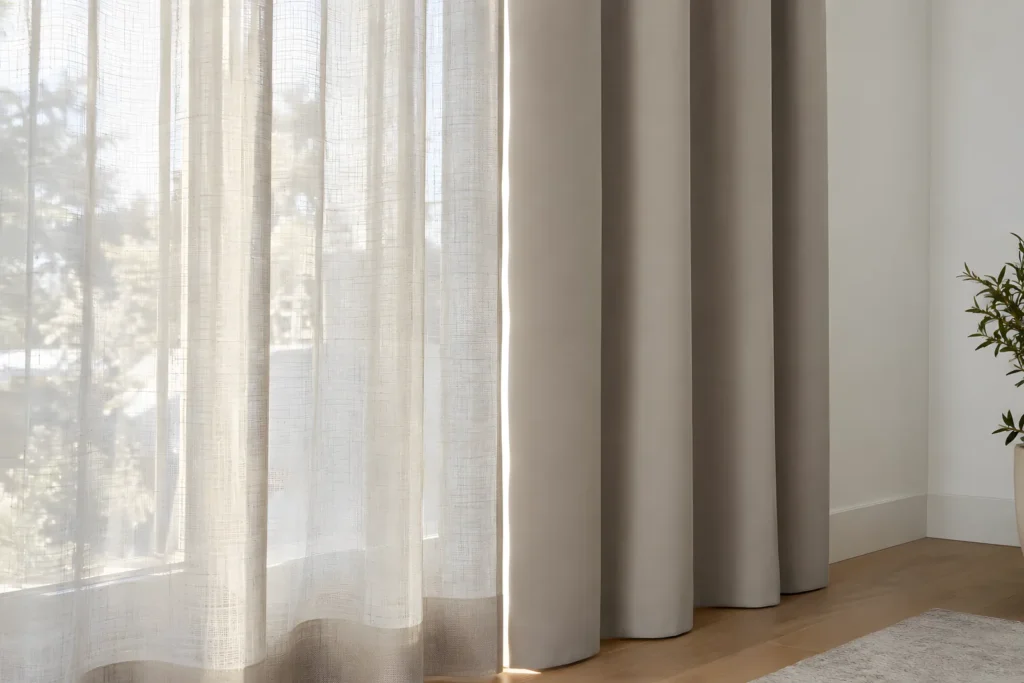
Blockout curtain fabrics: Galaxy and Epic
Blockout fabrics are coated so no light passes through the cloth, and they give you night privacy when closed. Many people search for them as blackout, and it means the same thing. A little light can still show at the edges, top and bottom.
- Epic is a three-pass coated fabric in eight colours, from Chalk and Cloud through Putty and Pewter to Ebony.
- Galaxy is our heaviest fabric and has the widest colour choice, fifteen colours with names taken mostly from the night sky.
Both have a white backing. If the weight of the curtain matters to you, ask for free samples and compare them in your hand. Details of the range are on our blockout curtains page.
Polyester vs linen: what linen-look means
Our sheers are polyester, woven and finished to have the soft, natural texture people like about linen. Here is how the two generally compare:
| Real linen | Linen-look polyester | |
|---|---|---|
| Fibre | Natural, made from flax | Synthetic |
| Creasing | Creases easily, which many people like | Generally holds its shape and creases less |
| Shrinking | Can shrink when washed | Generally more stable, but always follow the care label |
| Sunlight | Natural fibres can weaken and fade in strong sun over time | Generally copes well with sun |
| Look | Slubby, uneven natural texture | Designed to look similar, with a soft natural texture |
Treat this as general guidance and rely on the care instructions for your fabric. You get the look of linen with the practicality of polyester, though not the exact feel of natural linen, which is why samples are worth ordering.
Lined and double curtains: combining fabrics
You can combine the two families on a single window. Both options are covered in our article on lined or unlined curtains:
- Lined curtains have a blockout lining sewn behind a sheer, so the two move together on one track. See lined curtains.
- Double curtains use two tracks, with the sheer at the front and the blockout at the rear, drawn separately. See double curtains. They project about 220 to 250 mm from the wall, so plan for that.
Kitchens are the exception: curtains are not used there, so look at our kitchen blinds instead.
How to choose curtain fabric
- Start with night-time. Do you need privacy or a darker room? If yes, you need a blockout layer, either on its own, as a lining or as a rear curtain.
- Think about daytime. Do you want soft light, a view and some privacy? A sheer is the answer. A sheer on its own is fine for a living room where the blinds handle night privacy.
- Pick a texture and weight. Sheers are light and soft. Blockouts are heavier. Compare them in your hands.
- Choose colours with samples. Look at samples in morning and evening light, and hold them against your walls, floor and window frame. For double curtains, order both fabrics and hold them together.
- Check the care. Both families need gentle care, as the next section shows.
- Choose the heading. S Fold, pencil pleat and pinch pleat headings are available across both the sheers and the blockouts. Each heading changes how the fabric falls, so it is worth choosing the fabric and heading together.
What to check when your samples arrive
Samples are free, and they are the fastest way to avoid a disappointing colour. When they arrive:
- Hold each one up to the window, then step back and look at it from inside the room, where you will really see it.
- Look again in the evening with lamps on. Sheers change a lot between daylight and lamp light.
- Hold it against your wall colour, floor and window frame. Whites and greys vary in warmth, and the difference shows next to trim.
- For a blockout, hold the sample to a bright window. No light should pass through the cloth.
- Gather a corner in your hand to see how the fabric falls when it is pleated or folded.
Room by room
| Room or window | Where to start |
|---|---|
| Bedroom | A blockout fabric, lined curtains, or double curtains if you also want the sheer by day |
| Living room | A sheer for daylight, or double curtains to add a blockout layer for evenings |
| Dining room | Lined curtains |
| Sliding doors and large windows | Sheers or double curtains, with wall space planned for the stack |
| Home theatre or media room | A blockout layer, on a ceiling-fit track |
Two practical points apply to every choice. A sheer moves easily in a draught and shows its texture in strong light, so it is worth seeing a sample lit from behind, in front of a window, rather than flat on a table. A blockout hangs more heavily and straighter, and its weight is worth planning for. Our curtains installation guide covers fixing the track.
Caring for each fabric
| Fabric | Everyday care | Washing | Ironing |
|---|---|---|---|
| Sheers | Vacuum gently | Hand wash only in warm water. No bleach, rubbing or wringing. Drip dry by the hooks in the shade | Warm iron, under 150 °C |
| Blockouts | Dust or vacuum gently | Not in the washing machine. A professional wet clean is recommended, or hand wash at 40 °C at most. Do not tumble dry | Iron the fabric side only. Can shrink by up to 3 per cent |
Our guide on how to clean curtains the right way covers routine care and spot cleaning.
Check the care label first. Coated blockout fabrics mark easily, so test any cleaner on a hidden spot.
Questions
Are your curtains made from linen?
No. Our sheers, Cassis, Cassis Volume and Bali, are linen-look polyester. They have a soft natural texture but are not linen fabric.
What is the difference between sheer and blockout curtain fabric?
A sheer softens daylight and gives some privacy by day, but people outside can see in at night with the lights on. A blockout is coated so no light passes through the cloth, although some still enters at the edges, top and bottom.
Can I wash my curtains?
Sheers are hand wash only, in warm water, without bleach, rubbing or wringing. Blockout fabrics should not go in the washing machine, and a professional wet clean is recommended. Always check the care label first.
How do I choose curtain fabric?
Start with what the room needs at night, then how much daylight you want by day. Order free samples and look at them against your walls, floor and window frame in morning and evening light.
Compare curtain fabrics at home
Order free samples and see the colour and texture in your own light.
Keep reading
 CurtainsLined or unlined curtains: what a lining really doesOur lined curtains sew a blockout lining behind a sheer so both move together on one track. Here is how they compare with unlined and double curtains.
 CurtainsTypes of curtains: fabrics, headings and linings explainedEvery type of curtain we make, from sheer and blockout fabrics to lined and double layers, headings and tracks, with a room-by-room guide to choosing.
 Room ideasSheer curtain ideas for Australian homesPractical sheer curtain ideas for Australian homes: how to hang them, which colours to try, and how to get night privacy in a bedroom.