
Lined or unlined curtains: what a lining really does
Our lined curtains sew a blockout lining behind a sheer so both move together on one track. Here is how they compare with unlined and double curtains.
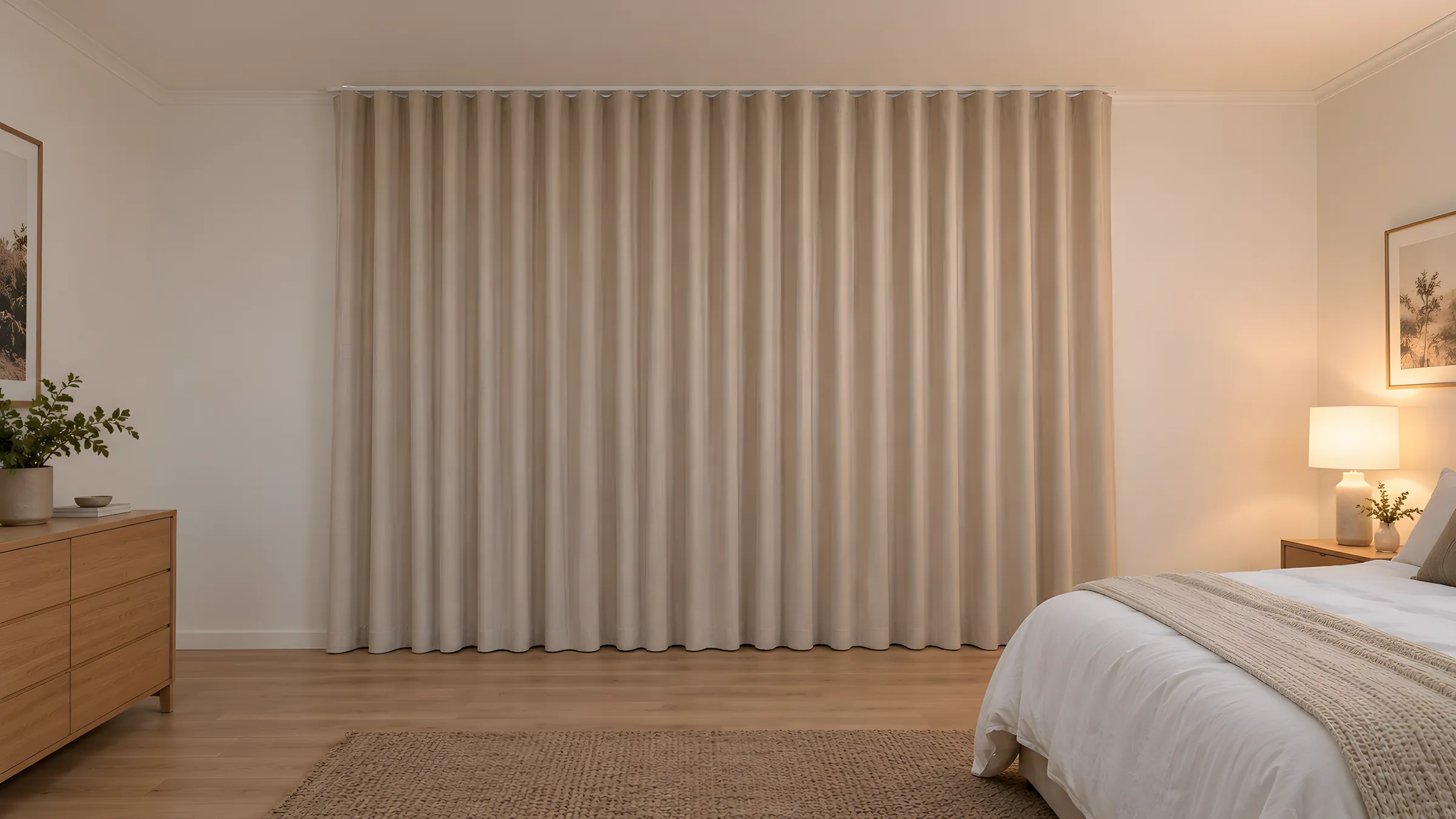
Lined curtains have a second layer of fabric sewn behind the main curtain. Ours pair a sheer with a blockout lining, so the two layers move together on one track and the closed curtain stops light passing through the cloth. Unlined curtains are a single layer, either a sheer for softness and daylight or a coated blockout that is opaque by itself.
In short
- Our lined curtains are a sheer with a blockout lining sewn behind it, on one track.
- The trade-off is that the layers move together, so you cannot draw the sheer on its own by day. Double curtains on two tracks can.
- A coated blockout curtain is already opaque and does not need a lining.
- Lined curtains are chosen for light control and drape, not as a soundproofing or insulation product.
- Lined curtains are cleaned as one piece, so follow the rules for the coated lining.
What lined curtains are and what a lining does
A lining is a second layer of fabric sewn behind the face fabric. It can block light, add weight so the curtain hangs and drapes better, and put a layer between the front fabric and the sun. On our lined curtains, the face is a sheer and the lining is a blockout, so the room side keeps the soft look of a sheer while the lining behind it does the blocking.
Blockout, which many people search for as blackout, means the fabric is coated so no light passes through the cloth. A little light can still show at the edges, top and bottom; a track set close to the ceiling, a track wider than the window and a drop that finishes near the floor all reduce it.
Without a lining, a single layer behaves as its own fabric allows. A sheer softens daylight and gives some privacy by day, but at night with the lights on people outside can see in. A coated blockout fabric is opaque on its own. That is why a lining only matters when you are starting from a sheer.
Lined, unlined or double: how they compare
| Unlined sheer | Unlined blockout | Lined curtain | Double curtains | |
|---|---|---|---|---|
| What it is | One layer of sheer | One layer of coated blockout (Galaxy or Epic) | Sheer face with a blockout lining sewn behind | A sheer and a blockout as two separate curtains |
| Tracks | One | One | One | Two |
| By day | Softens light and keeps some privacy | Blocks light through the cloth | Blocks light through the cloth | Draw the sheer alone for soft light |
| At night | Not private with lights on | Opaque when closed | Opaque when closed | Draw the blockout for privacy |
| Use the sheer alone | It is the only layer | Not applicable | No, the layers move together | Yes |
| Projection from the wall | One track | One track | One track | About 220 to 250 mm |
| Cleaning | Sheer rules | Coated rules | One piece, coated rules | Each layer by its own rules |
Double curtains sit on two tracks: blockout on the rear track and sheer at the front. If the projection matters, that 220 to 250 mm needs planning before you order. Our guide to how to layer sheer and blockout curtains explains the styling.
When lined curtains are the right choice
Lined curtains suit a room where you want daylight to be soft and night to be private, and you can do it all with one pull.
- Bedrooms and rooms you close up at night. The lining does the blocking whenever the curtain is closed.
- Limited wall space. One track keeps the projection small compared with double curtains.
- Simple operation. One track, one set of carriers or hooks, one wand.
- A sheer look from inside the room. The face is a sheer, so you see its texture and colour rather than the lining.
They are a poor match if you like to have the sheer closed on its own in the daytime. With lined curtains, closing them means closing the blockout too.
Room by room
| Room | What tends to work |
|---|---|
| Bedroom | Lined curtains if you close them every night. Double curtains if you also want the sheer alone by day |
| Dining room | Lined curtains are one of the options we suggest on our dining room blinds page, alongside SunScreen and double roller blinds |
| Living room and sliding doors | Double curtains or a sheer on its own, so you can control glare without losing the view |
| Home theatre or media room | A blockout layer, with the track fixed close to the ceiling to keep the top gap small |
| Kitchen | Not curtains. Fauxwood and aluminium venetians and PVC plantation shutters are waterproof choices, and roller blinds suit as long as they do not get drenched. See our kitchen blinds page |
Tip: If you are unsure, ask yourself whether you will ever want the sheer closed with the blockout open. If the answer is yes, choose double curtains.
When unlined or double curtains suit better
Unlined sheers suit rooms where the priority is daylight, view and a soft finish. Sheers outsell blockout curtains roughly three to one for us, so for many rooms the sheer is the main event and the blockout is the add-on. Browse sheer curtains if that sounds like your room.
Unlined blockout curtains suit a room where you want a single opaque layer with the colour on the face. Blockout curtains come in Galaxy, our heaviest coated fabric, and Epic, a three-pass coated fabric. Both have a white backing and are opaque without a lining.
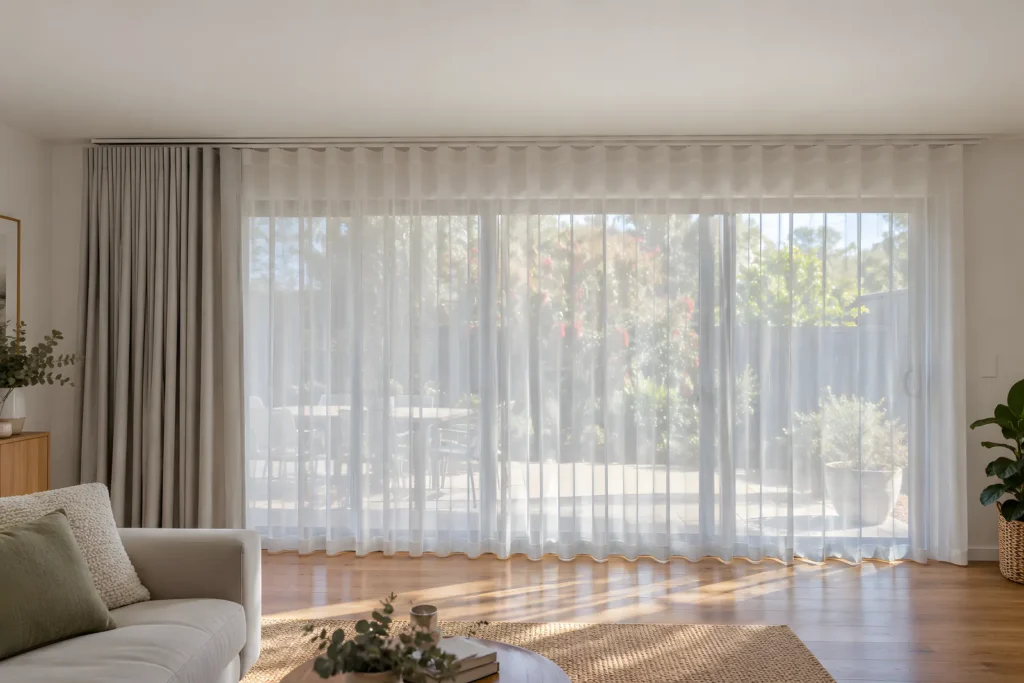
Double curtains suit living areas, sliding doors and any window where you want the sheer alone in the day and the blockout added on demand. See double curtains for the options.
Do lined curtains insulate or reduce noise?
Any extra layer of fabric between you and the glass adds a little comfort. Lined curtains are chosen for light control and drape, so treat any warmth or quiet as a bonus.
If that is your main goal, the right questions are about the whole window: the fit, how full the curtain is, how close it hangs to the ceiling and floor, and whether you add a blind. Our article on thermal curtains and insulating blinds covers those questions.
How to choose the right lining
With us, the lining is a blockout lining, so the decision is whether you want a lining at all rather than which type to pick. Work through it in order:
- Decide what the room needs at night. If you need privacy or a darker room, you need a blockout layer somewhere.
- Decide whether you will ever want the sheer alone. If yes, choose double curtains. If no, lined curtains cover it.
- Check the wall space. One track keeps the projection small. Two tracks project about 220 to 250 mm, and a built-in pelmet cavity needs about 250 mm of depth.
- Test the colour. Order free samples and view them against your walls, floor and window frame in morning and evening light. For double curtains, order both fabrics and hold them together.
- Measure with the official guide. Lined curtains use one track, so follow our curtain measuring guide and, when you are ready to fit, the curtain installation guide.
- Think about the weight. A lined curtain is heavier than a sheer on its own, especially on a wide window, so check your wall or ceiling type before you order. The measuring guide explains what the track can be fixed to.
Caring for lined curtains
Lined curtains are cleaned as one piece, following the rules for the coated lining rather than the sheer. That means no washing machine, and a professional wet clean is the safer route. Coated fabrics should not be tumble dried and can shrink slightly, so check the care label first. Our guide on how to clean blockout curtains at home explains what is safe.
Check the care label first. Coated fabrics are easily marked, so test any cleaner on a hidden spot.
Questions
What is the difference between lined and unlined curtains?
A lined curtain has a second layer of fabric sewn behind the face fabric. Ours are a sheer with a blockout lining, so both move together on one track. An unlined curtain is a single layer, either a sheer or a coated blockout fabric.
Do lined curtains block light?
Yes, the blockout lining stops light passing through the cloth. A track fixed close to the ceiling and wider than the window reduces the light that shows at the edges.
Are lined curtains thermal?
An extra layer of fabric at the window adds some comfort, but lined curtains are chosen for light control and drape rather than as an insulation product.
Should I choose lined curtains or double curtains?
Choose lined curtains if one track and simple operation matter most and you will not need the sheer on its own. Choose double curtains if you want to draw the sheer alone by day and the blockout when you need it.
Build your lined curtains
Choose your sheer, heading and track, then see your price before you order.
Keep reading
 CurtainsCurtain fabrics explained: sheer, blockout and linen-lookOur sheers are linen-look polyester and our blockouts are coated fabrics. Here is what each does, how to care for it and how to choose.
 CurtainsHow to layer sheer and blockout curtainsHang the sheer at the front and the blockout behind on a double track, or choose a lining. Here is how to pick fabrics, headings, colours and depth.
 CurtainsThermal curtains and insulating blinds: keeping heat inThermal curtains are a search term, not a fabric standard. Here is what really helps a window hold heat in, and which of our curtains and blinds do it best.