
How to layer sheer and blockout curtains
Hang the sheer at the front and the blockout behind on a double track, or choose a lining. Here is how to pick fabrics, headings, colours and depth.
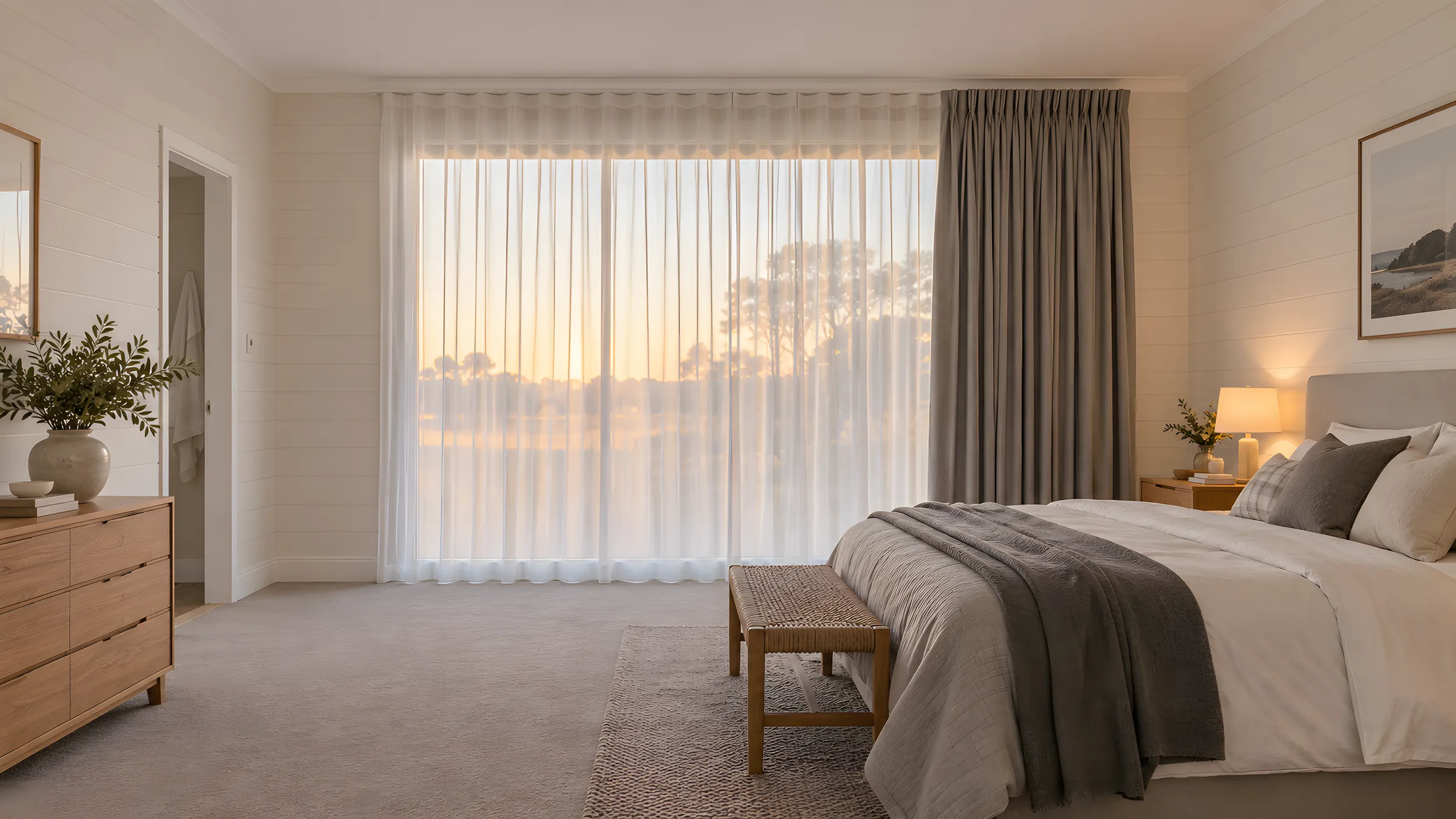
To layer sheer and blackout curtains, hang the blockout on a rear track and the sheer on a front track, so you can draw each one on its own. Blockout is the Australian word for blackout and means the same thing. The sheer handles daytime light and softens the room, the blockout behind it gives you night privacy and a darker bedroom, and if you would rather have one track, a lined curtain does a similar job.
In short
- There are two ways to layer: double curtains (a sheer and a blockout on two tracks) or lined curtains (a blockout lining sewn behind a sheer, on one track).
- On a double track the sheer goes at the front and the blockout on the rear track.
- An S Fold front with pencil pleat or inverted pleat behind gives the slimmest depth, about 220 mm. Double curtains typically project 220 mm to 250 mm.
- Choose the two colours together, because the blockout colour shows through the sheer when both are closed.
- Order a free sample of each fabric and hold the pair together in your own light before you decide.
Two ways to layer: double curtains or lined curtains
Both give you a sheer look with a blockout layer. The difference is whether the layers move separately or together.
| Double curtains | Lined curtains | |
|---|---|---|
| Tracks | Two: blockout at the rear, sheer at the front | One |
| How they move | Each layer separately | Both together, as one curtain |
| Day and night | Sheer alone, blockout alone, or both | One setting: sheer with its lining |
| Depth from the wall | Typically 220 mm to 250 mm | Less than a double, because there is one track |
| Cleaning | Each layer by its own fabric rules | Cleaned as one piece, following the coated lining rules |
Choose double curtains if you want a real day and night setting: the sheer across for daytime light and privacy, then the blockout drawn at night or on a sleep-in morning. Choose lined curtains if you want a simpler, slimmer arrangement and are happy with one setting. Our post on lined vs unlined curtains covers the lining in more detail.
How to layer sheer and blackout curtains on a double track
Work through seven decisions in this order.
1. Get the order right
The blockout hangs on the rear track, closest to the window, and the sheer on the front track, facing the room. The sheer softens what you see from inside, and the blockout can be drawn aside without disturbing it.
2. Choose the two fabrics together
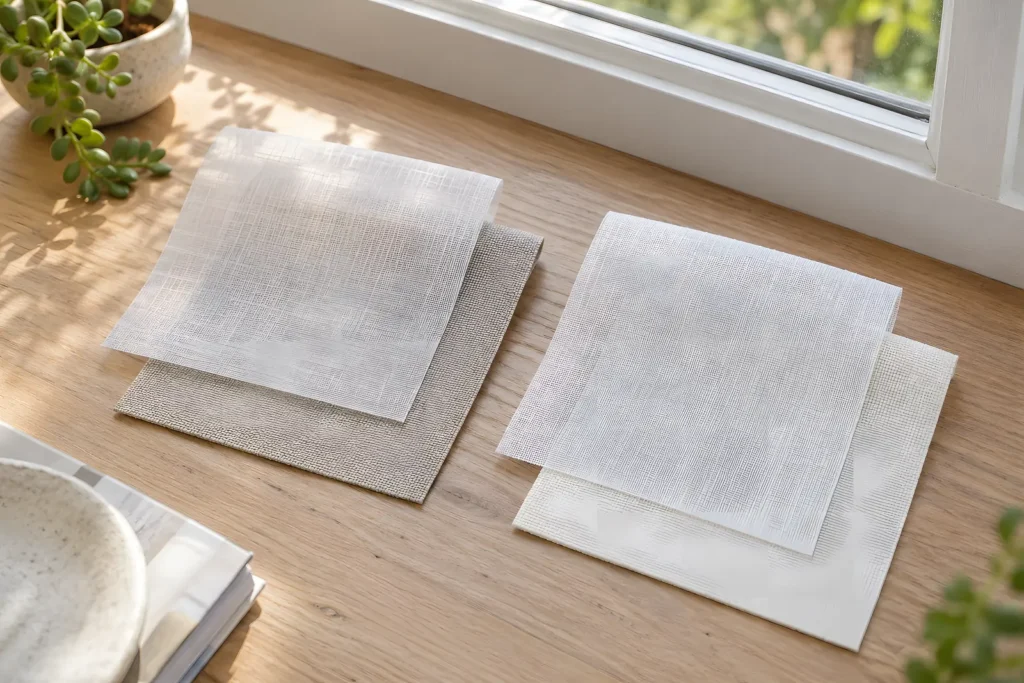
Our sheer curtains come in Cassis, Cassis Volume and Bali, all linen-look polyester. Our blockout curtains come in Galaxy, our heaviest blockout, and Epic, coated in three layers. Sheers filter daylight and soften the view. At night, with lights on inside, people outside can see in through a sheer, which is why the second layer matters.
Order a free sample of each and hold them together in your own light, in the morning and in the evening. That is the only reliable way to judge the pair.
3. Pick a heading for each layer
The usual pairing is S Fold at the front and pencil pleat or inverted pleat at the back. S Fold gives regular, even waves and is our most popular heading, and the flat-stitched pencil and inverted pleats have folds similar in shape to an S Fold, so the two layers sit comfortably together. Our guide to curtain headings explained compares all five.
4. Check depth and clearances
Double curtains typically project 220 mm to 250 mm from the wall, including the tracks and the fabric. S Fold at the front with pencil pleat or inverted pleat behind gives the slimmer 220 mm. S Fold on both layers is possible and looks matching, but it is not the slimmest option.
Check the space around the window before you order:
- Window handles and winders that swing into the curtain path.
- Sills, radiators and furniture directly under the window.
- Cornices, which leave a larger gap between a ceiling-fixed curtain and the glass.
- A built-in pelmet cavity, which needs 250 mm of depth for double curtains.
If something is in the way, extension brackets move the track further from the wall or ceiling than a standard bracket.
5. Plan the opening and the stack
Each layer needs wall space to stack when open. A one-way curtain stacks to about 30 per cent of the track width and a centre-opening pair to about 15 per cent on each side. On a double curtain the sheer and the blockout stack in roughly the same place, so allow for two bundles of fabric rather than one.
6. Choose the finish at the floor
Give both layers the same bottom finish unless you have a reason not to, because differences show at the floor. The three options are just off the floor (5 mm to 10 mm short of your drop), touching (skimming by up to 5 mm) and puddled (about 20 mm of extra fabric on the floor).
7. Measure with the double curtain guide
Double curtains have their own method, which is not the same as measuring for a single curtain. Follow our double curtain measuring guide so that both layers are measured and ordered correctly.
Choosing colours for layered curtains
When both layers are closed you see the blockout colour through the sheer, so the pair works as one colour. Sheer over a dark blockout looks deeper and more contrasty than the sheer on its own.
| Look you want | Sheer | Blockout | What to expect |
|---|---|---|---|
| Bright and airy | Cassis Volume Snow or Bali Snow | Epic Chalk or Cloud | Pale layers that keep the room light |
| Warm and natural | Cassis Sand or Fawn | Epic Putty | Warm neutrals that sit well with timber floors |
| Soft grey | Cassis Volume Silver or Bali Smoke | Epic Smoke or Pewter | A calm, cool combination |
| Deep and cosy | Cassis Volume Pearl or Bali Pearl | Epic Ebony | Strong contrast between the two layers |
Colour names are a guide only, so check the samples before you commit.
Tip: Blockout fabrics have a white backing, and on a double track the backing faces the window. From the street you will see the white backing through the glass, not the fabric colour, so a dark blockout still looks white from outside.
How to use the two layers through the day
Layered curtains earn their keep with a simple routine:
- Morning: the blockout drawn open and stacked, the sheer across for soft light.
- Midday: the sheer across to cut glare while keeping the view and the light.
- Early evening: draw the blockout before you turn the lights on. A sheer on its own gives some privacy by day, but not at night with lights on inside.
- Night: both closed, with the blockout doing the work.
S Fold blockout curtains: can you layer them?
Yes. S Fold is available in both sheer and blockout fabrics, so you can put an S Fold blockout on a single track or on the rear track of a double curtain. S Fold is used with a ceiling (top) fit and is the deepest heading in the range, and blockout fabric is heavier than a sheer, so it is worth checking clearances and the fixing. Ceiling battens are the easiest fixing for a ceiling-fit track, and a stud finder locates them.
If you want the slimmest double curtain, put the S Fold on the front sheer and pencil pleat or inverted pleat on the blockout behind it.
Hanging sheer and blockout curtains
Fit a double track and both curtains by following our double curtain installation guide. It covers the fixings for your wall or ceiling, the bracket marks for each heading and fullness, and the order for hanging the layers. A second person makes the job easier, and the installation guides cover the other curtain types.
Common problems and fixes
| Problem | What helps |
|---|---|
| Light at the edges, top or bottom | Blockout stops light passing through the cloth, but some still enters around the edges. A track that extends past the frame or a pelmet above it helps |
| The curtain catches on a window handle | Extension brackets move the track further out; alternatively choose a flatter heading |
| The stack looks bulky | A centre opening splits the stack between two sides, and a lower fullness sits flatter |
| The layers look mismatched at the floor | Choose the same bottom finish for both layers |
| The sheer does not give night privacy | It is not designed to; close the blockout, or choose lined curtains |
If you would like to open and close both layers from a remote, a double curtain can be motorised. Read motorised curtains explained for what to plan.
Questions
Which goes in front, the sheer or the blockout?
On a double track the sheer hangs at the front and the blockout on the rear track, which sits closest to the window.
Can I layer curtains on one track?
Not as two separately drawn curtains. Lined curtains have a blockout lining sewn behind a sheer so the two layers move together on one track.
How far do double curtains stick out from the wall?
Double curtains typically project 220 mm to 250 mm, including the tracks and the fabric. An S Fold front with a pencil pleat or inverted pleat rear gives the slimmer 220 mm.
Will layered curtains make the room completely dark?
No. The blockout stops light passing through the cloth, but some light still comes in around the edges, top and bottom of the curtain.
Can layered curtains be motorised?
Yes. A double curtain can pair a sheer and a blockout, each on its own track, including a motorised option.
Build your double curtains
Choose a sheer and a blockout, set the headings and see the price before you order.
Keep reading
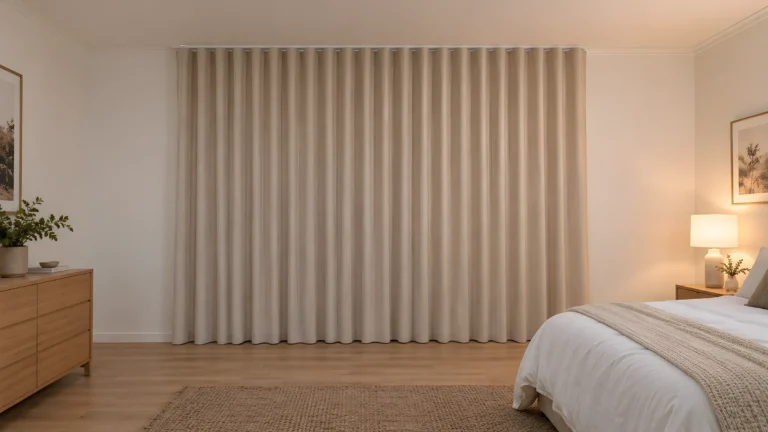 CurtainsLined or unlined curtains: what a lining really doesOur lined curtains sew a blockout lining behind a sheer so both move together on one track. Here is how they compare with unlined and double curtains.
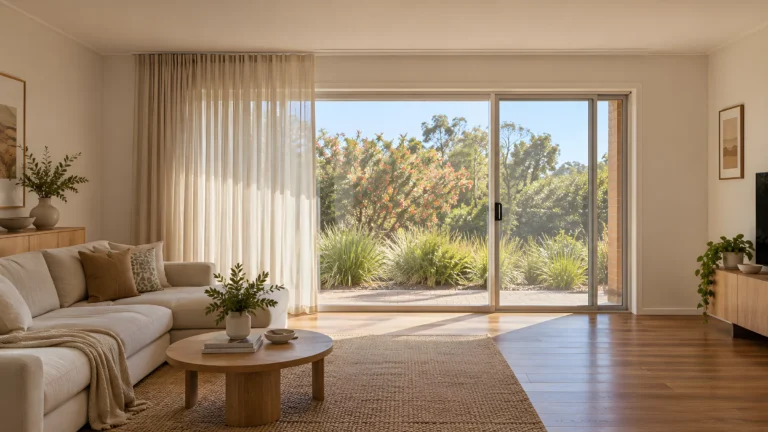 CurtainsCurtain headings explained: S Fold, pencil, pinch and invertedHow S Fold, pencil pleat, pinch pleat and inverted pleat headings look, hang and stack, with a comparison table to help you choose the right one.
 CurtainsCurtain tracks explained: wall, ceiling, curved and motorisedHow curtain tracks work and how to choose one: Designer, Half Moon, curved and motorised, ceiling or wall fit, fixed or free flow, brackets and wands.