
Thermal curtains and insulating blinds: keeping heat in
Thermal curtains are a search term, not a fabric standard. Here is what really helps a window hold heat in, and which of our curtains and blinds do it best.

Thermal curtains are a search term rather than a fabric standard. What keeps a room warmer is a thick, closely woven or coated layer that hangs close to the window, covers the whole frame and is closed at dusk. In our range, lined curtains, double curtains and well-fitted blockout blinds are the closest match, because they work on the same principles.
In short
- Warmth comes from layers, coverage, closeness to the glass and closed edges, not from a product name.
- Of our range, lined curtains, double curtains and blockout curtains are the best choices for winter; face-fit blockout rollers, cassettes and double rollers help too.
- Sheer curtains, SunScreen and Light Filter fabrics are for light and privacy, and add little on their own.
- Fit matters as much as fabric: run curtains wider than the glass, finish them near the floor and close the top with a pelmet.
- Treat "thermal" labels cautiously and look at layers, coverage and fit rather than the name.
What thermal curtains really means
Shops use "thermal", "insulated" and "energy saving" as labels, but the words alone do not tell you how one product compares with another. Two curtains sold as thermal can behave very differently.
The useful question is not whether a curtain is called thermal, but what it physically does at the window. The same applies to "thermal blinds" and "thermal window coverings": they describe a job, not a product.
That is why this guide looks at how heat behaves at a window, then shows which of our products suit the job.
How a window covering helps keep heat in
Glass is usually the coldest surface in a room in winter. Warm room air touching it cools, sinks and flows out along the floor, and that movement pulls warm air into the same loop. A good covering interrupts it in four ways.
- A solid layer. A heavier, coated or lined fabric adds more material between you and the glass than a sheer does.
- Still air. A pocket of air trapped between the covering and the glass, and between two layers, slows heat moving through. In general, more layers with a little space between them help more than one thin layer.
- Coverage. The covering should overlap the frame at the sides, top and bottom. Gaps let air circulate and undo the work of the fabric.
- Timing. Close coverings at dusk, before the room and glass cool. On a sunny winter day, open them on windows the sun reaches, so the light warms the room.
Which of our products help most
This table describes how each option works, as a guide to the principles rather than a ranking.
| Option | How it helps | Limits |
|---|---|---|
| Lined curtains | A blockout lining sewn behind a sheer, so two layers move together on one track | The layers move together, so the sheer cannot be drawn alone; cleaned as one piece under the coated-lining rules |
| Double curtains | Sheer on the front track, blockout on the rear track, with air between | Projects 220-250 mm from the wall; needs space |
| Blockout curtains (Galaxy, Epic) | Thick, coated cloth in a single layer | No sheer layer for daytime privacy |
| Double roller blind | Two fabrics on one set of brackets, so two layers | Needs 90 mm recess depth with both rolled over, or 70 mm with both rolled under |
| Blockout roller, face fit, standard roll | Covers the frame; a standard (under) roll drops closer to the glass | Still one layer, with small gaps at the edges |
| Cassette roller blind | Headbox, side channels and bottom channel close the edges | Needs 50 mm clear depth; ordered with a matching under-roll blockout blind; cannot be retrofitted |
| Plantation shutters | Solid frame and panels close to the glass | Blades and hinges are not sealed |
| Sheer curtains, SunScreen, Light Filter | Soften light and glare | Thin layers; add little for warmth on their own |
Insulated blinds and curtains for winter
Insulated window coverings, thermal insulated curtains and winter blinds all come down to the same four principles: a solid layer, still air, full coverage and closing them at dusk. In our range that means lined, double or blockout curtains on the curtain side, and face-fit blockout, cassette or double roller blinds on the blind side. A curtain and a blind together beat either on its own.
Thermal insulated curtains for winter
Curtains are the natural first choice because you can build in layers, fullness and coverage.
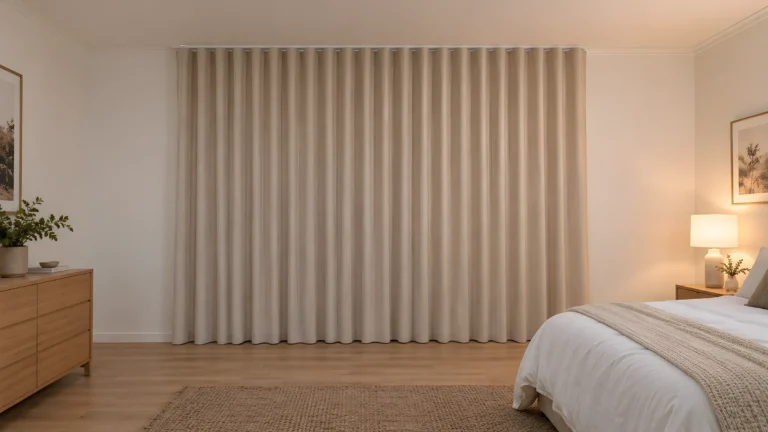
Lined or double. If you want one track and one operation, choose lined curtains: a sheer face with a blockout lining behind it. If you want to draw each layer separately, choose double curtains: blockout on the rear track and sheer on the front. Our lined vs unlined curtains guide covers the difference in more detail.
Fullness. Fullness runs from about 2.0 to 2.75 times the finished width. More fullness means more fabric in the folds and a thicker-looking layer. We set it for you, so you do not need to multiply your track width.
Track width and stack-back. Let the track run well past the window so the curtains overlap the frame when closed, and so they stack back clear of the glass when open. Our curtain measuring guide explains how wide to make the track.
Finish at the floor. A curtain that finishes just off the floor (5-10 mm short) lets air move underneath. One that touches, skimming up to 5 mm, leaves a smaller gap. A puddled finish (20 mm) is best kept for uneven drops.
Close the top. Cold air spills over the top of a curtain into the room. A box pelmet over the curtain, or a fabric-covered Bonded Pelmet, stops that flow. Our guide to what a pelmet is explains the options. Double curtains with a built-in pelmet cavity need 250 mm depth.
Tip: On a cold evening, hold the back of your hand a few centimetres from the frame and glass. If you can feel cold air moving, sealing the gaps will help more than changing the fabric.
Are roller blinds good for insulation?
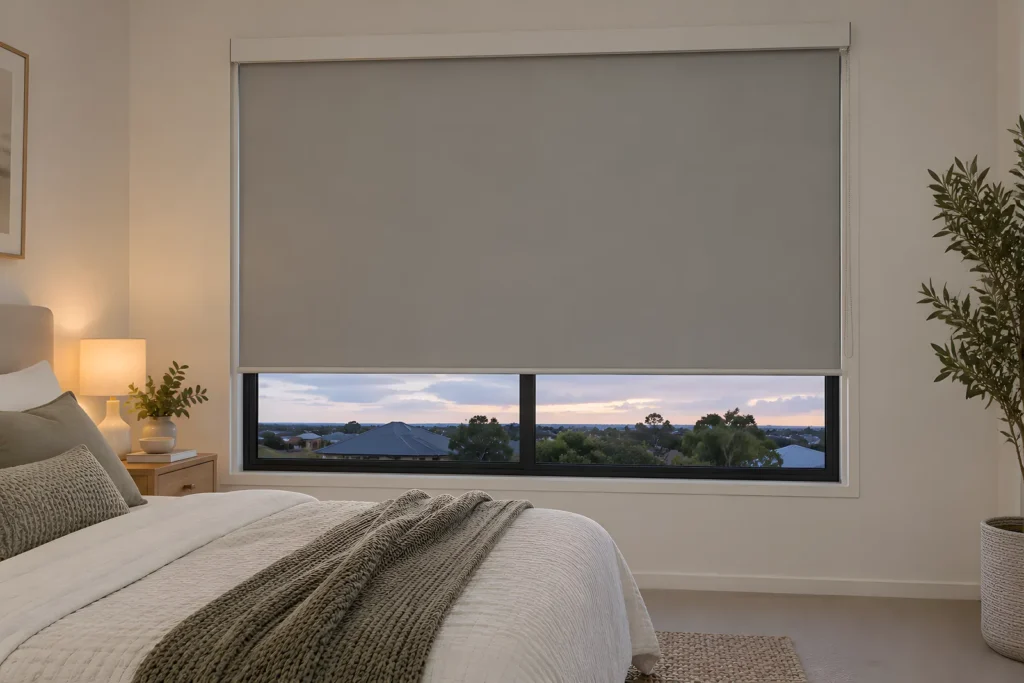
Insulated blinds in the strict sense are not a separate product, and insulating roller blinds are really a matter of choosing and fitting the blind well. A single roller blind is a thin layer, so expect it to help a little rather than a lot. A few choices improve it:
- Blockout fabric. It is denser than Light Filter or SunScreen.
- Face fit. Fixed to the frame or wall, it overlaps the opening. A recess fit leaves small gaps at each side.
- Standard (under) roll. The fabric drops from the back of the tube, closer to the glass.
- Cassette. The side and bottom channels close the edges. A cassette narrows the gaps but is not a seal.
- Double roller. A double roller blind gives two independently controlled layers.
A blind and a curtain together is the strongest combination. A blockout roller against the glass with lined curtains outside it gives you more layers than either alone. Read how to layer sheer and blockout curtains for the fitting details.
Plantation shutters and venetians
Plantation shutters add a solid frame and panels close to the glass, and you can tilt the blades to admit winter sun. They are not sealed, so hinges, blades and frame gaps still let air move. Treat them as one layer rather than a full solution, and add curtains if you want more.
Venetian blinds work the same way in principle, but slats leave gaps when open and small gaps when closed. They are better for controlling light than for keeping heat in.
Insulated blinds and curtains for summer heat
In summer the job reverses: you want to keep the sun's heat out rather than the room's warmth in. Heat blocking curtains and insulated blinds are not a product category any more than thermal curtains are, but the same principles apply. Cover the glass the sun reaches, add a layer where you can, and close the edges. We cover the wider picture in how to keep your home cool in summer.
Do blockout curtains keep heat out?
A blockout curtain or blind (often searched for as blackout) closed over a sun-facing window stops sunlight reaching the room, which is where most of the unwanted heat comes from. A covering inside the glass is less effective than shade outside it, but it still helps.
What helps most in summer
- Close early. Draw blockout curtains or lower blinds on sun-facing windows before the sun reaches the glass, rather than after the room has warmed.
- Use blockout where the sun is strongest. A blockout roller blind or blockout curtains on a west-facing window do more than a sheer or a light fabric.
- Keep a daylight layer for the rest of the day. SunScreen cuts glare and keeps the view, but it lets more sun through than blockout. A double roller blind lets you use SunScreen by day and bring the blockout layer down when the sun is hottest.
- Consider a lighter colour. Pale colours generally reflect more sunlight than dark ones, so a light blockout such as Shade "Ice" or Allure "Snow" is worth sampling for a hot window.
- Tilt shutters and venetians. Angle the blades to cut direct sun while still letting light and air in.
- Layer sheers with a blockout. Sheers soften glare but add little shade on their own, so pair them with a blockout layer on the hottest windows.
A winter checklist
- Fix draughts at the source first; a covering cannot replace a seal.
- Choose a heavy or lined fabric for the rooms you heat most, usually the bedroom and living room.
- Make the covering wider than the window, so it overlaps the frame.
- Finish it just touching the floor, unless your floor is uneven.
- Close the top with a pelmet or, for blinds, a fascia (a fascia is not a cassette and does not remove every gap).
- Close coverings at dusk. Open them on sunny windows in the day.
- Order free samples to check colour and weight before you order.
Questions
Do you sell thermal curtains?
Not under that name. Lined curtains, double curtains and blockout curtains are the closest products, and they help by adding layers and coverage.
Are roller blinds good for insulation?
A roller blind is a single thin layer with gaps at the sides, so it helps a little at best. Face fit, blockout fabric and a cassette or double roller add coverage and layers.
Do lined curtains keep a room warmer?
An extra layer of fabric hung close to the window and closed at dusk generally helps, and a lined curtain adds that second layer. Fullness, coverage and a pelmet on top matter as much as the fabric.
Should curtains touch the floor in winter?
A finish that touches the floor leaves less gap for cold air to move than one hung well above it. Choose the finish that suits your floor and how the curtains move.
Compare curtain fabrics at home
Order free samples of our blockout and sheer fabrics and see how they hang against your own window.
Keep reading
 CurtainsLined or unlined curtains: what a lining really doesOur lined curtains sew a blockout lining behind a sheer so both move together on one track. Here is how they compare with unlined and double curtains.
 BlindsHow to keep your home cooler in summer with blinds and curtainsKeep the sun off the glass and your rooms stay cooler. Here is which blinds, curtains and shutters work best, how to fit them and when to close them.
 CurtainsHow to layer sheer and blockout curtainsHang the sheer at the front and the blockout behind on a double track, or choose a lining. Here is how to pick fabrics, headings, colours and depth.