
Bunnings plantation shutters vs made-to-measure shutters
Bunnings sells adjustable, ready-made DIY shutters, while made-to-measure shutters are built to your window. Here is how they differ and how to compare them fairly.
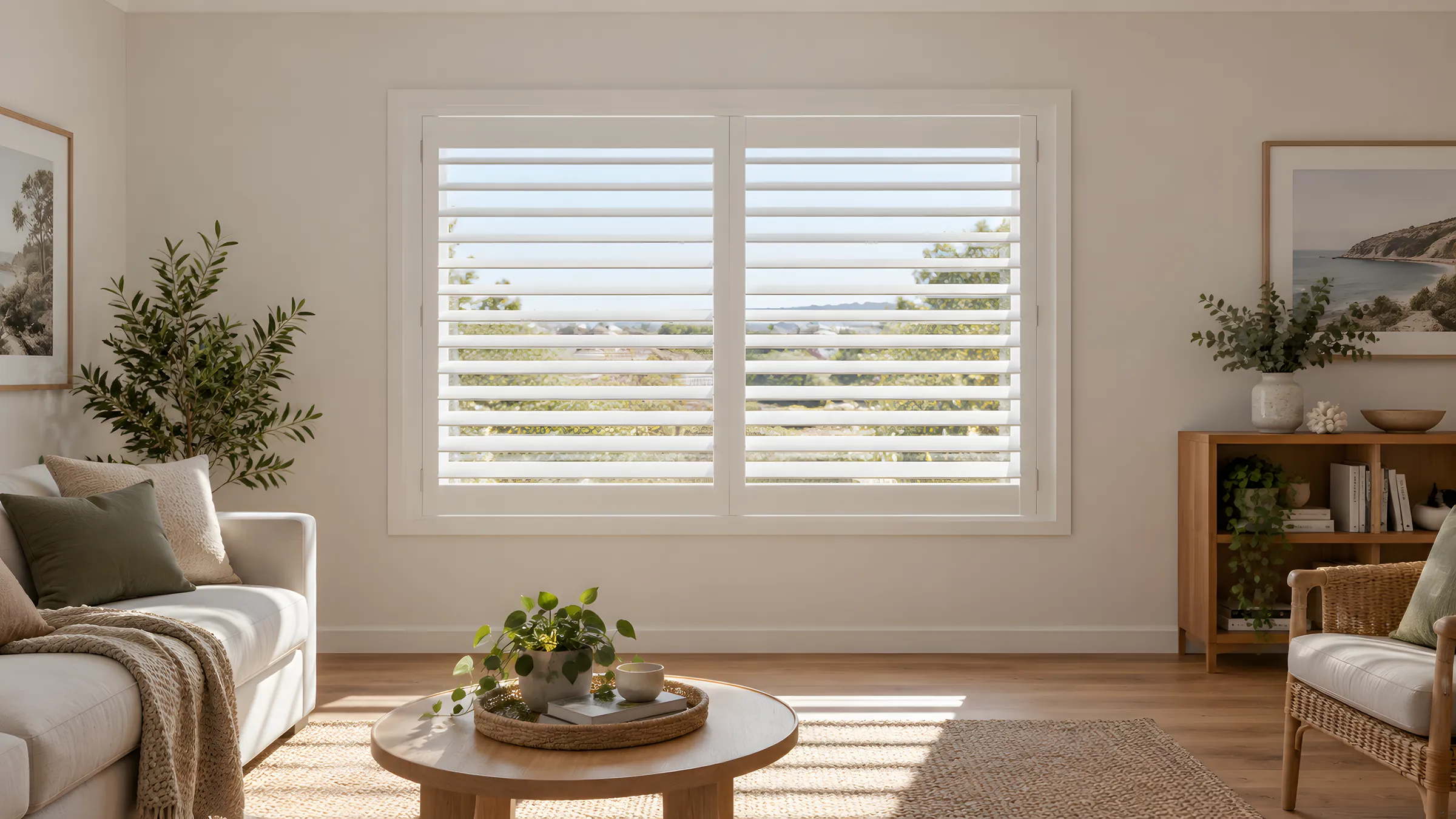
Bunnings plantation shutters are an adjustable, ready-made DIY option, designed to be adjusted to fit an opening rather than made to your measurements. Made-to-measure plantation shutters are built to the exact size of each window. Here is how they differ, when each makes sense, and how to compare them fairly if you are pricing both.
In short
- Bunnings sells adjustable, ready-made DIY plantation shutters. They are not made to your window measurements.
- Made-to-measure shutters are built to your window size, with the panel count, T-post and midrail positions planned around the window.
- An adjustable shutter may suit a simple, standard opening. Made to measure suits wide, uneven, wet-room or unusual windows.
- Compare like for like: material, frame, panels, what is included and who is responsible for a measuring error.
- Bunnings' range can change, so check its current listing before you decide.
What Bunnings plantation shutters are
Bunnings sells an adjustable, ready-made plantation shutter aimed at DIY buyers. Ready made means the shutter is produced to a set design rather than to your window. Adjustable means it is designed to be adjusted on site to suit an opening, instead of being manufactured to that opening's measurements.
Retail ranges change over time, so check the current Bunnings listing for sizes, materials, colours, prices and warranty, and check that your opening falls inside the product's stated size range. Bunnings also lists a made-to-measure shutter service, which is a separate product from its ready-made range.
What "ready made" means for the layout
With a ready-made shutter, the product decides the panel count and the positions of the T-posts and midrails, not your window. That is the main practical difference. In our view, an adjustable frame that has to fit within your opening can also show joiners at the corners and use smaller panels, which some people find less tidy than a frame made for the opening. Whether that matters depends on the window and how closely you will look at it.
What made-to-measure plantation shutters are
Every blind, curtain and shutter we sell is made to your measurements. For shutters, you enter your width and drop in the shutter configurator, choose a material and frame, and the factory works out the rest. The layout is planned around your window, and you keep control of the details that make a shutter look intended.
- Material. PVC, an aluminium-reinforced polymer in Glacial White, Shell or Antique, or timber, which is paulownia, stained or painted.
- Frame. Inside Z-frame, inside L-frame or outside L-frame, chosen for your depth and how even the opening is.
- Panel layout. Panels of about 900 mm at most, T-posts in custom positions, up to two midrails, and hinges on the left or right.
- D-mould. The overlap lip that blocks the view between panels is standard on every panel, at no extra charge.
- Support. Expert Review is a paid check where the team looks over your photos and measurements before production, and SureFit is a separate measurement protection with its own conditions.
You can read the full breakdown of materials, frames and layouts in our plantation shutters guide.
Adjustable vs made-to-measure plantation shutters
This table sets the two approaches side by side. Check the retailer for anything the adjustable column does not cover.
| Question | Adjustable, ready-made (as sold by Bunnings) | Made to measure (My Direct Blinds) |
|---|---|---|
| How it is sized | Designed to be adjusted to fit an opening | Made to your measurements |
| Panel count and T-post positions | Set by the product | Planned around your window, with T-posts in custom positions |
| Midrails | Set by the product | Up to two, placed to suit the window |
| Frame | Adjustable frame that must fit within your opening | Inside Z, inside L or outside L, sized for your opening |
| Materials and colours | Check the current listing | PVC or paulownia timber, with sample colours to order |
| Bay and corner windows | Check the retailer | Confirmed with our team before manufacture |
| Measuring support | Check the retailer's terms | Guides, a paid Expert Review check and SureFit measurement protection |
When an adjustable DIY shutter may be enough
An adjustable ready-made shutter can be a reasonable choice in some situations. These are the ones where the compromise matters least.
- The opening is a standard size that sits inside the product's stated range.
- The window is square and has no mullions or glazing bars that you want the panel joins to match.
- You are happy for the panel count and midrail positions to be whatever the product provides.
- The room is dry, or the product's material clearly suits the room.
- You would like to see a shutter in a store before you buy.
If all of those are true, an adjustable shutter may do the job, and it is worth looking at properly. If one or two are not, read on.
When made to measure is worth it
Made-to-measure shutters earn their place when the window is the hard part. These are the common cases.
- Uneven openings. Real openings are rarely perfect. More than 6 mm of variation rules out an inside L-frame, and more than 12 mm rules out a Z-frame, so you need a frame chosen for the opening you actually have.
- Wide windows. A panel is about 900 mm wide at most, and openings over about 950 mm need several panels. Made to measure lets you decide where the joins fall.
- Windows with mullions or glazing bars. T-posts in custom positions let you line the shutter up with the window behind it.
- Wet rooms. PVC shutters suit kitchens, bathrooms and laundries, being waterproof, though they are for interior use only.
- Timber finishes. If you want visible grain or a stained colour, timber is the option to consider.
- Bay and corner windows. These are confirmed with our team before manufacture.
Our PVC plantation shutters and timber plantation shutters pages show the materials and current finishes.
What to check before buying any DIY plantation shutter
Whoever supplies the shutter, these points decide whether it fits and works.
- Depth. Check the clear depth in the recess against the frame. Our Z-frame needs 60 mm and our inside L-frame 70 mm; an outside L-frame projects about 65 mm.
- Squareness. Check how even the opening is. Our out-of-square windows guide explains the limits for each frame.
- Obstructions. Look for window handles, winders, taps, blind or curtain hardware and anything else that could foul the blades.
- Panel joins. Decide where the joins fall and whether they should line up with the glazing.
- Hinge side and swing. Panels open into the room, so check furniture, doors and taps.
- Material for the room. Use PVC for wet areas, and check timber care needs in humid rooms.
- What happens if it does not fit. Ask what the supplier's measure check and remake terms actually cover.
Tip: Photograph each window straight on and from the side, showing the handle, trim and depth. Photos help you spot a clearance problem yourself, and they are what our Expert Review works from.
How to compare prices fairly
Price is usually where a comparison starts, but a ready-made shutter and a made-to-measure shutter are not the same product, so a single price comparison can mislead. Compare ready-made with ready-made, and made to measure with made to measure.
Before you compare totals, line up these points:
- The same window sizes, measured the same way.
- The same material and finish.
- The same frame type and fit, inside or outside.
- The same panel count, T-post and midrail positions.
- What each price includes: delivery, measuring support and any remake conditions.
- Warranty terms and what a defect claim covers.
Spend & Save discounts apply automatically on eligible orders, so check the current terms on our Spend & Save page. If you have a like-for-like polymer shutter quote from an eligible Australian competitor, our Price Beat Guarantee may apply; the terms are on the shutter product page. For your own windows, enter the measurements in the configurator to see the price, and order free samples to check the finish.
Our shutter guide has the full measuring steps, our plantation shutter measuring guide takes you through them window by window, and the warranty and SureFit page explains what the measurement protection covers and what it does not.
Questions
Are Bunnings plantation shutters made to measure?
The Bunnings shutters we are comparing here are an adjustable, ready-made DIY option, designed to be adjusted to fit an opening rather than made to your window measurements. Bunnings also lists a made-to-measure service, so check its current listing for details.
What are adjustable plantation shutters?
Adjustable plantation shutters are ready-made shutters designed to be adjusted to fit within a range of opening sizes. Made-to-measure shutters are instead built to the exact size of your window.
Can I do plantation shutters as a DIY job?
Yes. With our made-to-measure shutters you measure and install, and we deliver the shutters with practical guidance and support. The most important step is measuring, so follow the shutter guide closely.
What is the difference between ready-made and made-to-measure shutters?
Ready-made shutters are produced to a set design and adjusted to suit your opening, while made-to-measure shutters are manufactured to your measurements, with the panel layout planned around your window.
Which is better for a bathroom or kitchen?
Whichever you choose, check that the material suits a wet room. Our PVC plantation shutters are waterproof and suit kitchens, bathrooms and laundries, though they are for interior use only and should be kept out of continual direct soaking.
Price made-to-measure shutters
Enter your measurements and see the price for your own windows before you order.
Keep reading
 Plantation shuttersHow much do plantation shutters cost? What sets the priceThere is no single price per window. Here is what sets the cost of plantation shutters and how to price your own home, window by window.
 Plantation shuttersPVC or timber plantation shutters: which suits your room?PVC suits wet rooms and painted finishes, while timber suits dry rooms where you want grain or a stain. Compare the two room by room.
 Plantation shuttersPlantation shutters: the complete guideWhat plantation shutters are, how they work, what they are made of and how to plan frames, panels and measuring before you order made-to-measure shutters online.