
Linked roller blinds: covering wide windows neatly
Two or three roller blinds on shared brackets cover wide windows with a much smaller join gap than butted blinds. Here is how layouts, mullions and fabrics fit together.
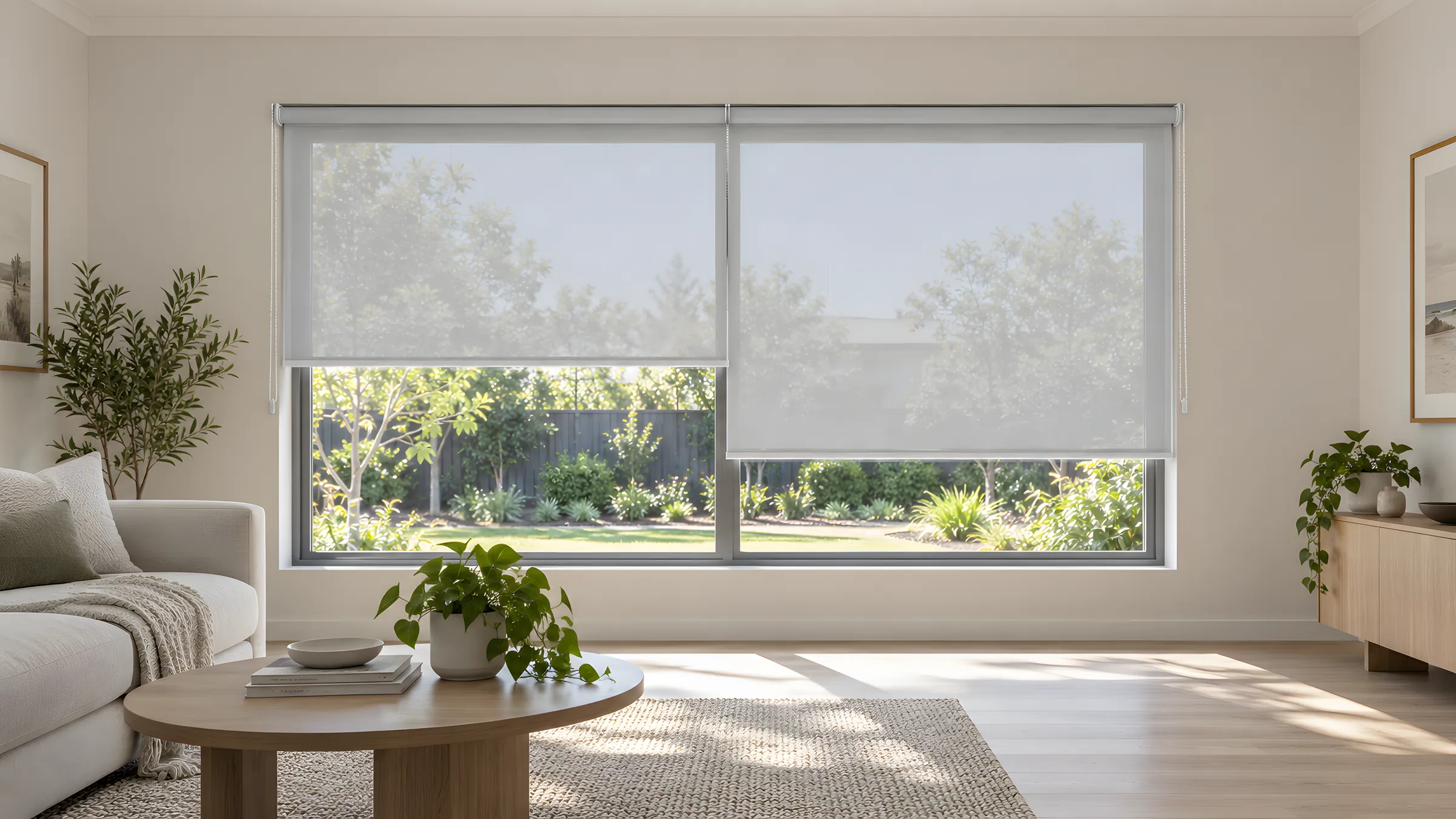
Linked roller blinds are two or three roller blinds fitted on shared brackets so they read as one wide blind, with a join gap of about 17 mm. Two blinds simply butted side by side leave a gap of 30 mm or more. If your window is wider than a single blind can go, or you want each section to work on its own, linking is the neat way to cover it.
In short
- Linked blinds share brackets, leaving a join of about 17 mm. Butted blinds leave 30 mm or more.
- A single roller blind can be up to 3000 mm wide, so anything wider must be linked.
- Plan the join to fall over the centre of a mullion so the gap sits where the frame already breaks up the glass.
- Layout codes such as LL, LR or LRR describe the blinds left to right as you look from inside the room.
- Battery motors allow the two-blind LR layout only. Hardwired and C-Bus also allow three blinds.
What are linked roller blinds?
Linked roller blinds are separate blinds, each with its own tube and fabric, mounted on brackets that are shared where two blinds meet. Because a shared bracket holds the end of both blinds, the blinds sit closer together than two independently bracketed blinds can. That is where the small join gap comes from.
You can link two or three blinds. Each one is made to its own width and drop, so the set can follow the window rather than forcing one width across everything. Each blind also works on its own, which can be reason enough to link a window that one wide blind could cover.
The linked roller blinds page lets you build the set and see the price before you order.
Linked blinds vs two separate blinds
You can hang two ordinary roller blinds side by side in one window, and plenty of people do. The difference is at the join.
| Linked blinds | Two separate (butted) blinds | |
|---|---|---|
| Brackets | Shared where the blinds meet | One set of brackets per blind |
| Join gap | About 17 mm | 30 mm or more |
| Look | Reads as one wide blind | Two blinds with a visible strip of light between |
| Ordering | One linked set, with a layout chosen up front | Two separate blinds |
| Best for | Wide windows, sliding doors and picture windows | Two separate windows side by side, where a gap between them is expected |
If you are deciding how to cover one window with two roller blinds, linking gives a neater result than butting. A 30 mm strip of light between two blinds is easy to see in a bedroom at dawn or a living room with the TV on.
When one wide blind is enough, and when to link
A single roller blind can be up to 3000 mm wide, and a lot of wide windows fit within that. Wider blinds change in a few ways:
| Blind width | What changes |
|---|---|
| Up to 2100 mm | 38 mm tube as standard |
| Over 2100 mm | 50 mm tube, fitted automatically |
| Over 2500 mm | Upgraded gear-drive clutch, at no extra charge |
| Over 3000 mm | Too wide for one blind, so link two or more |
Even under 3000 mm, there are good reasons to link:
- Different light needs across the window. One section faces the sun or a neighbour's window. The other faces the garden.
- A very wide blind is a big piece of fabric to lift. Two smaller blinds are easier to raise and lower, and you can move only the part you need.
- A mullion or door in the middle. The join can sit over it, so the blinds follow the structure of the window.
For more options on big glazing, including panel glide and motorised choices, see our blinds for large windows page and the large windows guide.
Tip: If one blind in your set is over 2100 mm and gets the 50 mm tube, you can upgrade a smaller neighbour to 50 mm as well. That keeps the tubes matching side by side.
Reading the layout codes: LL, RR, LR, LRR and LLR
Linked sets are ordered by layout. Each letter stands for one blind, read left to right as you look from inside the room, and shows which side that blind's control is on: L for left, R for right.
| Layout | Blinds | Chain | Hardwired and C-Bus | Battery |
|---|---|---|---|---|
| LL | 2 | Yes | Yes | No |
| RR | 2 | Yes | Yes | No |
| LR | 2 | Yes | Yes | Yes |
| LRR | 3 | Yes | Yes | No |
| LLR | 3 | Yes | Yes | No |
| LLL | 3 | No | Yes | No |
| RRR | 3 | No | Yes | No |
To choose one, stand where you will use the blinds and decide where the controls should be. Look for free wall, and avoid a control that sits behind a curtain, a door swing or a piece of furniture. LR is a good starting point for a two-blind pair, because it puts one control at each outer edge.
Where to put the join: mullions
The join should sit over the centre of a mullion, the vertical bar that divides one pane of a window from the next. The frame already breaks up the glass there, so the narrow join gap sits where a visual break exists anyway. Put a join in the middle of a pane and the slot of light shows against the glass.
Work out where the joins fall before you measure, then follow our linked blinds measuring guide for the measurements themselves. It also covers face fit, recess fit and how to enter each blind of the set when you order.
Choosing fabrics and controls for a linked set
Every blind in a linked set can be blockout, SunScreen or light filter. The ranges can also differ from one blind to the next, so a bedroom corner could use blockout on the side facing the street and light filter on the side facing the garden.
If you mix fabrics, check these before you order:
- Colour and texture side by side. Two ranges that look alike on a screen can look different next to each other. Order free samples of every fabric in the set and hold them together against the window.
- Backing. Shade has the same colour on both sides, Serene II and Lakeside have a colour-coordinated backing, and the other blockout ranges have a white backing. With a standard roll, the backing shows at the top of the roll, so a mismatch can show between neighbours.
- Night privacy. SunScreen keeps the view but does not give privacy at night. See the blockout, SunScreen and light filter pages for what each fabric does.
For controls, chain is available in every two-blind layout and in LRR and LLR. Motorised sets follow the layout table: battery motors are limited to the two-blind LR layout, with a motor for each blind, while hardwired sets can link up to three blinds with a combined width of 6 m. Our motorised blinds guide explains the options, and the roller blind controls guide compares chain, cordless and motorised.
Fitting linked blinds
Linked blinds share brackets, so fit them with our linked roller blinds installation guide rather than a general roller blind method. Every blind is made to your measurements, so label each one with the window and position it belongs to when it arrives.
Common mistakes with linked blinds
- Putting a join over open glass. The slot of light shows against the pane. Move the join to a mullion, or change the widths so it lands on one.
- Treating the window as one blind. Each blind in a linked set is a separate width, so plan the split first and measure to that plan using the linked blinds measuring guide.
- Ignoring where the controls end up. A control behind a sofa arm or a curtain is one you will stop using.
- Forgetting the motor count. With battery motors, every blind needs its own motor, so a two-blind set is two motors and a remote channel plan to go with it.
Linked rollers or something else?
Linked rollers are not the only way to cover a wide opening. For a sliding door, panel glide blinds and vertical blinds are the other blind options, and curtains are another option if you can leave room for them to stack back. Linked rollers win when you want the clean, flat look of a roller blind, blockout fabric and the choice of chain or motor.
Questions
What is the gap between linked roller blinds?
Linked blinds leave a join gap of about 17 mm. Two separate blinds butted side by side leave a gap of 30 mm or more.
How many roller blinds can be linked?
Two or three blinds can be linked on shared brackets. Hardwired motorised sets cover up to three linked blinds with a combined width of 6 m.
Can linked roller blinds use different fabrics?
Yes. You can choose blockout, SunScreen or light filter, and the fabric ranges can differ from one blind to the next.
Can I link battery motorised roller blinds?
Yes, in the two-blind LR layout only, and each blind needs its own motor. Hardwired and C-Bus motors also allow three-blind layouts.
How wide can a single roller blind be?
A single roller blind can be up to 3000 mm wide. Anything wider needs two or more linked blinds.
Build your linked roller blinds
Enter your measurements, choose your layout and fabric, and see the price before you order.
Keep reading
 Room ideasBlinds for large windows: linked, panel glide and motorisedA single roller blind stops at 3000 mm wide. Here is how linked blinds, panel glide, motors and curtains cover larger windows, with the size limits that apply.
 BlindsChain, cordless or motorised: choosing roller blind controlsChain, cordless or motorised? How each roller blind control works, what limits apply and which suits a bedroom, nursery, home theatre or wide window.
 BlindsMotorised blinds explained: battery, hardwired and C-BusBattery, hardwired or C-Bus? A plain guide to how motorised blinds are powered, how remotes and hubs work, and what to check before you order.