
Motorised blinds explained: battery, hardwired and C-Bus
Battery, hardwired or C-Bus? A plain guide to how motorised blinds are powered, how remotes and hubs work, and what to check before you order.
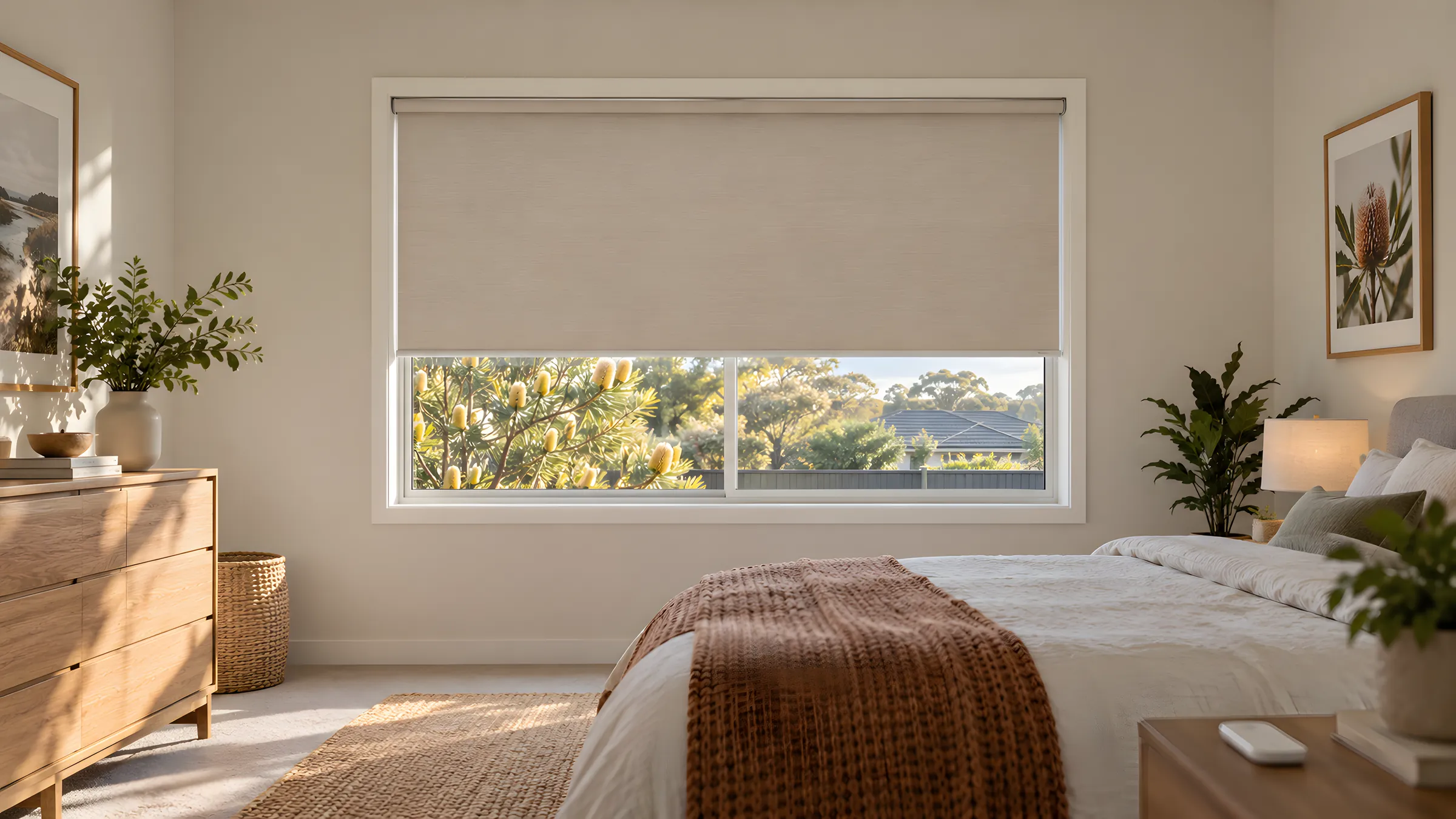
Motorised blinds are roller blinds with a motor, so they raise and lower from a remote, an app or a voice command instead of a chain. The main decision is how the motor is powered: a rechargeable battery, hardwired mains power, or a connection to an existing C-Bus system. Battery motors need no mains wiring, which makes them the simplest way to add motorised blinds to a home that is already built.
In short
- Motorised, electric and smart blinds describe the same thing: a roller blind with a motor. "Smart" means it also connects to a hub.
- Battery motors need no mains wiring. Hardwired and C-Bus motors need a licensed electrician.
- A battery motor drives one blind, so a linked battery set needs a motor for each blind. Hardwired motors can serve up to three linked blinds with a combined width of 6 m.
- A 2-channel or 16-channel remote runs the blinds. A compatible smart hub adds an app, scenes, timers and Alexa or Google Home voice control.
- Hardwired motors carry a 5-year warranty and battery motors a 3-year warranty.
What are motorised blinds, electric blinds and smart blinds?
"Motorised blinds" and "electric blinds" mean the same thing: the blind moves under motor power. "Smart blinds" usually means motorised blinds that can also be scheduled or voice-controlled through an app or a hub. The hub is what makes it smart.
Our motorised roller blinds use Silent Glide motorisation, one of three ways to operate a roller blind alongside the SunBoss chain drive and ZeroGravity cordless. The roller blind controls guide compares all three.
A motor also removes the chain. Nothing hangs beside the window, which helps in children's rooms, behind a sofa or desk, and on windows that are hard to reach. If you already have manual blinds and wonder about adding a motor, can you motorise existing blinds explains the options.
How are motorised blinds powered?
There are three power options, and the one you pick decides who installs it, which remotes it uses and how many blinds one motor can serve.
| Battery | Hardwired | C-Bus | |
|---|---|---|---|
| Power source | Rechargeable battery, needs a charger | Mains power | Your existing C-Bus system |
| Who installs the power | You (no mains wiring) | Licensed electrician | Electrician |
| Remote and smart hub | Yes | Yes | No, does not use the RF remote or hub |
| Linked blinds | A motor per blind; two-blind LR sets only | Up to three linked blinds, 6 m combined width | Three-blind sets available |
| Warranty on the motor | 3 years | 5 years | See the warranty page |
| Suits | Existing homes and DIY fitting | New builds and renovations | Homes already running C-Bus |
Battery motors
A rechargeable battery motor is the DIY-friendly choice. There is no mains wiring and no electrician, so you can add it to any window where a roller blind fits. It is also the usual choice when you are renting, as long as your lease allows the brackets.
The trade-off is that the battery needs recharging, and one motor drives one blind. If you link blinds on shared brackets, each blind needs its own motor, and linked battery blinds are offered as a two-blind LR set only.
Hardwired motors
A hardwired motor runs from mains power, connected by a licensed electrician. It suits a new build or a renovation, because the cabling to the head of the window is far easier to run before the walls are lined. Hardwired motors can be used on up to three linked blinds, with a combined width of 6 m.
Hardwired motors carry the longer warranty of the two, 5 years, and there is no battery to charge.
C-Bus motors
C-Bus is for homes that already have a C-Bus automation system. The blind connects to that system and is fitted by an electrician. It does not use the RF remote or the smart hub, so the app, timer and voice features described below do not apply. Control comes from your existing C-Bus system instead.
Which power option suits your home?
Work through these questions in order:
- Can you run power to the window head? If walls are open in a new build or renovation, hardwired is worth planning in. If not, battery avoids the wiring altogether.
- Do you want to avoid an electrician? Battery is the only option you can fit and power yourself.
- Do you already have C-Bus? If so, ask your electrician whether the blinds should join it.
- How many blinds share the window? Three linked blinds are possible on hardwired or C-Bus. Battery links top out at two blinds.
- How wide is the run? Hardwired links are limited to a combined width of 6 m. A single roller blind is limited to 3000 mm wide.
Tip: You can mix power types in one home. Hardwired motors in a new extension and battery motors in the older rooms is a sensible split, with each window chosen on its own merits.
Remotes, channels and the smart hub
Battery and hardwired motors work with a 2-channel or a 16-channel remote. Range is up to 80 m outdoors in a clear line of sight and up to 30 m indoors. Every motor is assigned to a channel, and motors on the same channel move together.
That channel rule is the part to plan. Put blinds on one channel only if you always want them to move at the same time, such as three windows on the same wall. Give a blind its own channel if you sometimes want it different from its neighbours.
| Situation | Sensible channel plan |
|---|---|
| One bedroom window with a blind | Any remote works; one channel is enough |
| A double roller blind with a daylight layer and a blockout layer | A 2-channel remote, one channel per layer |
| Three windows facing the same direction | One channel so they open and close together |
| A whole house with rooms you run separately | A 16-channel remote, grouped by room or by orientation |
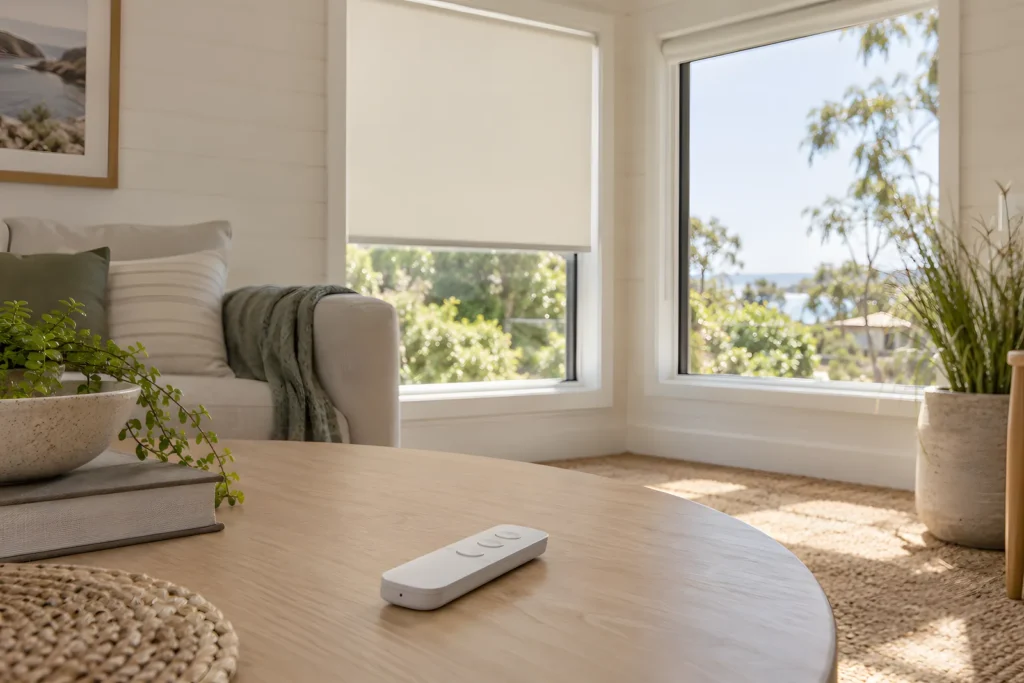
What a smart hub adds
A compatible smart hub is optional. It adds phone app control, scenes, timers, sunrise and sunset triggers, and voice control through Alexa and Google Home. A scene might close every bedroom blind at sunset, or open the living room blinds at a set time.
Check that your hub is compatible with the motors before you buy one. A hub works with the battery and hardwired motors; C-Bus does not use it.
How to charge motorised blinds
Battery motors need a charger. The exact steps depend on the motor and the charger supplied, so follow the instruction sheet that comes with your blind. Check in particular whether the blind can stay on its brackets while it charges.
How often you charge depends on the size of the blind and how many times a day it moves. Two habits help in any household:
- Keep the charger somewhere you will find it, not in the bottom of a drawer with old cables.
- If the blind starts to move slowly or stops short of its ends, charge it before it goes flat.
If you would rather never think about charging, hardwired motors remove the question. Where wiring is not possible, a ZeroGravity cordless roller blind is a chain-free alternative with no battery at all. You lift it by the base rail and it holds at any height.
How much do motorised blinds cost?
The price depends on the motor type, the blind size, the fabric range and how many blinds you order. The configurator shows the price for your exact measurements before you order.
What moves the total:
- Motor type. Battery, hardwired and C-Bus are priced differently, and hardwired and C-Bus also need an electrician, which is a separate cost.
- Size. Price follows the width and drop you enter, as it does for any roller blind.
- Number of blinds. With battery motors, each blind in a linked set needs its own motor.
- Remotes and hub. A 16-channel remote or a smart hub adds to a plain 2-channel setup.
- Discounts. Spend & Save discounts apply automatically on eligible orders.
Planning checklist before you order
- Decide the power type for each window: battery, hardwired or C-Bus.
- Measure each window with the roller blind measuring guide.
- Choose the fabric type for each room. Order free samples and look at them in your own light.
- Count your blinds and decide which should share a channel.
- Decide whether you want a smart hub, and check it is compatible.
- For hardwired or C-Bus, book a licensed electrician before installation day. The motorised roller fitting guide covers the motor hardware and setup.
Where motorised blinds earn their place
- Bedrooms. Open and close a blockout blind without getting out of bed or reaching behind a headboard.
- Home theatres. Motorised blinds pair naturally with blockout fabric and a full cassette. See home theatre blinds.
- Large windows. A wide window is easier to operate by remote than by chain, especially when several blinds are linked. The linked roller blinds guide covers how to set them up.
- High or awkward windows. Over a staircase or behind a bath, a remote replaces a stretch or a step ladder.
They are less necessary on a small window in a room you rarely use. There, a chain or cordless blind is simpler and quicker to fit.
Motorised curtains work on the same principle, with a few differences. See motorised curtains explained.
Questions
Are electric blinds the same as motorised blinds?
Yes. Electric blinds and motorised blinds both describe a blind that moves under motor power. Smart blinds are motorised blinds that are also connected to a compatible smart hub.
Do motorised blinds need an electrician?
Battery motors need no mains wiring, so you can fit them yourself. Hardwired and C-Bus motors need a licensed electrician.
How do you charge motorised blinds?
Battery motors need a charger. Follow the instructions supplied with your blind for the exact charging steps.
Can motorised blinds work with Alexa or Google Home?
Yes, with a compatible smart hub, which adds voice control through Alexa and Google Home. C-Bus motors do not use the hub.
How long is the warranty on blind motors?
Hardwired motors carry a 5-year warranty and battery motors a 3-year warranty.
Build your motorised roller blind
Choose your fabric, enter your measurements and pick a motor type to see the price before you order.
Keep reading
 BlindsChain, cordless or motorised: choosing roller blind controlsChain, cordless or motorised? How each roller blind control works, what limits apply and which suits a bedroom, nursery, home theatre or wide window.
 BlindsCan you motorise existing blinds? Retrofit vs factory-fittedSome existing roller blinds can be motorised after the fact. Here is how retrofit works, where it falls short, and how a factory-fitted motor from us differs.
 CurtainsMotorised curtains: how they work and what to planHow motorised curtains work, battery or hardwired power, remotes and smart hubs, the limits to know about and what to plan before you order.