
Living room curtain ideas: headings, fabrics and layers
Sheers, S Fold and layered looks for the living room, with the headings, colours, tracks and clearances that make curtains frame a window instead of covering it.
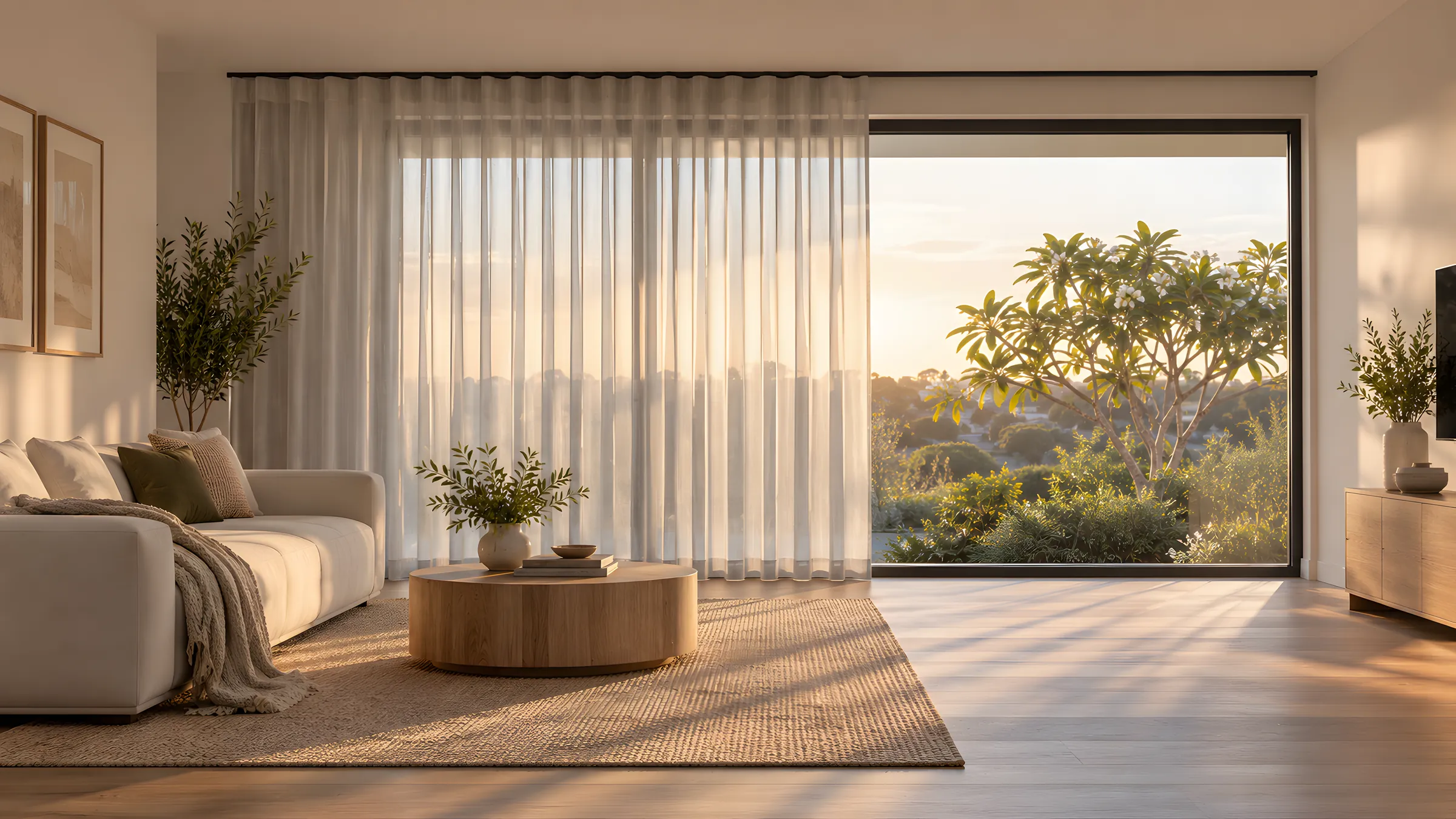
The best curtain ideas for a living room pair S Fold sheers with a roller blind or a second layer, hung from a track fixed close to the ceiling and wide enough to stack clear of the glass. Sheer curtains soften daylight and give the room a finished look, and the blind or blockout layer handles the evening. Start with the fabric and heading, then plan the track so the curtains frame the window instead of covering it.
In short
- S Fold sheers on a ceiling-fixed track are the most popular living room look.
- Sheers give some privacy by day. At night with the lights on, people outside can see in, so layer a blind or a blockout.
- Choose the heading for the mood: S Fold is relaxed, pinch pleats are tailored, inverted pleat is flat and modern.
- Make the track at least 30 per cent wider than the window, and leave clear wall for the stack.
- Order free samples and check them in daylight and at night.
Curtain ideas for the living room at a glance
| Idea | What it is | Best for | Watch out for |
|---|---|---|---|
| S Fold sheers | Regular waves in Cassis, Cassis Volume or Bali | A soft, tall, relaxed room | Daytime privacy only |
| Sheers over a Light Filter roller blind | A blind behind, curtains in front | A window that needs control day and night | Allow depth for both |
| Double curtains | A sheer on the front track, a blockout on the rear track | A street-facing room or a television wall | They project 220 to 250 mm from the wall |
| Lined curtains | A blockout lining sewn behind a sheer | One-track simplicity | The sheer cannot be drawn alone |
| Wall-to-wall track | A track between the walls or cornices | A feature window wall | Check the curtain measuring guide first |
| Motorised curtains | Battery or hardwired motor and remote | Wide windows and hard-to-reach tracks | Not available with free-flow tracks or multiple openings |
Sheer curtain ideas for a living room
Sheers are what most of our customers choose, outselling blockout curtains roughly three to one in our curtain range.
- Cassis is a linen-look polyester sheer with a soft natural texture, in warm neutrals: Sand, Linen, Fawn and Pewter. ("Cassis Linen" is a colour name, and the fabric is polyester, not linen.)
- Cassis Volume is the same sheer in whites and greys: Snow, Pearl, Driftwood, Silver, Ash and Charcoal.
- Bali is the lightest linen-look sheer, in Blush, Cobblestone, Gardenia, Onyx, Pearl, Smoke, Snow, Taupe, Black, Thunder and Ash.
A few pairings work reliably. Cassis Sand or Fawn warms a room with timber floors. Cassis Volume Snow or Pearl keeps a small room bright. Bali Smoke, Thunder or Black gives a darker, more dramatic finish against pale walls. Sheer curtain ideas covers colour and styling in more depth, and our sheer curtains page shows the full range.
Sheers give some privacy by day. At night with the lights on, people outside can see in, so add a blind or a second layer if the room faces the street.
Choose a heading for the living room
The heading is the top of the curtain, and it sets the style of the whole window.
| Heading | Look | Living room use |
|---|---|---|
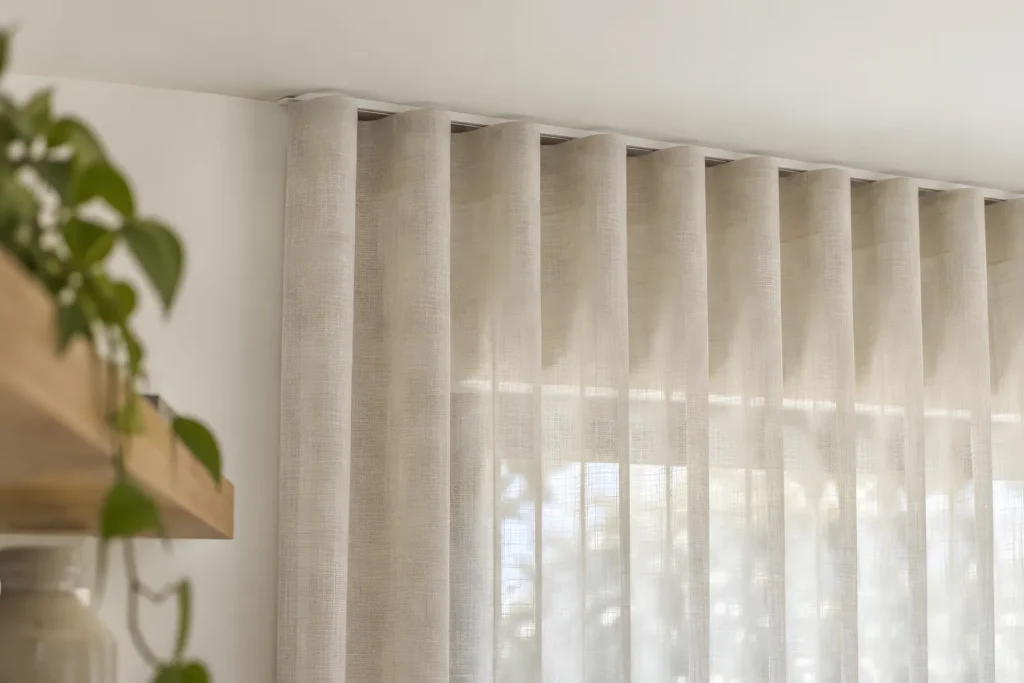
| S Fold | Regular, relaxed waves. The most popular, with the deepest profile | Sheers or blockout on a ceiling-fixed track |
| Pencil Pleat | A gathered, traditional heading | The rear layer behind an S Fold front |
| Double Pinch Pleat | Two fabric fingers per pinch | A tailored, formal room |
| Triple Pinch Pleat | Three fabric fingers per pinch | A fuller, more formal look |
| Inverted Pleat | A flat front, with the fullness folded behind | A clean, modern room |
S Fold is used with a top fit, and it has the deepest profile of the five, so check the space between the wall and any furniture. Some suppliers call it ripplefold or wave. Read curtain headings explained for the full comparison, or price your window with S Fold curtains.
Layering ideas: sheers, blinds and blockout
Layering is the most useful idea for a living room, because one window has to do different jobs at different times.
- Sheers over a Light Filter roller blind. The Light Filter roller blind diffuses daylight and obscures the view, and the curtains soften the frame. Pair Ultra LF Cream with Cassis Sand, or Serene LF Chalk with Cassis Volume Snow.
- Double curtains. A sheer on the front track and a blockout on the rear track suit a television wall or a street-facing window. Draw the blockout for movie night and open it for the day.
- Lined curtains. A blockout lining sewn behind a sheer gives one-track simplicity. You cannot open the sheer alone, so they suit a room you want dark in the evening.
- A double roller blind with curtains in front. A double roller blind handles light on its own, and the curtains add a soft finish.
How to layer sheer and blockout curtains explains the mechanics of double curtains and lined curtains. Our living room blinds page shows the roller blinds that sit behind curtains.
Plan the height, width and stack-back
- Height. Fix the track close to the ceiling and let the curtains fall to just off the floor. The wall looks taller and the window looks larger. This is the idea behind floor-to-ceiling curtains.
- Width. To frame a window, make the track at least 30 per cent wider than the glass. A wall-to-wall track sits between the walls or cornices.
- Stack-back. The extra track width is what lets the curtain stack clear of the glass, so leave clear wall for it on the side or sides where the curtain opens.
- Length. Choose just off the floor (5 to 10 mm short), touching (skimming up to 5 mm) or puddled (about 20 mm, if your drops differ by more than 10 mm).
- Measure with the official guide. You give us the track width, not the fabric width, and the exact drop with no adjustments. Our curtain measuring guide covers both.
We work out the fullness for you, at about 2.0 to 2.75 times the finished width, depending on the heading.
Modern curtains for the living room
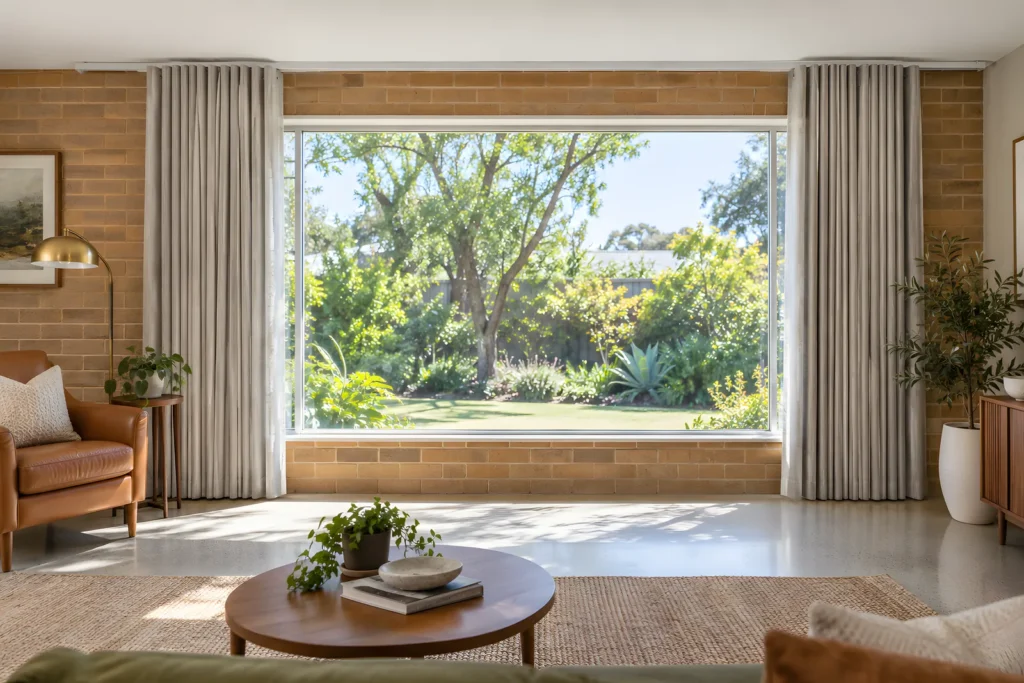
Modern curtain ideas are mostly about restraint:
- Keep the palette to two tones. A light sheer and a matching blind in the same family look considered.
- Use a plain track. The Designer track has a plain straight profile, and it comes in silver, black or white. Choose the colour to match the ceiling or window frame.
- Choose a clean heading. Inverted Pleat has a flat front, and S Fold is relaxed without being fussy.
- Add a box pelmet if you want to hide the track and finish the top.
- Consider motorised curtains for a wide window, so they open and close with a remote.
Curtain ideas for bay windows, corners and doors
Living rooms often have a bay window, a corner window or a sliding door, and each needs a track that follows the shape.
- Bay windows. A box and bay curtain track is made for 45 and 90 degree bays, and a curved track follows a gentle curve. Both take S Fold, Pencil Pleat or Pinch Pleat headings. Measure with our box and bay curtains measuring guide, and send us a photo and a plan sketch of the window if you want the layout checked.
- Corner windows. Two straight tracks can meet at the corner, and the curtain measuring guide explains how to measure that join. Curved tracks can bend up to two 90 degree corners online.
- Sliding and stacker doors. Curtains need a wide stack-back so the doorway stays clear, and a track that runs past both sides of the frame. Read curtains for sliding and bifold doors for the details.
Curved tracks are available in Designer and Motorised styles only.
How to choose curtains for a living room
- Decide the job. Is it glare, privacy, television darkness or simply a finished look?
- Choose the fabric. Sheer for daylight, blockout or a lining for evenings.
- Pick a heading. S Fold for relaxed, pinch pleat for tailored, inverted for modern.
- Plan the track. Ceiling or wall fit, opening direction, stack-back and any furniture nearby.
- Order free samples. Check them against your walls and floor.
Tip: Hold your samples up to the window in daylight, then again at night with the lamps on. Both sheer and blockout fabrics change colour once the room is lit.
Questions
What curtains look best in a living room?
S Fold sheers on a ceiling-fixed track are the most popular choice, with regular waves and a soft, tall look. Pair them with a roller blind or a blockout layer if you want control in the evening.
How do I choose curtains for a living room?
Decide the job first, whether glare, privacy or a darker room for television. Then choose the fabric, the heading and the track, allow clear wall for the stack, and check samples in your own light.
Can sheer curtains work on their own in a living room?
Yes, for daytime softness and some privacy. At night with the lights on, people outside can see in, so add a blind, lined curtains or a blockout layer on a second track.
How wide should living room curtains be?
The track should be at least 30 per cent wider than the window to frame it. We calculate the fullness for you, so you give us the track width rather than the fabric width.
What is the difference between S Fold and pencil pleat?
S Fold makes regular, relaxed waves and has the deepest profile of our five headings. Pencil pleat gives a more gathered, traditional heading and is often used as the rear layer behind an S Fold front.
Build S Fold curtains
Choose your fabric, heading and track and see the price for your window.
Keep reading
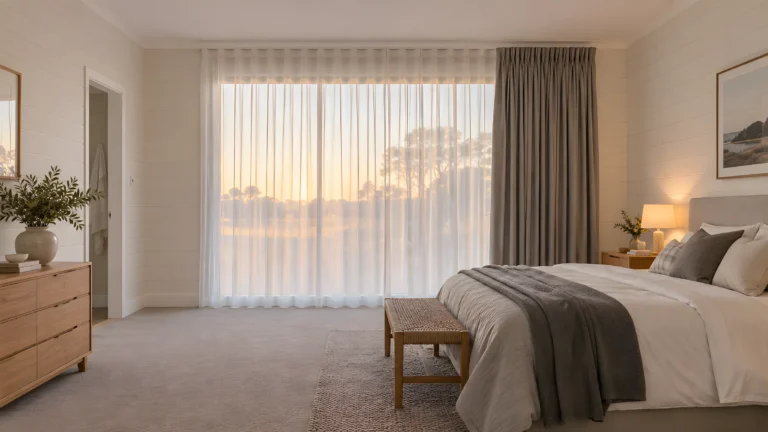 CurtainsHow to layer sheer and blockout curtainsHang the sheer at the front and the blockout behind on a double track, or choose a lining. Here is how to pick fabrics, headings, colours and depth.
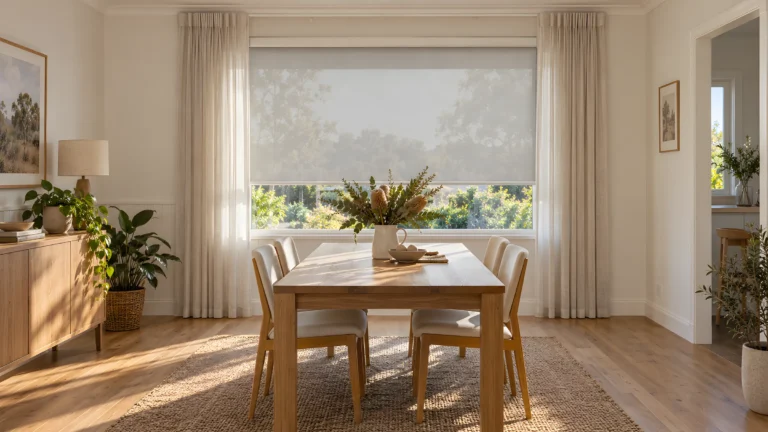 Room ideasDining room curtain and blind ideasDining room window ideas for glare at lunch, privacy at dinner and easy care near food, from SunScreen and double roller blinds to sheers and lined curtains.
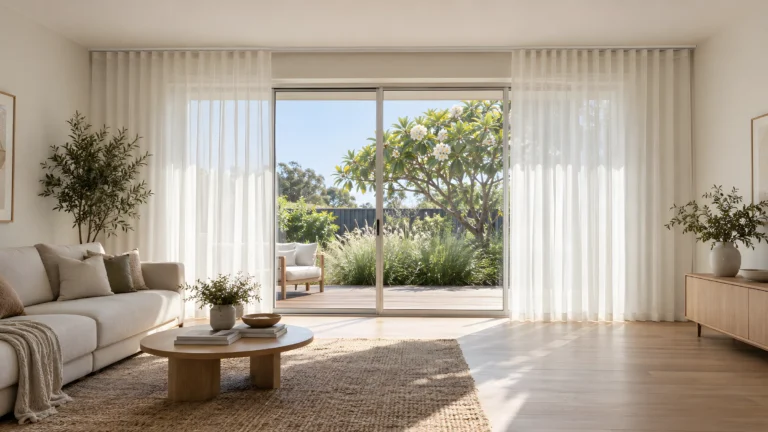 Room ideasSheer curtain ideas for Australian homesPractical sheer curtain ideas for Australian homes: how to hang them, which colours to try, and how to get night privacy in a bedroom.