
Roller blind parts: chains, brackets and replacement
Know your roller blind parts: tube, brackets, clutch, chain, base rail and more. Learn what each does and when to replace the chain or the whole blind.
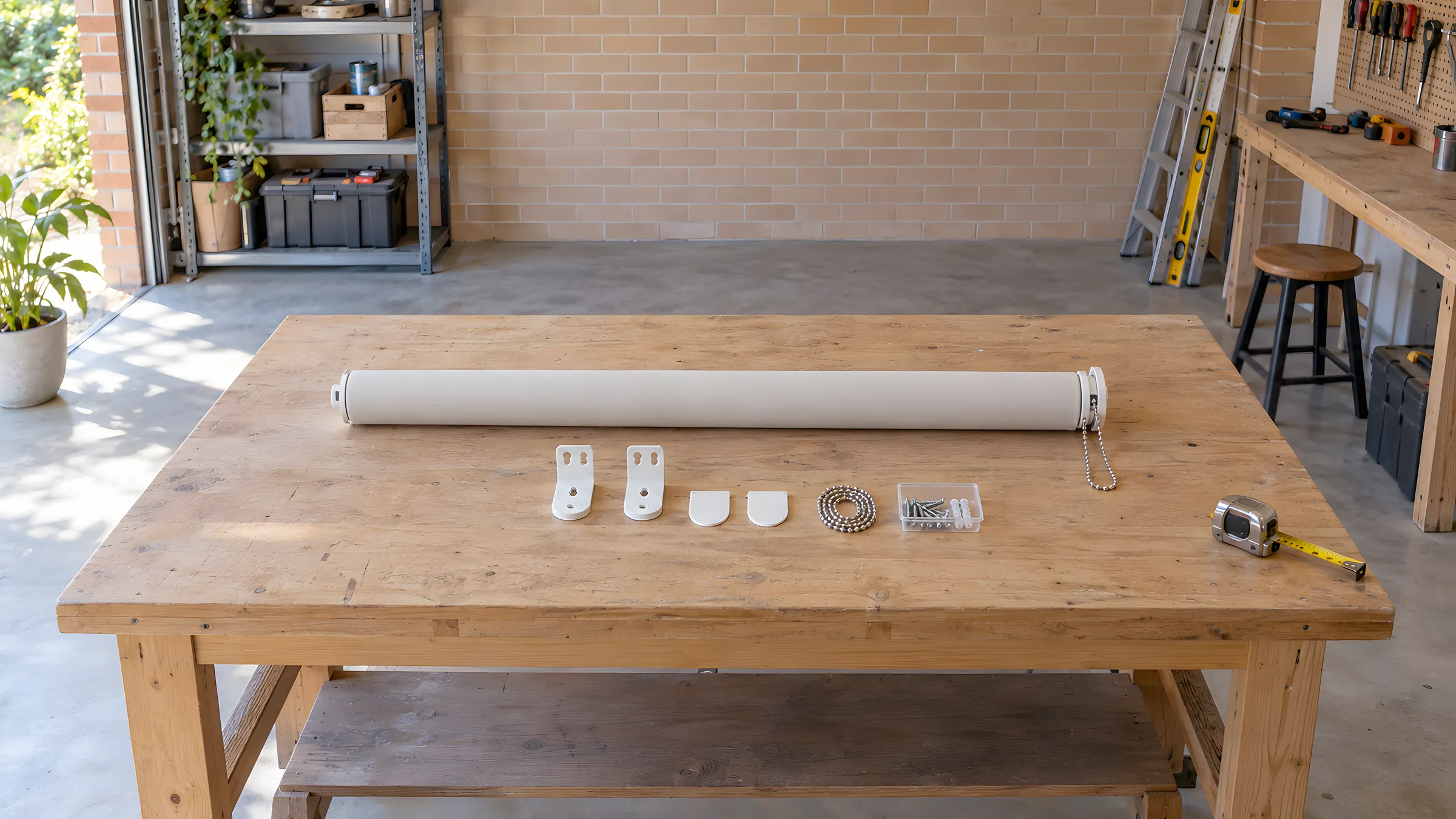
Roller blind parts are fewer than you might expect: fabric wound on a tube, a bracket at each end, a control at one end and a base rail along the bottom. Fascias, side covers and cassettes are optional extras. Knowing the names helps you describe a fault, judge whether a repair is realistic, and see when a new blind is the simpler answer.
In short
- The core parts are the fabric, tube, two brackets, the control (chain with clutch, ZeroGravity spring or motor) and the base rail.
- Our tube is 38 mm, or 50 mm for blinds wider than 2100 mm.
- A bead chain is a closed loop joined by a small connector, and any chain safety device must be refitted after a repair.
- We do not sell spare parts separately. For a blind from us, contact us with your order details.
- Torn, faded or marked fabric is usually a reason to replace the whole blind.
Roller blind parts and what they do
Every roller blind follows the same layout, whatever the fabric or control. This table covers the parts of a typical blind from our range.
| Part | What it does | Good to know |
|---|---|---|
| Fabric | Blocks or filters light | Blockout, light filter or SunScreen, in ranges from Shade to Screen |
| Tube | The aluminium roller the fabric winds onto | 38 mm as standard. Blinds wider than 2100 mm use 50 mm automatically |
| Brackets | Hold the tube at each end and fix to the window or wall | White, grey, ivory, latte or black |
| Clutch (control end) | Holds the blind at any height and turns the tube | Larger chain blinds get spring assistance. Over 2500 mm wide gets an upgraded gear-drive clutch at no extra charge |
| Chain | Turns the tube when you pull it | Metal, White, Birch, Beige, Grey, Black or Stainless Steel |
| Chain safety device | Stops the chain forming a loop | Supplied with SunBoss chain blinds, limiting the loop to 220 mm |
| ZeroGravity spring | Balances the blind so it holds where you leave it | No chain. Suits blinds up to 3 m wide by 3 m drop |
| Motor | Turns the tube from a remote or app | Silent Glide, in battery, hardwired and C-Bus versions |
| Base rail | Weights the bottom of the fabric | Deluxe oval or flat. An optional insert cushions the oval rail |
Optional parts: fascia, side covers and cassette
Some blinds carry extra parts that change how the top looks.
- Side covers finish the ends of the blind.
- Fascia is a decorative cover that conceals the hardware along the top. It is ordered with the blind and comes with its own matching brackets and side covers. It is a face-fit system and is not a cassette, so it does not remove every light gap.
- Cassette is a full enclosure: a headbox, side channels and a bottom channel. A cassette is ordered together with a compatible under-roll blockout blind. It cannot be retrofitted to an existing blind, and it needs 50 mm of clear depth. Our cassette roller blinds page has the detail.
Chains, joiners and connectors
The chain of a chain blind is a closed loop of beads that runs around the clutch at the control end. Most loops are closed with a small connector, often called a roller blind chain joiner or chain connector. Pulling either side turns the tube, and the clutch holds it where you stop.
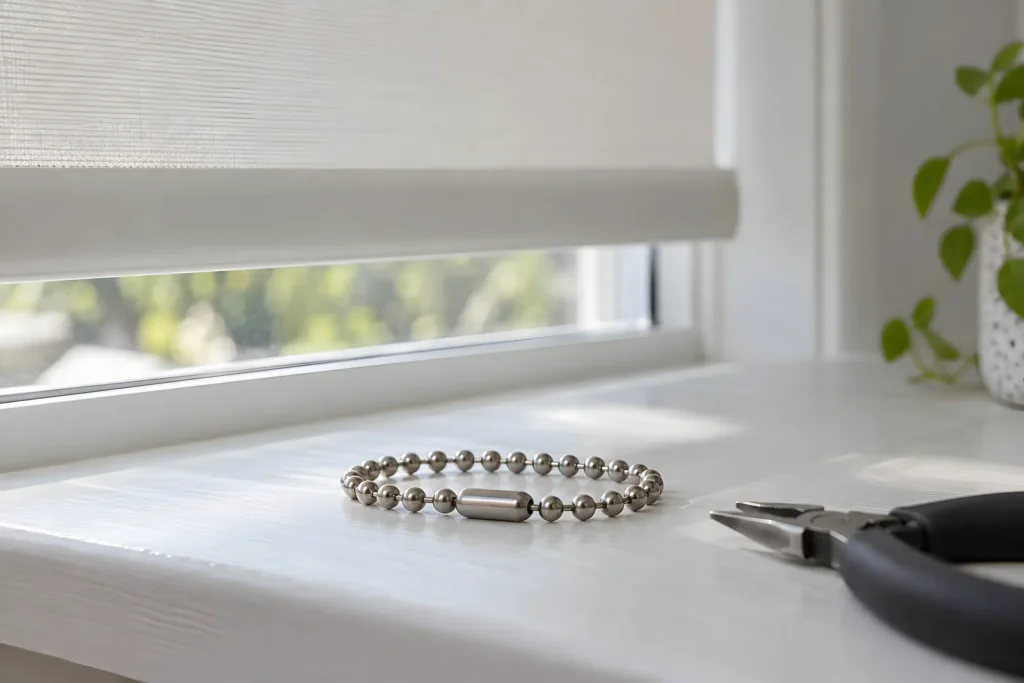
If you are searching for roller blind chain replacement, first work out what has failed. A chain that has jumped off the clutch, or a blind that will not hold its height, is covered in our guide to roller blind chain problems. If the loop has broken at the connector, keep these points in mind:
- The chain must match. Bead size, style and colour need to suit your clutch, so a random replacement may slip or jam.
- The safety device must go back on. After any chain repair, check that it is fitted as instructed and still stops the chain forming a loop over 220 mm.
- Stainless steel suits coastal homes. It resists rust and corrosion better than the standard metal chain.
- Do not improvise. A knot, a paperclip or tape can stop the blind working and can create a hazard.
Our cordless roller blinds and motorised roller blinds have no chain, which removes this part of the maintenance altogether.
Double, linked and motorised blinds
A few blinds carry extra parts, and it helps to know which you have.
- Double roller blinds hold two tubes on one set of dual brackets, with a daylight layer and a blockout layer that are operated independently. Each layer has its own control.
- Linked roller blinds put two or three blinds on shared brackets, which keeps the join gap to about 17 mm, against 30 mm or more between separate blinds. Each blind keeps its own control.
- Motorised blinds replace the chain and clutch with a motor. A battery motor drives one blind, so linked blinds need a motor each, and it needs a charger. Hardwired motors are installed by a licensed electrician.
Which parts can be fixed
Match the fault to the part, then decide what is realistic to do yourself.
| Fault | Part involved | Realistic route |
|---|---|---|
| Blind rolls up crooked | Brackets | Refit them following the installation guide |
| Chain slips or jams | Chain and clutch | Try the steps in the chain guide, and contact us if it persists |
| Chain has broken or come apart | Chain, connector | Contact us with a photo and your order details |
| Blind will not hold its height | Clutch or spring | Contact us, because it is not something to open yourself |
| Bracket is cracked or loose | Bracket and fixings | Refit it as the installation guide describes, or contact us if it is cracked |
| Fabric is torn, marked or faded | Fabric | Usually a new blind (see below) |
| Motor does not respond | Motor, battery or remote | Charge the battery and check the remote, then contact us |
Roller blind spare parts and fabric replacement
We do not sell spare parts such as chains, connectors, brackets, clutches or safety devices separately. If your blind came from us, contact us with your order details and a clear photo of the problem. Say which window the blind is from, where the control is and what happens when you use it. The roller blind warranty covers materials, mechanisms and components, and our warranty page explains how it works alongside SureFit measurement protection.
Roller blind fabric replacement is rarely worth attempting. The fabric is cut to the blind's exact width and fitted to the tube when the blind is made, and an off-centre or crooked re-cover leads to a blind that rolls sideways. A new blind in the same size is the simpler route, and it gives you the chance to change the fabric, colour or control.
If you are unsure of the right size, measure the window again with our roller blinds measuring guide rather than copying the old blind. Lakeside fabric can vary slightly in colour between batches, so a new blind may differ a little from an older one beside it.
When to replace the whole blind
Replace the blind, rather than hunt for parts, when:
- the fabric is torn, stained, faded or no longer rolls evenly
- several parts are worn at once
- the blind came from another supplier and its parts cannot be identified
- you want a different control, such as cordless or motorised, to remove the chain
- the window has changed, or you want a different fit, such as face fit rather than recess
Take the old blind down carefully first. Our guide to how to remove a roller blind shows the steps, and photographs of the brackets and control end will help when you order.
Tip: Keep the order label or the window name from your original order. It makes any conversation about the blind, whether you are repairing it or replacing it, much quicker.
Questions
What are the main parts of a roller blind?
Fabric wound on a tube, a bracket at each end, a control at one end (a chain with clutch, a ZeroGravity spring or a motor) and a base rail. Fascia, side covers and cassettes are optional extras.
Can I buy a roller blind chain connector or joiner?
We do not sell chain connectors or other spare parts separately. If your blind came from us, contact us with your order details and a photo, because the connector and the safety device both need to match your blind.
Can I replace the fabric on a roller blind?
Fabric is cut and fitted to the tube when the blind is made, so the simpler route is a new made-to-measure blind in the same size.
What size tube does my roller blind have?
Our roller blinds use a 38 mm tube as standard. Blinds wider than 2100 mm use a 50 mm tube, and a 50 mm tube can also be chosen to match a larger neighbouring blind.
When should I replace the whole roller blind?
Replace it when the fabric is torn, marked or faded, when several parts are worn, or when you want a different control such as cordless or motorised.
Replace the whole blind
Build a new roller blind to your measurements, choose your fabric and control, and see the price before you order.
Keep reading
 Care & cleaningRoller blind chain problems and how to fix themChain slipped off, blind won't stay up or rolling crooked? A quick diagnosis table and safe step-by-step fixes, plus when to stop and contact us.
 Measuring & fittingHow to remove roller blinds (and put them back)How to take down a roller blind safely, label it and put it back the right way round, with the installation guide to follow for your blind type.
 BlindsChain, cordless or motorised: choosing roller blind controlsChain, cordless or motorised? How each roller blind control works, what limits apply and which suits a bedroom, nursery, home theatre or wide window.