
Standard roll or reverse roll: which way should your blind roll?
Standard (under) roll blocks more light and needs less depth. Reverse (front or over) roll hides the tube and clears handles. Here is how to choose.
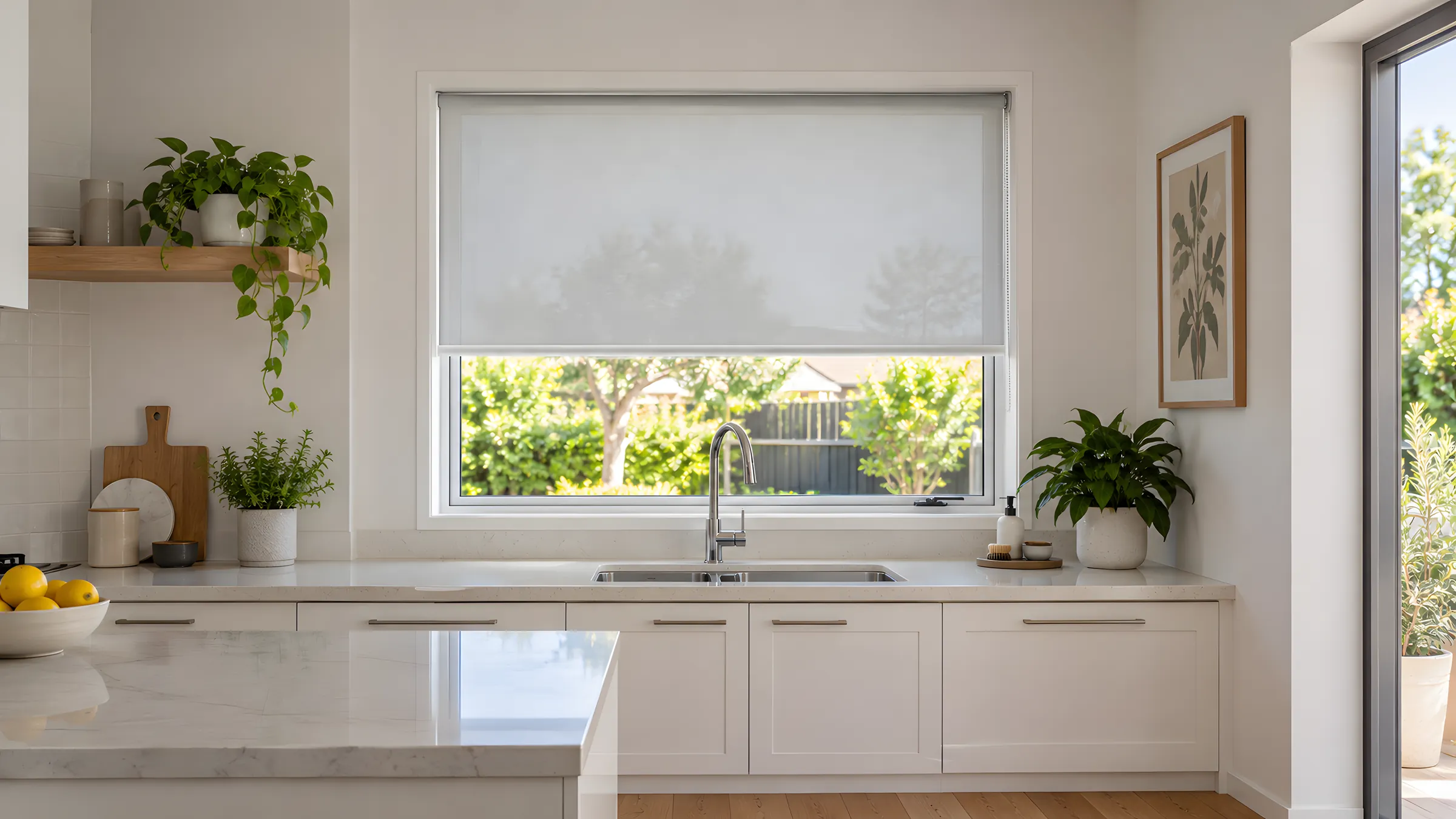
Reverse roll vs standard roll comes down to where the fabric leaves the tube. A standard roll (also called an under roll) drops the fabric from the back of the tube, close to the glass, and blocks more light. A reverse roll, which is also called a front roll or an over roll, drops it from the front of the tube, so the tube is hidden and the fabric clears handles and winders, but it sits farther from the glass. Choose standard roll by default, and reverse roll when something is in the way.
In short
- Standard (under) roll: fabric drops from the back of the tube, closer to the glass, blocks more light and needs 45 mm of recess depth on a single blind.
- Front (over or reverse) roll: fabric drops from the front, hides the tube, clears handles and winders, sits farther from the glass and needs 70 mm.
- A Full Blockout Cassette needs an under-roll, so a front roll is not possible.
- With a standard roll, the backing shows at the top of the roll.
- Face fit with an under-roll is the recommended setup.
Reverse roll vs standard roll: the differences at a glance
Front roll, over roll and reverse roll are three names for the same thing. Standard roll and under roll are two names for the other.
| Standard roll (under roll) | Front roll (over roll, reverse roll) | |
|---|---|---|
| Fabric leaves the tube | At the back | At the front |
| Distance from the glass | Closer | Farther |
| Light control | Blocks more light | Leaves more space between fabric and glass |
| The tube | Visible in the room | Hidden |
| Handles and winders | May be in the way | Cleared |
| Single blind recess depth | 45 mm | 70 mm |
| Double roller recess depth | 70 mm with both under-rolled | 90 mm with both over-rolled (recommended recess setup) |
| Full Blockout Cassette | Required | Not possible |
How each roll direction works
Standard roll (under roll)
The fabric leaves the back of the tube and hangs close to the glass. That closeness is what makes it the better light blocker: there is less space for light to slip between the fabric and the window. It also needs less recess depth, 45 mm on a single blind, which helps when a reveal is shallow.
The trade-offs are that the tube stays visible from the room and that the blind sits closer to anything on the window, such as a handle or winder.
With a standard roll, the backing shows at the top of the roll. That matters most with a dark colour on a white backing, because the white band at the top of the roll is easy to see.
Front roll (over roll, reverse roll)
The fabric leaves the front of the tube and hangs a little farther from the glass. The tube is hidden behind the fabric, and the blind clears window handles and winders. In a recess, it needs 70 mm of depth on a single blind, so check your reveal first.
The cost is light control. With more space between the fabric and the glass, a front roll gives up some of the light blocking that a standard roll provides. It is a good choice when clearance is the problem, and not the first choice for a bedroom.
Five questions to decide
- Is anything in the way? A handle, winder or crank that touches the lowered blind points to a front roll. In a kitchen, check taps and handles separately: a front roll can clear a handle, but it hangs farther into the room, so check clearance at the tap as well. Kitchen blinds has the room guidance.
- How dark do you need the room? For the most light control, choose a standard roll, face fit, and blockout fabric. See how to reduce light gaps around roller blinds for the full set of fixes.
- How deep is the recess? A single blind needs 45 mm for an under-roll and 70 mm for an over-roll, a 25 mm difference. A double roller needs 70 mm both under-rolled or 90 mm both over-rolled. Our guide to window depth for blinds explains each case.
- Do you want the tube hidden? A front roll hides it. A fascia also conceals the hardware, is a face-fit system, and is not a cassette; see what is a pelmet.
- Will the backing show? Shade is the same colour on both sides. Serene II and Lakeside have a colour-coordinated backing. Serene, Ultra, Array, Allure, Elegance and Opulence have a white backing. Check the reverse of a sample using the free samples service before you order.
Tip: If you are torn, choose standard roll for bedrooms and media rooms, and front roll only for the specific windows where a handle, winder or crank forces the issue. Choose roll direction window by window.
Which roll direction for which room
| Window or room | Usually | Why |
|---|---|---|
| Bedroom | Standard roll, face fit | Blocks more light. See bedroom blinds |
| Nursery or home theatre with a cassette | Standard (under) roll | A cassette needs an under-roll |
| Kitchen window with a handle | Front roll | Clears a handle; check clearance at the tap too |
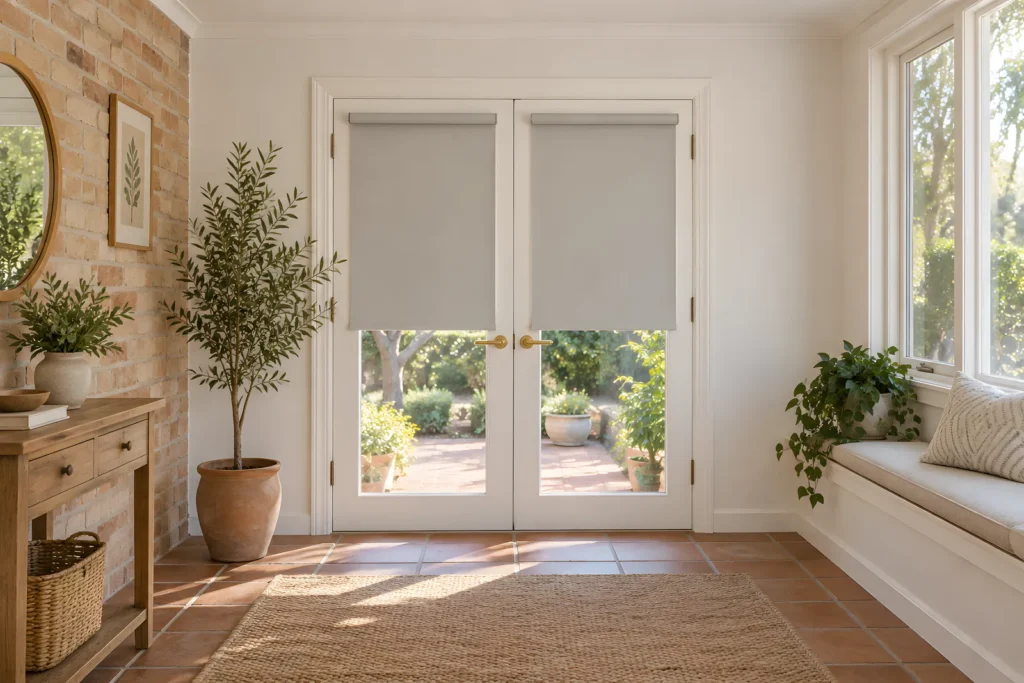
| French doors | Front roll | Front-roll rollers suit door handles. See blinds for French doors |
| Window with a winder or crank | Front roll | Clears winders and handles |
| Shallow reveal | Standard roll | Needs 45 mm instead of 70 mm |
Roll direction, fit and cassettes
Roll direction works together with fit. Face fit with an under-roll is the recommended setup, because the under-roll blocks more light and the face fit cuts the side gaps and clears obstructions. Recess fit is neater but leaves small light gaps at each side, and the roll direction you pick decides how deep the recess needs to be. (Some sites call these inside mount and outside mount.) Recess fit or face fit helps you choose between them.
A Full Blockout Cassette is the strongest answer to edge light. It is ordered together with a compatible under-roll blockout blind, matched by dimensions and window name, and it cannot be retrofitted. Front roll is not possible with it. Read more on the cassette roller blinds page.
A clearance check and common mistakes
Before you order, check any window that has something near the glass.
Check clearance
Note where the handle, winder or crank sits when the window is shut, and look for a tap, sill ledge or latch near the glass. A standard roll hangs close to the glass, so anything that projects will sit in its path. If a handle, winder or crank is in the way, choose a front roll for that window. If a tap or ledge is the problem, consider a face fit, which mounts on the wall or frame and clears obstructions. If nothing is in the way, keep the standard roll. How to measure clear depth is in the roller blinds measuring guide.
Mistakes to avoid
- Choosing front roll for looks in a bedroom. It hides the tube, but it gives up some of the light control that a standard roll provides.
- Planning to add a cassette later. A cassette is ordered together with the blind and cannot be retrofitted.
- Ordering an over-roll for a shallow reveal. A single over-roll needs 70 mm of recess depth, which is 25 mm more than an under-roll.
- Using one roll direction for every window. A kitchen window with a handle and a bedroom window with none can sensibly differ.
Choosing the roll direction when you order
You choose roll direction in the configurator, along with fabric, controls and fit. Measure each window with our official roller blind measuring guide, which covers recess and face fit. The roller blinds buyer's guide puts roll direction in the context of every other choice.
Questions
What is the difference between reverse roll and standard roll?
A standard roll drops the fabric from the back of the tube, closer to the glass, and blocks more light. A reverse roll drops it from the front, which hides the tube and clears handles but sits farther from the glass.
Are front roll, over roll and reverse roll the same thing?
Yes. Front roll, over roll and reverse roll all mean the fabric drops from the front of the tube. Standard roll and under roll are the same thing.
Which roll direction blocks more light?
A standard (under) roll blocks more light because the fabric hangs closer to the glass.
Which roll suits a window with a handle in the way?
A front roll, because it sits farther from the glass and clears handles and winders. In a kitchen, also check taps and handles before you order.
Can I choose a front roll with a Full Blockout Cassette?
No. A cassette is ordered with a compatible under-roll blockout blind, and a front roll is not possible.
Build your roller blind
Choose your roll direction and fit, enter your measurements and see the price before you order.
Keep reading
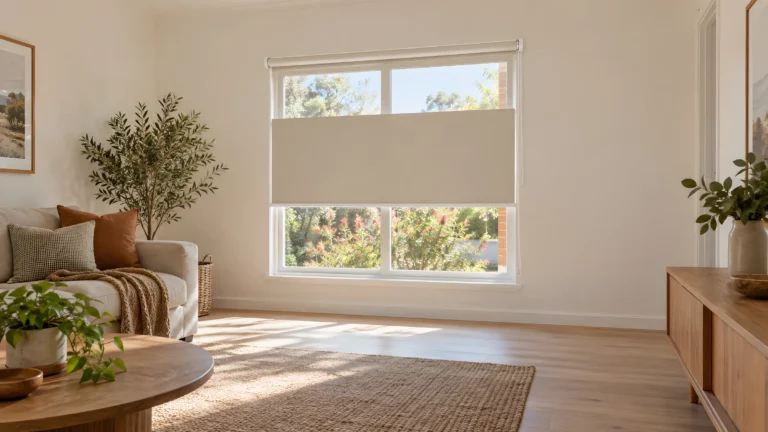 BlindsRoller blinds: the complete buyer's guideFabric, colour, controls, fit, roll direction and special formats: every decision in ordering a made-to-measure roller blind, in the order you make it.
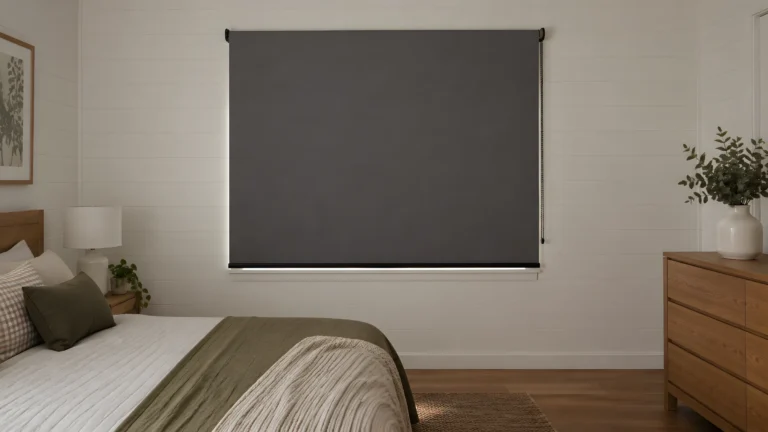 BlindsHow to reduce light gaps around roller blindsLight gaps come from fit, not just fabric. Compare face fit, under-roll, side channels, linked blinds and layering to get the darkest room a roller blind allows.
 Measuring & fittingRecess fit or face fit? How to decide before you measureRecess fit sits inside the window opening; face fit mounts on the wall or trim around it. Here is how to choose, and what changes when you measure.