
Roller blinds: the complete buyer's guide
Fabric, colour, controls, fit, roll direction and special formats: every decision in ordering a made-to-measure roller blind, in the order you make it.
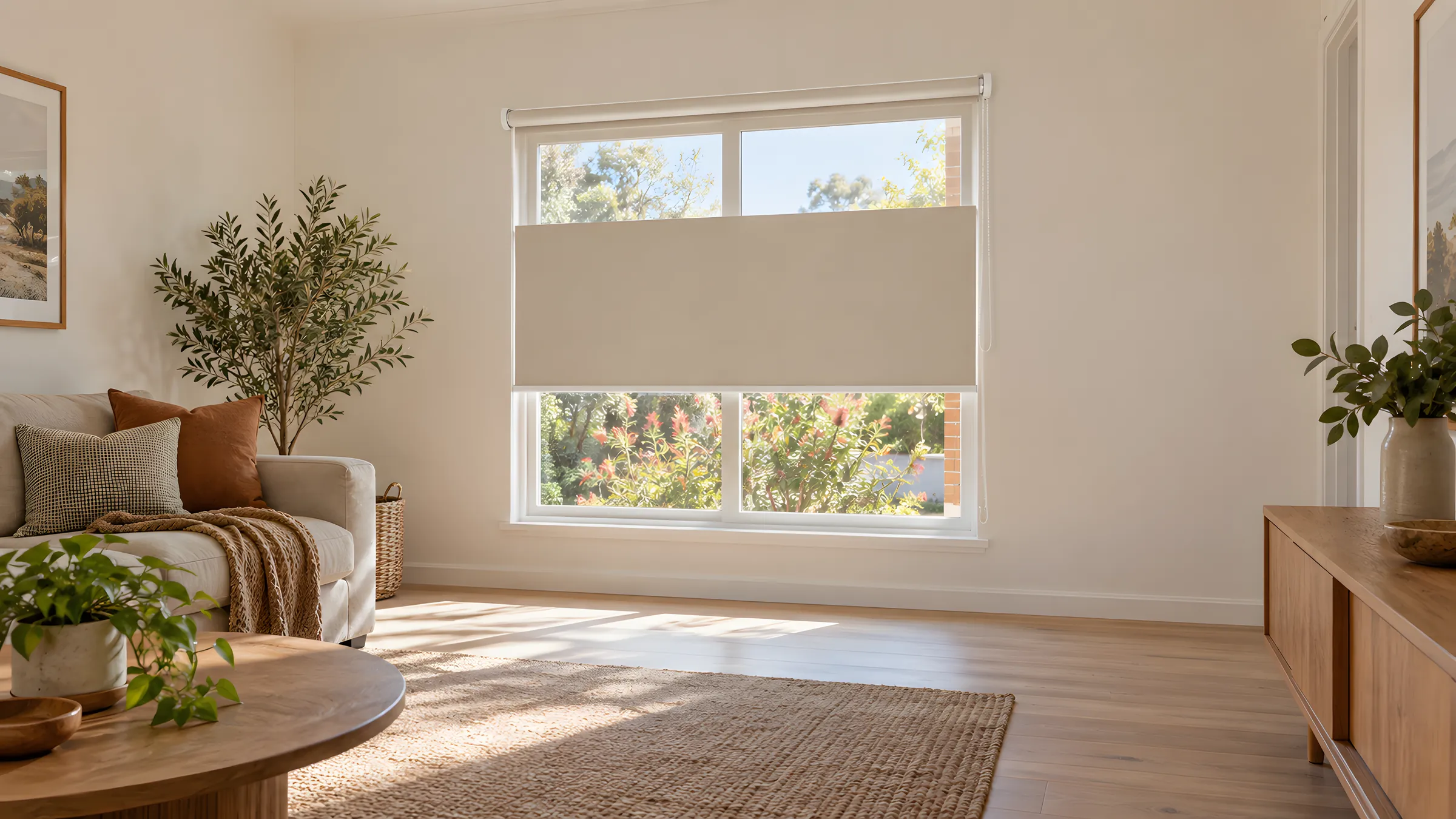
A roller blind is one piece of fabric wound onto a tube, and every choice in this roller blinds guide comes down to three things: what the fabric does with light, what turns the tube, and where the tube sits in your window. Get those right and colour and hardware are detail. This guide takes the decisions in the order you make them when you order a made-to-measure roller blind.
In short
- Choose the fabric type first: blockout for privacy and darkness, light filter for soft daylight, SunScreen for glare control with a view.
- Then choose the controls: chain, cordless or motorised.
- Decide recess or face fit, and standard or front roll, before you measure, because they change the depth you need.
- Cassette, linked and double roller blinds solve light gaps, wide windows and day-and-night control.
- Order free samples and measure every window with our official roller blind measuring guide.
Roller blinds guide: how they work and what they are made of
A roller blind is a length of fabric fixed to a tube. Brackets hold the tube at each end, and a control at one end turns it. The fabric winds onto the tube to raise the blind and unwinds to lower it. Everything else in this guide is a variation on that mechanism.
Our roller blinds are made to your measurements in Australia. You enter your window sizes in the online configurator, choose fabric and controls, and see the price before you order.
What roller blind fabric is made of
Our blockout fabrics are coated polyester. Shade, for example, is 100% polyester with an acrylic coating, and Lakeside is 100% polyester with a colour-coordinated acrylic coating. The coating is what helps the cloth stop light passing through.
SunScreen is a different construction. It is a woven fabric, 30% polyester and 70% vinyl on polyester, with about 5% openness, which is why it cuts glare and still lets you see out.
Holland blinds and roller blinds
Holland blind is an older name for a roller blind, and most people now use the two terms for the same product. When you compare suppliers, compare the fabric, the controls and the fit rather than the label.
Fabric type and range: blockout, light filter or SunScreen
The fabric type decides how the blind handles light and privacy, so settle it before you look at colours.
| Blockout | Light Filter | SunScreen | |
|---|---|---|---|
| Light through the cloth | Stopped | Diffused | Some passes through the weave |
| View out | None | Obscured | Kept |
| Daytime privacy | Yes | Yes, the view is obscured | Only when it is brighter outside than inside |
| Night privacy | Yes | Silhouettes may show when lights are on | Not a night-privacy fabric |
| Best for | Bedrooms, nurseries, media rooms | Living areas, bathrooms, laundries | Kitchens, offices, dining rooms |
Blockout
Blockout stops light passing through the cloth and gives you privacy at night. Many people search for "blackout blinds"; it is the same product, and blockout is the usual Australian term. The word describes the fabric, not the room. Light still enters around the edges of a conventional roller blind, so a blockout blind makes a room much darker but not fully dark. Our guide to blockout vs blackout blinds explains where the light gets in, and the blockout roller blinds page shows every range.
There are nine blockout ranges: Shade, Serene, Serene II, Ultra, Array, Allure, Elegance, Lakeside and Opulence. Shade is a matte fabric in ten colours. Lakeside has a texture inspired by exposed bedrock and comes in twelve colours. The other ranges differ in texture, colour palette and backing, which is easiest to judge with a sample in your hand.
Light filter
Light Filter fabric diffuses daylight and obscures the view, so a room stays bright without feeling exposed. It suits spaces where you want daylight and privacy but not darkness. At night with the lights on, silhouettes may show from outside. There are four LF ranges: Serene LF, Ultra LF, Array LF and Opulence LF. See light filter roller blinds for colours.
SunScreen
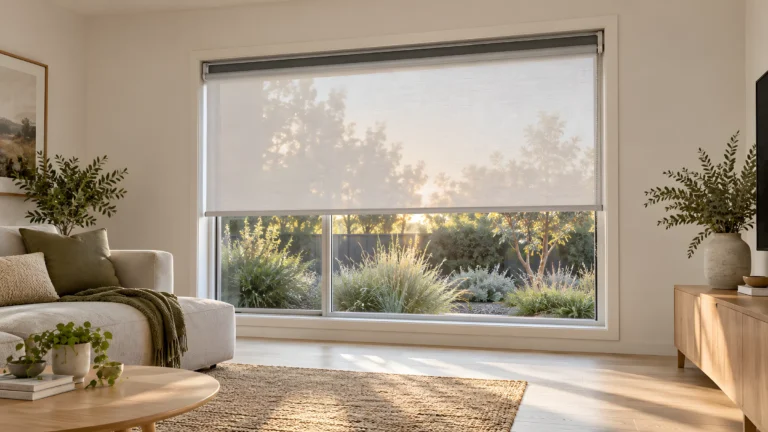
SunScreen is the Screen range, in seven colours: Ice, White Linen, White Grey, Mist, Dolphin, Charcoal Grey and Charcoal. (White Linen is a colour name, not a material.) It cuts glare and keeps the view of the garden or street. It gives daytime privacy only when it is brighter outside than inside, and it is not a night-privacy fabric, so pair it with something else where you need privacy after dark. The full detail is on the SunScreen roller blinds page, and our comparison blockout, light filter or SunScreen goes deeper on choosing between them.
Backing colour
The back of the fabric matters because, with a standard roll, it shows at the top of the roll.
- Shade is the same colour on both sides.
- Serene II and Lakeside have a colour-coordinated backing.
- Serene, Ultra, Array, Allure, Elegance and Opulence have a white backing.
If you are choosing a dark colour in a white-backed range, look at the reverse side of the sample before you commit.
Choosing a colour
Order free samples and look at them in your own light, in the morning and evening, held against your walls, floor and window frames. A fabric used across several products counts as one sample, and a sample pack gives you four hand-picked colours at a time. The free samples page has the details, and how to choose blind colours covers the styling side.
Some starting points by colour:
- White: Shade Ice, Ultra Cool White, Allure Snow.
- Black and charcoal: Array Jet, Elegance Obsidian, Screen Charcoal.
- Grey: Ultra Ash Grey, Array Moon Grey, Screen White Grey.
- Beige and cream: Shade Biscuiti, Ultra Cream, Allure Griege.
Best roller blinds for bedroom, kitchen and other rooms
Room use narrows the fabric choice quickly.
| Room | Suits | Notes |
|---|---|---|
| Bedroom | Blockout, Full Blockout Cassette, double roller, face fit | See bedroom blinds |
| Nursery | ZeroGravity cordless, blockout, cassette | See nursery blinds |
| Home theatre | Blockout, Full Blockout Cassette, motorised | See home theatre blinds |
| Home office | SunScreen, Light Filter | Cuts glare and keeps the view. See home office blinds |
| Living room | Light Filter, SunScreen, double roller | Daylight by day, more privacy when needed. See living room blinds |
| Dining room | SunScreen, double roller | Keeps the view. See dining room blinds |
| Kitchen | SunScreen, Light Filter | Not cassette; check clearance at taps and handles, and avoid drenching. See kitchen blinds |
| Bathroom and laundry | Light Filter, Blockout | Keep out of direct splashing; PVC shutters are the wet-area alternative. See bathroom blinds |
Roller blinds for a bedroom
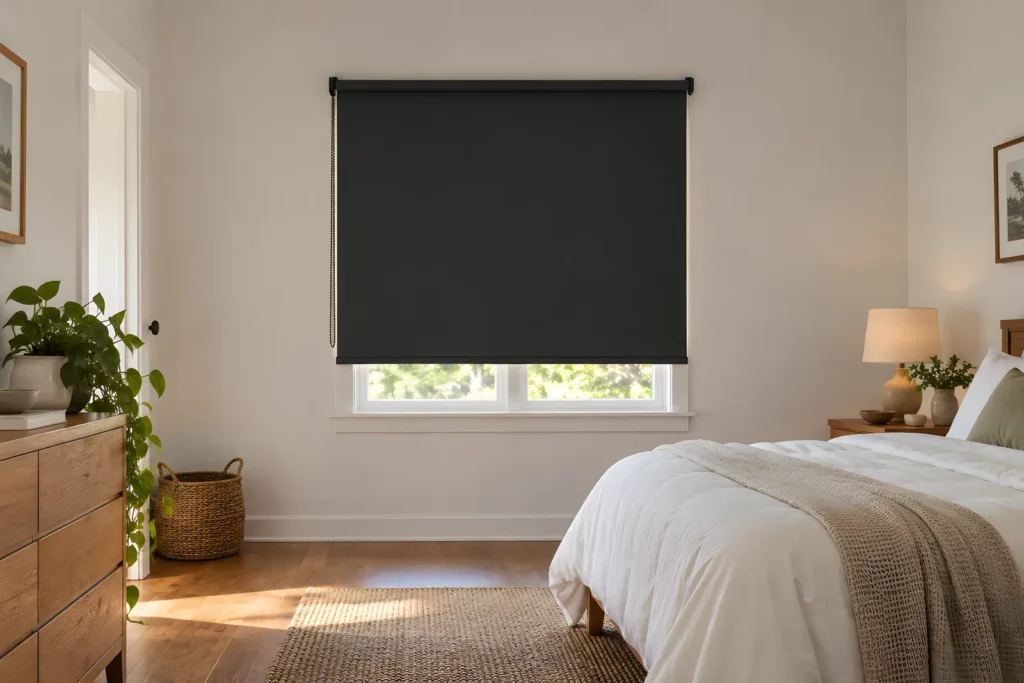
For a bedroom, start with blockout in a standard (under) roll, face fitted so the fabric overlaps the window opening. That combination keeps edge light down as far as a conventional blind allows. If light at the edges still bothers you, step up to a Full Blockout Cassette, or choose a double roller so you have a light filter or SunScreen layer by day and the blockout layer at night. A darker room can make it easier to sleep, and the edges are where most of the remaining light comes from.
Kitchens, bathrooms and laundries
Roller blinds are fine in a kitchen as long as they do not get drenched, so SunScreen and Light Filter are the usual choices, and cassette systems are not used there. Check that the lowered blind clears taps and handles; a front roll can help with a handle. In bathrooms and laundries, Light Filter and Blockout work where they stay out of direct splashing. PVC plantation shutters are the more forgiving choice in a wet room.
Chain, cordless or motorised controls
Three control systems are available, and the right one depends on who uses the blind, how large it is and whether you want to run it from across the room. Our guide to roller blind controls covers each one.
| System | How it works | Good to know |
|---|---|---|
| SunBoss chain drive | Pull the chain to raise or lower; chain on the left or right | Spring assistance on larger blinds; chain safety device supplied |
| ZeroGravity cordless | Lift or lower by the base rail; spring-balanced and holds at any height | No chain; up to 3 m wide by 3 m drop |
| Silent Glide motorisation | Remote, plus app and voice control with a compatible smart hub | Battery, hardwired or C-Bus motors |
Chain. The SunBoss chain drive is the simplest and most familiar option. A safety device is supplied to stop the chain forming a loop over 220 mm. Keep chains out of reach of children, and consider cordless or motorised controls for a nursery or kids' room.
Cordless. With cordless roller blinds there is no chain at all. You lift or lower the blind by the base rail and it stays where you leave it.
Motorised. A rechargeable battery motor is DIY-friendly because it needs no mains wiring, though it needs a charger and each blind needs its own motor. A hardwired motor is installed by a licensed electrician. A C-Bus option exists for homes with an existing C-Bus system. Remotes come in 2-channel and 16-channel versions, and a compatible smart hub adds scenes, timers, sunrise and sunset triggers, and Alexa and Google Home voice control. The motorised roller blinds page covers the options.
Recess or face fit, standard or front roll
These two decisions change how the blind looks and how much light gets past it, so make them before you measure.
Recess fit or face fit
A recess fit sits inside the window reveal and looks neat, but it leaves small light gaps at each side: about 20 mm on the chain side and 10 to 20 mm at the pin end. A face fit mounts on the wall or frame around the window, covers more and cuts the gaps, and it also clears obstructions. (Some sites call these inside mount and outside mount.) Our guide to recess fit or face fit helps you choose.
For a single roller blind you need 70 mm of recess depth for an over-roll and 45 mm for an under-roll. If your reveal is shallow, see window depth for blinds before you decide.
Standard roll or front roll
With a standard (under) roll, the fabric drops from the back of the tube, closer to the glass, and blocks more light. With a front (over or reverse) roll, the fabric drops from the front of the tube, which hides the tube, clears handles and winders and sits farther from the glass. Standard roll is the usual choice for bedrooms and for face-fit blinds; front roll is what to reach for when a window handle or winder is in the way. The full comparison is in standard roll or reverse roll.
Tip: Face fit with an under-roll is the recommended setup. The under-roll blocks more light and the face fit cuts the side gaps and clears obstructions.
Tubes, brackets, base rails and fascias
The hardware is where a roller blind is matched to your window and your décor.
Tubes
Roller blind tubes come in two sizes only: 38 mm and 50 mm. The 38 mm tube is standard. Blinds wider than 2100 mm use the 50 mm tube automatically, and you can choose the 50 mm upgrade on a narrower blind to match a larger neighbour. A blind over 2500 mm wide gets an upgraded gear-drive clutch at no extra charge.
Brackets, chain and base rail
- Brackets: white, grey, ivory, latte or black.
- Chain: Metal, White, Birch, Beige, Grey, Black or Stainless Steel. Stainless is recommended for coastal homes.
- Base rail: the deluxe oval in Anodised, White, Black or Cream, or a flat rail. An optional insert cushions the oval rail.
- Side covers: available for the ends of the blind.
Fascia
A decorative fascia conceals the hardware. It is ordered with the blind and comes with matching brackets and side covers. It is a face-fit system, and it is not a cassette, so it does not remove every light gap. A fabric-wrapped fascia cannot be made in Screen or Shade fabric. If you are comparing a fascia with other pelmet-style finishes, what is a pelmet sets out the differences.
Cassette, linked and double roller blinds
Three special formats solve problems a single blind cannot:
Full Blockout Cassette
The cassette roller blinds have a headbox, side channels and a bottom channel, available as a full four-sided or a three-sided system. They are ordered together with a compatible under-roll blockout blind, matched by dimensions and window name, and they cannot be retrofitted to an existing blind. A front roll is not possible. Allow 50 mm of clear depth for a recess fit, and measure three widths and three drops, using the smallest, with no deductions. A cassette is the strongest answer to edge light. If you have seen these called "roller blinds with side tracks", the same idea is what we call side channels, and how to reduce light gaps around roller blinds shows the alternatives.
Linked roller blinds
Linked roller blinds put two or three blinds on shared brackets so a wide window reads as one. The join gap is about 17 mm, compared with 30 mm or more for blinds butted side by side, and the join should sit over a mullion centre. Control combinations are read left to right from inside the room:
- Chain: LL, RR, LR, LRR or LLR.
- Hardwired or C-Bus: also LLL and RRR.
- Battery: LR only.
The ranges can differ from blind to blind. A single roller blind is limited to 3000 mm wide, so linking is how you cover wider glass.
Double roller blinds
A double roller puts two independently operated fabrics on one set of dual brackets: a daylight layer (Screen or Light Filter) and a blockout layer. Slimline dual brackets need 90 mm of recess depth with both blinds over-rolled, which is the recommended recess setup, or 70 mm with both under-rolled. Controls are chain, cordless or motorised, depending on the dimensions, and a 2-channel remote suits a double roller. Read double roller blinds explained for pairings and layout, or visit the double roller blinds page.
Measure, order, fit and care
Follow these steps to avoid common measuring and ordering slips:
- Order samples. Choose two or three fabrics and look at them in your own light. If you are ordering a double roller, order both fabrics and hold them together.
- Measure each window separately using our roller blinds measuring guide.
- Check depth and obstructions for the fit you chose: taps, handles, winders and the depths listed above, as the measuring guide describes.
- Build and order in the configurator, where you see the price before you pay.
- Install using the roller blinds installation guide.
Sizes run from 250 to 3000 mm wide and 300 to 3000 mm drop. Your measuring steps depend on the fit, so follow the measuring guide alongside the configurator. SureFit is a measurement protection with its own conditions, separate from the product warranty; read the warranty and SureFit page before you order.
Care
Dust with a soft cloth, wipe with a damp sponge and dry the fabric. Do not use abrasive or solvent cleaners, and do not roll the fabric up while it is damp. Step-by-step advice is in how to clean roller blinds.
Note: Some batch-to-batch colour variation is normal in Lakeside, so treat the sample as a guide to colour rather than an exact match.
Questions
What are roller blinds made of?
Our blockout fabrics are coated polyester, for example Shade is 100% polyester with an acrylic coating. SunScreen is a woven fabric of 30% polyester and 70% vinyl on polyester.
Are holland blinds the same as roller blinds?
Holland blind is an older name for a roller blind, and most people now use the two terms for the same product. Compare the fabric, controls and fit rather than the label.
How do roller blinds work?
The fabric is fixed to a tube held in brackets at each end. A chain, spring or motor at one end turns the tube, winding the fabric up or letting it unwind.
How wide can a single roller blind be?
A single roller blind can be 250 to 3000 mm wide and 300 to 3000 mm drop. For wider windows, use two or three linked blinds on shared brackets.
Which roller blind fabric is best for a bedroom?
Blockout with a face fit and a standard roll is the usual choice. If edge light still bothers you, consider a Full Blockout Cassette or a double roller.
Build your roller blind
Enter your measurements, choose fabric and controls, and see the price before you order.
Keep reading
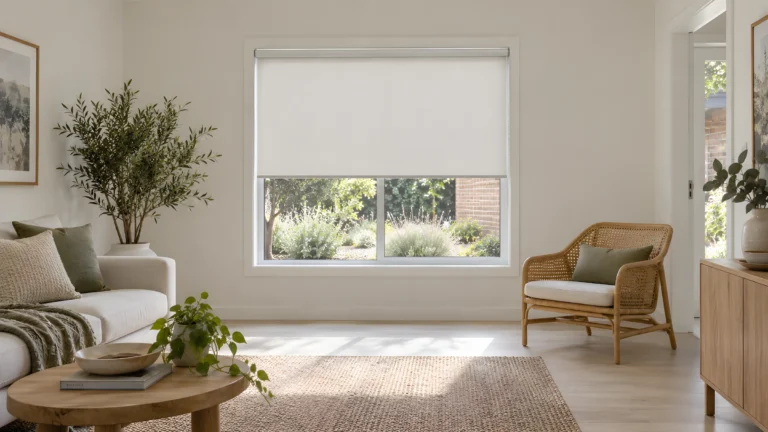 ComparisonsBlockout, light filter or SunScreen? Choosing roller blind fabricWhat each roller blind fabric does with light, view and privacy by day and night, and which one suits each room in your home.
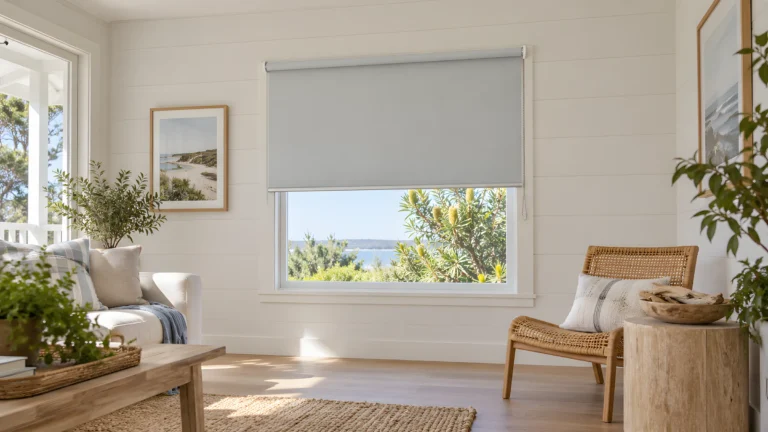 BlindsChain, cordless or motorised: choosing roller blind controlsChain, cordless or motorised? How each roller blind control works, what limits apply and which suits a bedroom, nursery, home theatre or wide window.
 BlindsDouble roller blinds: day and night in one windowA double roller puts a daylight layer and a blockout layer on one set of brackets. Here is how the pairings, depth, controls and fascias work.