
How to choose the right colour for your blinds
Start with the walls, trim and floor, then test samples in your own light. Here is how to choose roller blind colours, from white and grey to charcoal.

To choose roller blind colours, start with what is already in the room: the wall colour, the window frame, the floor. Pick a fabric that either sits close to the wall tone so the blind blends in, or one clear step darker or lighter so it becomes a feature. Then order two or three samples and look at them in your own light, in the morning and again in the evening, before you decide.
In short
- Start with the walls, trim and floor. Decide whether the blind should blend in, sit a step off the wall or contrast.
- Undertone (warm or cool) matters more than the colour name. "White" covers a lot of ground.
- Fabric type changes how a colour reads. Blockout is solid, light filter glows and SunScreen shows the view through it.
- Check the backing. Shade is the same colour on both sides, Serene II and Lakeside have a colour-coordinated backing, and the other blockout ranges have a white one.
- Order samples and compare them against your trim and flooring in daylight and at night.
Start with what is already in the room
Blind colour is a relationship, not a choice made on its own. Look at four things before you look at any fabric.
- Wall colour. Is it a warm white (cream, biscuit) or a cool white (blue-grey)? A quick check is to hold a sheet of plain white paper against the wall. The wall will look yellower, pinker or bluer than the paper.
- Window frame and trim. White, black and timber frames each pull different colours forward.
- Floor. Timber, tile and carpet all have an undertone, and the blind hangs above it.
- Big fixed items. A sofa, joinery or a feature wall will not change, so the blind has to work with them.
Whichever of these is least likely to change is your anchor. Choose the blind to suit it.
Three ways to choose blind colours
| Approach | What it does | Choose it when | Examples |
|---|---|---|---|
| Blend | Sits within a shade of the wall so the blind recedes | The window, view or architecture is the feature, or the room is small | Shade Ice or Allure Snow on white walls |
| Tonal | One step darker or lighter than the wall | You want a quiet layer of interest | Ultra Ash Grey on pale grey walls |
| Contrast | Clearly darker or lighter than the wall and frame | The walls are plain and you want the blind to be a feature | Array Jet or Elegance Obsidian on white walls |
If you are unsure, blend or tonal is the lower-risk choice. Contrast looks intentional when it is clearly a step away from the wall and looks like a mistake when it is only just different.
Roller blind colours by family
Our colour pages group the range by family, and each suggests ordering several samples to compare in daylight and at night against your trim and flooring.
| Family | Roller blind examples | Curtain matches | Colour page |
|---|---|---|---|
| White | Shade Ice, Ultra Cool White, Allure Snow | Cassis Volume Snow, Bali Snow | White blinds and curtains |
| Grey | Ultra Ash Grey, Array Moon Grey, Array Platinum, Screen White Grey | Epic Smoke, Epic Cobblestone | Grey blinds and curtains |
| Black and charcoal | Array Jet, Elegance Obsidian, Serene II Charcoal, Screen Charcoal | Bali Black, Cassis Volume Charcoal | Black blinds and curtains |
| Beige and cream | Shade Biscuiti, Ultra Cream, Allure Griege | Cassis Linen | Beige blinds and curtains |
White blinds
White is the easiest colour to choose and the easiest to get wrong. White blinds range from crisp and cool to soft and creamy, and next to a wall in a different white, the difference is obvious. Put two or three whites side by side against the wall and the trim before you decide.
Grey blinds
Grey suits cool, bright light and modern rooms, and it works with white trim and timber floors. Check whether the grey leans blue or warm once the lights are on in the evening. Ultra Ash Grey, Array Moon Grey and Array Platinum are all worth sampling together, because the small differences only show side by side.
Black and charcoal blinds
Dark blockout gives a room a strong, tailored edge, and it suits a bedroom or media room. In SunScreen, a dark fabric such as Screen Charcoal generally keeps the view through the blind clearer than a pale one. Check the backing before you order a dark colour (more on that below). For how dark and light colours sit in today's styles, see modern blinds: styles and colours that look current.
Beige and cream blinds
Shade Biscuiti, Ultra Cream and Allure Griege bring warmth, and they sit well with timber floors and warm white walls. Look at them in artificial light as well as daylight, because cream can turn yellow under some globes.
What colour blinds should I get for each room?
Choose the fabric type by the job first, then the colour.
| Room | Fabric type to start with | Colour direction |
|---|---|---|
| Bedroom | Blockout | Calm tones that blend in, or a deeper shade for a feature wall |
| Living room | Light filter or SunScreen | A colour you like in daylight, since it is on show most of the day |
| Kitchen | SunScreen or light filter | Lighter tones keep the room fresh; check taps and handles first |
| Home office | SunScreen or light filter | A mid to dark SunScreen for glare control without losing the view |
| Nursery | Blockout, with cordless ZeroGravity control | Soft neutrals |
Colour does not change what the fabric does. Blockout (many people search for "blackout", and it means the same thing) stops light passing through the cloth whatever the colour. If darkness is the goal, choose the fabric type first and see our guide to blockout, light filter or SunScreen.
How fabric type changes the colour you see
The same colour reads differently in each fabric type.
- Blockout: solid, so the colour on the sample is close to what you will see, day and night.
- Light filter: diffuses daylight, so it glows and looks lighter with the sun behind it. At night, with the room lit, silhouettes may show.
- SunScreen: woven, so you see the colour as a tint over the view. It cuts glare and keeps the view, but gives daytime privacy only when it is brighter outside.
Check the backing before you choose a dark colour
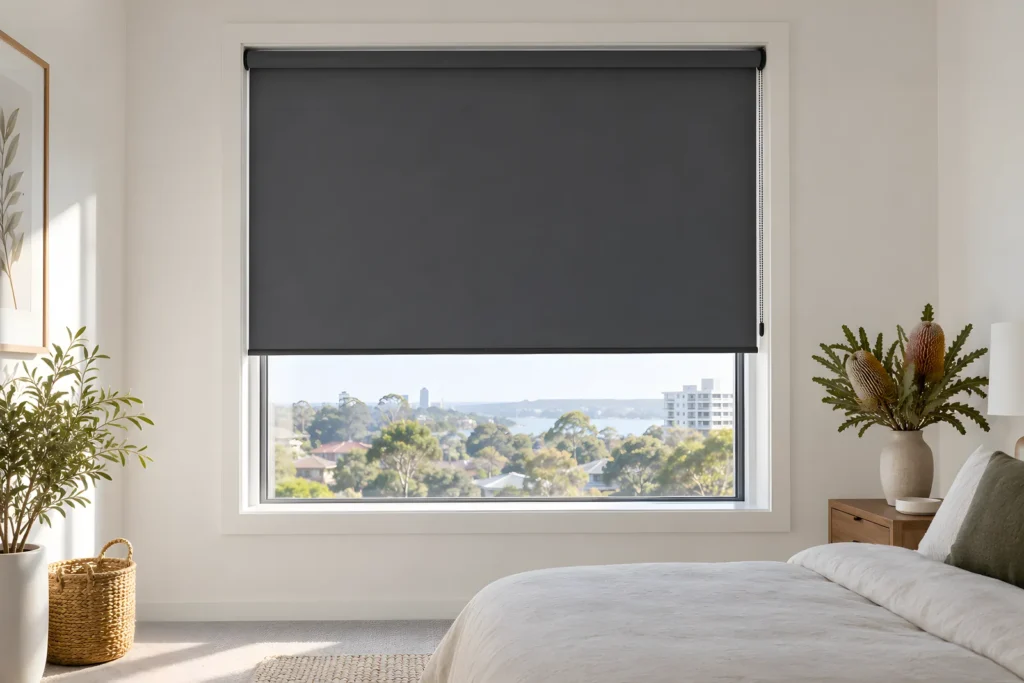
The reverse of a blockout fabric is its backing, and it affects how the blind looks from outside and at the top of the roll.
| Range | Backing |
|---|---|
| Shade | Same colour on both sides |
| Serene II and Lakeside | Colour-coordinated backing |
| Serene, Ultra, Array, Allure, Elegance and Opulence | White backing |
With a standard roll, the backing shows at the top of the roll. That is fine for a white or pale fabric. For a dark colour, a white backing is more noticeable, so Serene II Charcoal or a dark Shade colour gives a more uniform look than a dark Array or Elegance colour.
Matching curtains and blinds
If curtains and blinds share a window, keep them in the same colour family and let texture do the work. The blind is usually the more neutral of the two.
What colour curtains go with white walls? There are three easy routes:
- Blend: a sheer in Cassis Volume Snow or Bali Snow softens the window without adding colour.
- Warm neutral: Cassis Linen or Cassis Sand adds warmth against white. "Linen" is the colour name. The curtains are linen-look polyester.
- Stronger tone: Bali Taupe or Cassis Pewter gives the window more weight.
Colours that go with grey: white, charcoal and warm beige all work with a grey blind. A grey blind with charcoal curtains is a tonal layering, while a grey blind with warm neutral curtains softens a cool room. Our guide to matching curtain colours with your blinds goes further, and sheer curtain ideas shows how sheers behave in different colours.
How to test samples properly
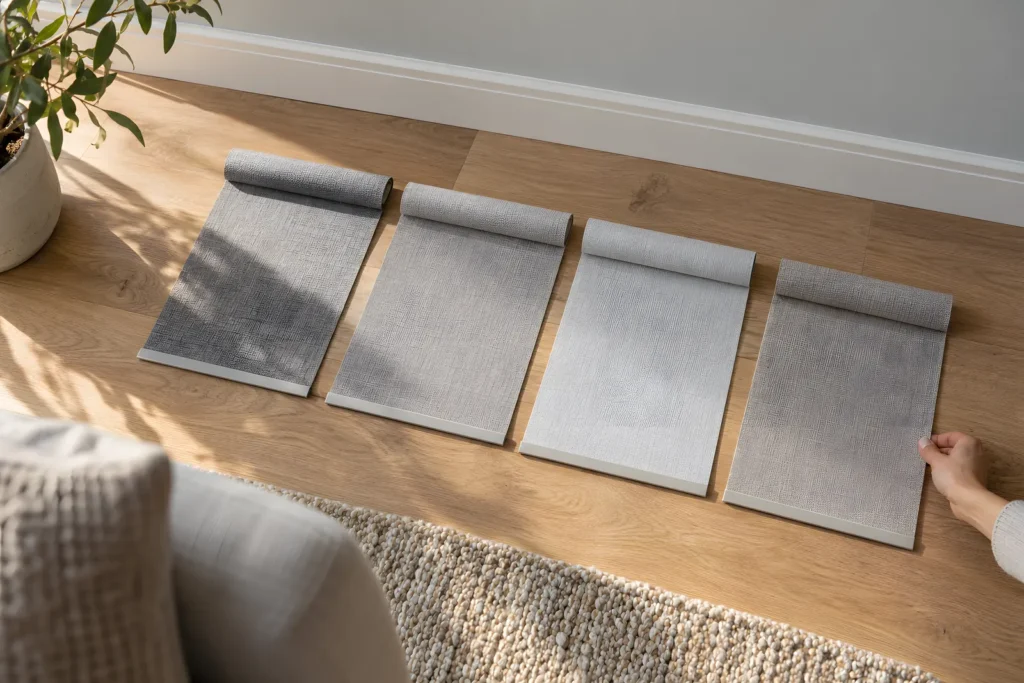
Samples are the only reliable way to choose blind colours, because screens change colour and every room's light is different.
- Order several at once. You get one sample order and one checkout, and a fabric used across several products is one sample, sent once. Sample packs give four hand-picked colours per click.
- Put them at the window. Tape or hold them at eye level against the frame, not flat on a table.
- Check the light. Look in the morning, at midday and in the evening with the lamps on.
- Compare against the fixed items. Hold each sample next to the trim, the floor and the sofa.
- Live with them for a few days. The one you keep going back to is usually the right one.
- Doubling up? For a double roller, order both fabrics and hold them together.
Tip: Order all the blinds for one room together. Lakeside is a coated fabric where some batch colour variation is normal, so blinds ordered months apart may not match exactly.
You can order free samples from our sample library and compare them at your own window.
Questions
What colour blinds should I get?
Start with the walls, trim and floor. A colour within a shade or two of the wall is the easiest choice, and a stronger colour makes the blind a feature. Always test samples in your own light first.
Are white blinds always the safest choice?
Not always. Whites vary from cool to warm, and a white that clashes with your walls stands out. Compare several white samples against your walls and trim.
What colour curtains go with white walls?
Warm neutrals such as Cassis Linen or Sand, whites such as Cassis Volume Snow or Bali Snow that blend in, or a stronger tone such as Bali Taupe or Cassis Pewter all work. Order samples and compare them against your trim.
Does blind colour change how much light it blocks?
No. Blockout fabric stops light passing through the cloth whatever its colour. Light can still show around the edges of a conventional blind, which a face fit or cassette reduces.
Do all roller blind fabrics have a white backing?
No. Shade is the same colour on both sides, Serene II and Lakeside have a colour-coordinated backing, and the other blockout ranges have a white backing.
See the colours in your own light
Order free samples and compare them at your window in the morning and the evening.
Keep reading
 ComparisonsBlockout, light filter or SunScreen? Choosing roller blind fabricWhat each roller blind fabric does with light, view and privacy by day and night, and which one suits each room in your home.
 Room ideasHow to match curtain colours with your blindsChoose the blind first, match undertones rather than exact colours, and keep one layer quiet. Here are real fabric pairings and the fitting details that make them work.
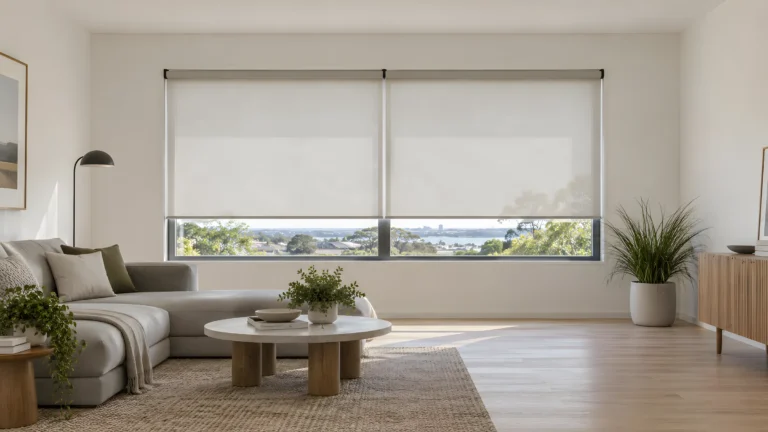 BlindsModern blinds: styles and colours that look currentWhat makes blinds look modern: concealed hardware, matte fabric, restrained colour and a tidy fit, with ideas for rollers, venetians, sliding doors and black blinds.