
Panel glide blinds explained: panels, tracks and stacking
Broad fabric panels on a track suit sliding doors and big windows. Here is how panel width, centre opening and stack space work, and which fabric to pick.
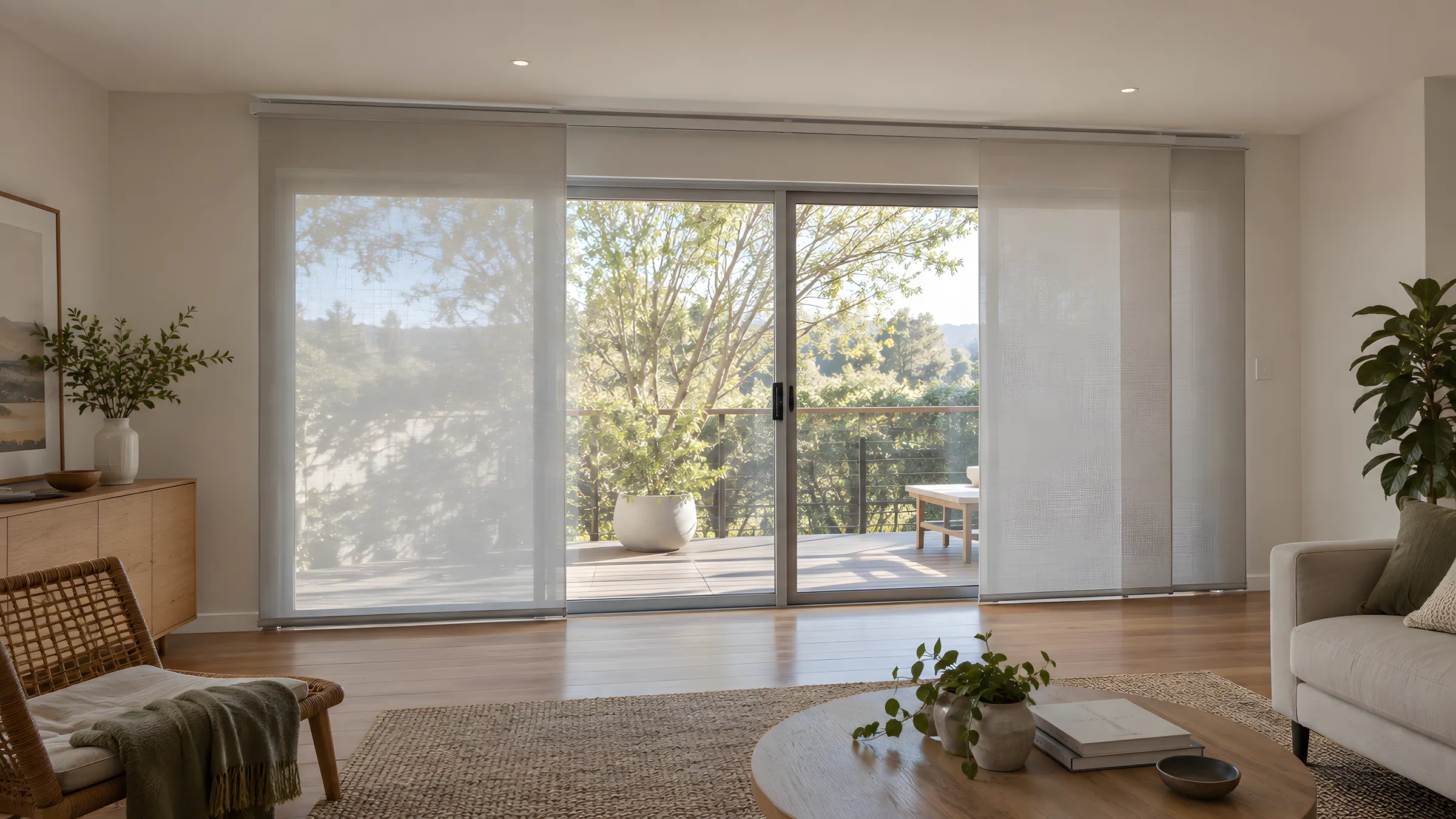
Panel glide blinds are broad fabric panels that slide along a track, so they cover a sliding door or a large window and stack to the side like a set of flat curtains. They can be made in any roller blind fabric, they are fitted to the face of the wall or frame, and each panel is typically between 500 and 1000 mm wide.
In short
- Panel glide blinds (also called panel track blinds) are wide fabric panels on a track, made for sliding doors and large windows.
- Any roller blind fabric can be used, and a flat base rail in white, black or silver is available at no extra charge.
- Panels are typically 500 to 1000 mm wide, and neighbouring panels overlap by 70 mm.
- A centre opening always has an odd number of panels: five on a 3-channel track, nine on a 5-channel track.
- The track needs room beyond the opening for the stack. Measure with our panel glide measuring guide. Panel glide blinds are not used in kitchens.
What are panel glide blinds?
A panel glide blind is a set of tall, flat fabric panels hung from a track. The panels slide sideways to open and close, and when open they stack against the side of the opening. The track has parallel channels, and the panels run along them and overlap each other as they stack.
That makes panel glide blinds a good fit for anything wider than a roller blind can cover neatly: sliding doors, stacker doors, big picture windows and wide openings. If you searched for panel blinds for sliding doors, this is the product. Panel track blinds is another name for the same thing.
The look is different from a roller blind: instead of one piece of fabric that rolls, you have broad, flat panels with clean vertical edges. You can open only the part of the door you use.
Panel glide vs vertical blinds vs curtains
On a sliding door, vertical blinds, curtains and linked roller blinds all compete with panel glide blinds, and our blinds for sliding doors page compares them.
| Panel glide blinds | Vertical blinds | Curtains | |
|---|---|---|---|
| Look | Broad flat panels, clean and architectural | Rows of vanes | Soft folds |
| Light control | Slide open or closed; fabric type sets the light | Rotate the vanes | Draw open or closed |
| Fabric choice | Any roller blind fabric | Lakeside and Shade only | Sheers and blockouts |
| Fit | Face fit | Face fit is common | Ceiling or wall track |
| Stack | Panels overlap at the side | Vanes gather at the side | Curtains stack back |
Choose panel glide when you want the smooth, flat look of roller blind fabric across a wide opening, or when the fabric you want is not offered on vertical blinds. Our vertical blinds guide covers the other side of that decision.
Choosing fabric and base rail
All roller blind fabrics can be used on panel glide blinds. That means you get the same three fabric types as any other roller blind, and the choice depends on what the door faces.
- Blockout: stops light passing through the cloth and gives night privacy. A little light can still show at the edges. Many people search for "blackout", and it means the same thing.
- Light filter: diffuses daylight and obscures the view. Silhouettes may show at night when the room is lit.
- SunScreen: cuts glare and keeps the view. It gives daytime privacy only when it is brighter outside, so it is not a night-privacy fabric.
For a sliding door onto a deck or garden, a common approach is SunScreen for daytime glare control, with blockout or curtains added where night privacy matters. Order free samples and hold them at the door in the morning and again in the evening.
Flat base rail colours
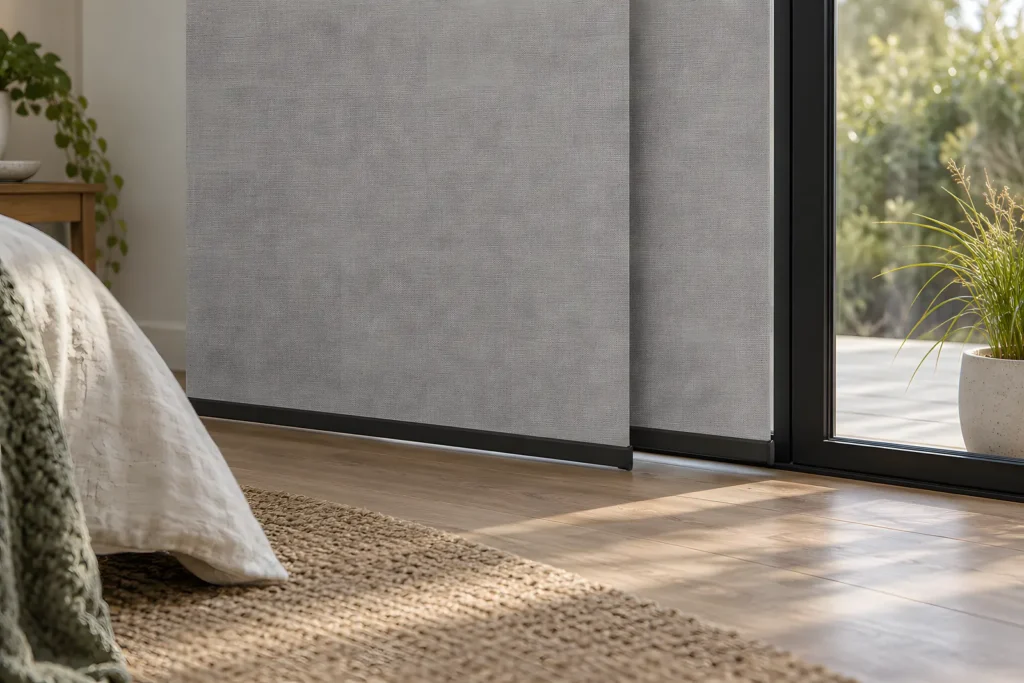
Panel glide blinds can have a flat base rail in White, Black or Silver at no extra charge. Match it to the door frame: white on a white frame, black on a black-framed door, and silver where the frame is a brushed metal finish.
How panel width works
Each panel is typically 500 to 1000 mm wide, and neighbouring panels overlap by 70 mm. Our measuring guide gives the panel width as the finished track width plus (panels - 1) x 70 mm, divided by the number of panels. For a 3000 mm track with four panels, that is 3000 + 210 = 3210 mm, divided by four, or 802.5 mm per panel.
The practical point is that a wider track needs more panels to stay inside the 500 to 1000 mm range. More panels also means more vertical edges when the blind is closed, so weigh the look against the panel width before you decide. The measuring guide also shows how to check the panel width before you order.
Centre opening and odd panel counts
A panel glide blind can open one way, or open from the centre. A centre opening always has an odd number of panels. A 3-channel track carries five panels, and a 5-channel track carries nine.
That has a practical effect on the look. More panels means each panel is narrower for the same track, which is useful on a very wide opening but changes the look, because you see more vertical edges when the blind is closed.
Stack space and measuring
Stacked panels take up wall space beside the opening, and this catches people out. The track extends beyond the opening on the stack side by at least 300 mm, and by at least 100 mm on the other side. For a centre opening, the guide asks you to confirm the allowance on both stack sides with us rather than apply the one-way figures.
Keep the stack area clear of furniture, switches, handles and wall lights. Everything else, including how to take the track width and the drop with or without architraves, is in the panel glide measuring guide.
Tip: Check the wall space either side of the opening before you settle on a stack side. If one side has a return wall or a bookcase, stack to the other.
If there is not enough space for the stack, look at linked roller blinds, which do not stack sideways.
Fitting panel glide blinds
Panel glide blinds are face fitted, so they go on the wall or frame above the opening. Follow our panel glide blinds installation guide for the fitting, and see the installation guides for the rest of the range.
Common mistakes with panel glide blinds
- Measuring the door instead of the track. The blind is sized to the track width, and the track has to clear the stack.
- Forgetting the stack. Stacked panels take real wall space. Check both sides before you commit.
- Ignoring handles and furniture. Check that the panels will hang clear of door handles and anything standing in front of the door.
Where panel glide blinds do not suit
Panel glide blinds are not used in kitchens. For a kitchen window, choose a PVC plantation shutter, a fauxwood or aluminium venetian, or a roller blind that will not be drenched.
They are also more than a small window needs. For a standard-size window, a roller blind or venetian is the simpler choice. For a big window, the blinds for large windows guide covers the wider set of options.
Questions
What are panel glide blinds?
Panel glide blinds are broad fabric panels that slide along a track. They suit sliding doors and large windows and are fitted to the face of the wall or frame.
What fabrics can panel glide blinds use?
All roller blind fabrics can be used on panel glide blinds, including blockout, light filter and SunScreen.
How wide is each panel on a panel glide blind?
Panels are typically 500 to 1000 mm wide. A wider track uses more panels to stay in that range.
Can panel glide blinds open from the centre?
Yes. A centre opening always uses an odd number of panels, so a 3-channel track carries five panels and a 5-channel track carries nine.
Do panel glide blinds suit kitchens?
No. Panel glide blinds are not used in kitchens. Choose a PVC plantation shutter, a fauxwood or aluminium venetian, or a roller blind that will not be drenched.
Build your panel glide blinds
Choose your fabric, track and opening style, and see the price before you order.
Keep reading
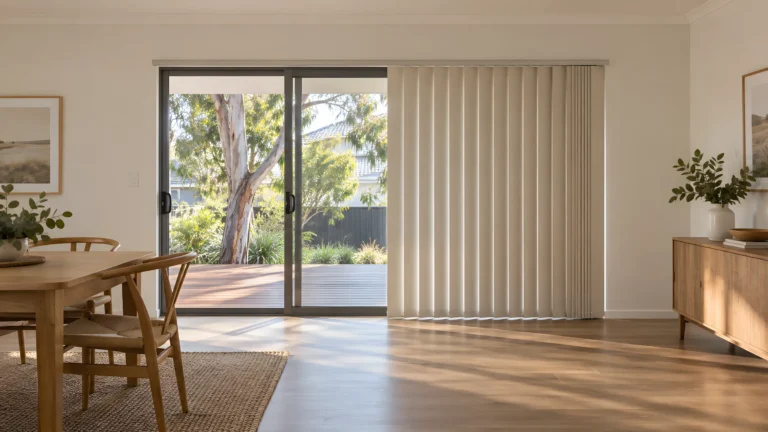 BlindsAre vertical blinds outdated? A guide to modern vertical blindsVertical blinds are not outdated, but dated fabric and colour made them look that way. Here is how vane width, stacking and fabric decide the result.
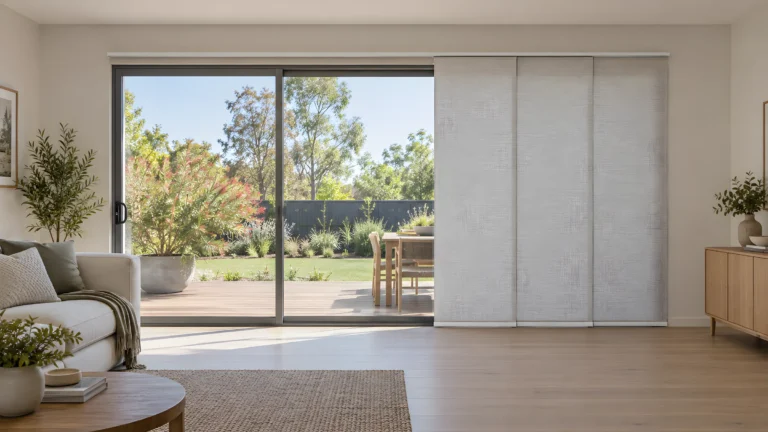 Room ideasThe best blinds for sliding doors and French doorsPanel glide, vertical, linked roller blinds or curtains? Compare the best blinds for sliding doors and French doors, with the clearances that decide what works.
 Room ideasBlinds for large windows: linked, panel glide and motorisedA single roller blind stops at 3000 mm wide. Here is how linked blinds, panel glide, motors and curtains cover larger windows, with the size limits that apply.