
Floor-to-ceiling curtains: how to plan ceiling-fixed tracks
How to plan floor-to-ceiling curtains on a ceiling-fixed track, from cornices and fixings to the finish at the floor, choosing sheers and which guides to follow.

Floor-to-ceiling curtains hang from a track fixed to the ceiling and fall to just above the floor, so the fabric runs the full height of the wall. The full-height line makes a room feel taller, hides awkward window proportions and lets one long track cover a wall of glass or a set of sliding doors. Planning them comes down to four things: your ceiling and cornices, the track width, the drop and the fabric.
In short
- A ceiling (top) fit track lets the fabric run the full height of the wall, and S Fold is used with a ceiling fit.
- Sheers (Cassis, Cassis Volume and Bali) work floor to ceiling but give privacy by day only. Add a blockout layer for night.
- Check the ceiling first: cornices, what you can fix into, and anything in the way.
- Measure with our curtain measuring guide, not a generic method. If the drop differs by more than 10 mm across the wall, choose a puddled finish.
- A wall-to-wall track gives the full-wall look, and a track that frames a window is made wider than the window.
What floor-to-ceiling curtains do for a room
A curtain that starts at the ceiling changes how the room reads, in four ways:
- Height. With the track at the ceiling line, the eye follows the fabric up and the room feels taller.
- Proportions. A small window, or several windows at different heights on one wall, looks like a single feature when one run of fabric covers them.
- Coverage. One long track can cover a wall of glass, a set of sliding or stacker doors, or a window and door combination.
- Softness. Long, full folds absorb the hard edges of large glass areas.
The trade-offs are practical. A full-height curtain uses more fabric than one that stops at the frame, it needs sound fixings into the ceiling, and it stacks to the side when open, so you need clear wall for it.
Floor-to-ceiling sheer curtains
Sheers are the most common choice for full-height curtains because they let daylight through and keep the room bright. We make three, all linen-look polyester:
- Cassis has a soft natural texture in warm neutrals: Sand, Linen, Fawn and Pewter. (Linen is a colour name only.)
- Cassis Volume is the same sheer in whites and greys.
- Bali is our lightest sheer, with an airy drape.
Sheer curtains give some privacy by day and soften the view, but at night, with lights on inside, people outside can see in. If the wall of glass faces a street or a neighbour, add a blockout layer on a second track or choose lined curtains. Our post on how to layer sheer and blockout curtains shows how the two work together.
Tip: Choose the track colour to match the ceiling or wall so it recedes. A white track disappears against a light ceiling and keeps the eye on the fabric. Black and silver are the other options.
Ceiling fit or wall fit for full-height curtains
Ceiling fit, also called top fit or ceiling mounted curtains, is what most people mean by floor-to-ceiling curtains. It puts the track on the ceiling, so the fabric starts right at the ceiling line.
| Ceiling (top) fit | Wall (face) fit | |
|---|---|---|
| Where the fabric starts | At the ceiling line | At the track on the wall |
| Best for | Straight-edge ceilings, and inside a cornice | Rooms with a large cornice, or where the ceiling is not suitable to fix into |
| Fixings | Ceiling battens are the easiest to attach to | Wall studs, or concrete, stone, brick or tile |
| Heading | S Fold is used with a ceiling fit | Check the heading options in the configurator |
If your ceiling has a cornice, a ceiling-fit track can sit inside it. The larger the cornice, though, the bigger the gap between the curtain and the window, so a wall fit may suit better in a room with a deep cornice.
What to check on your ceiling before you order
Work through this list with a step ladder and a stud finder before you measure:
- What is above the plaster. Ceiling battens are typically 450 mm to 600 mm apart and give the strongest fixing. A stud finder locates them. Check for cables and pipes before you drill.
- Cornices. Note whether you have them and how deep they are. If there are cornices, measure from the inside edge.
- How level the ceiling and floor are. You will measure three drops to find out.
- Things in the way. Downlights, fans, air-conditioning vents, smoke alarms and the swing of doors can all foul a long curtain or a track.
- Window handles and sills. They can catch a curtain. Extension brackets move the track further from the ceiling to clear an obstruction.
- The floor. Skirting boards, floor vents, heaters and thick rugs all affect where the hem finishes.
- Weight. Full-height blockout curtains are heavy, so fix into solid battens rather than plasterboard alone.
Measuring floor-to-ceiling curtains
Measure with our curtain measuring guide. It covers ceiling and wall fit, track width, the drop, splits and the three floor finishes, and it tells you exactly what to record so that no allowances of your own are needed. Windows that meet at a corner or sit in a bay have their own guide, the box and bay curtains measuring guide.
Tip: Decide the floor finish before you measure: just off the floor, touching or puddled. The guide explains how each finish is made, and a puddled finish hides a floor or ceiling that is slightly out of level. Our curtain size guide explains length, width and fullness.
Heading, fullness and opening for tall curtains
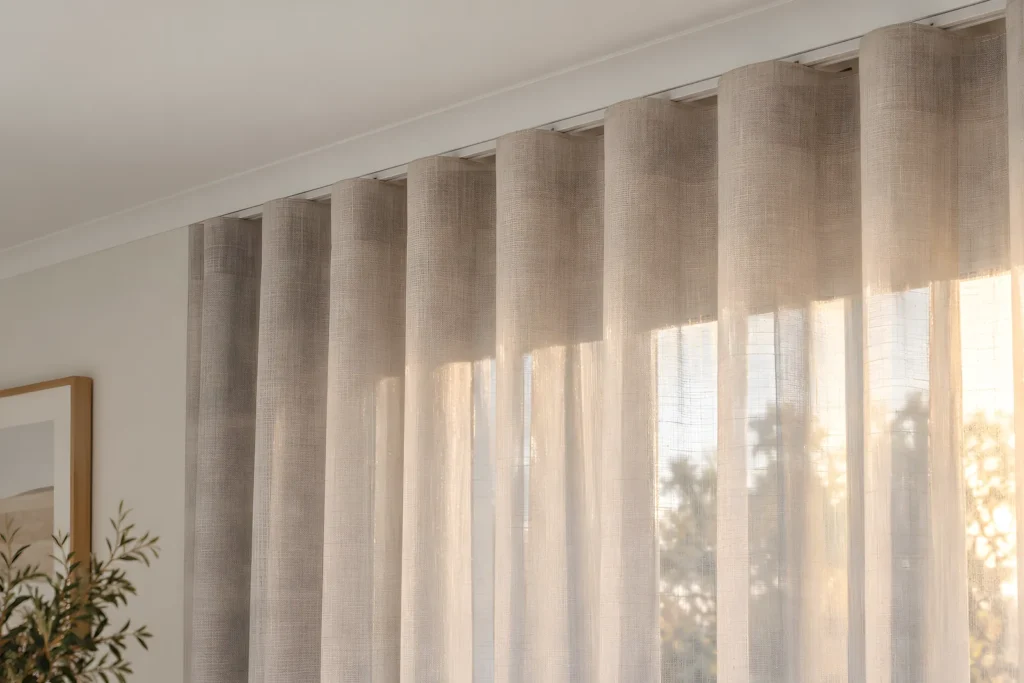
Heading. S Fold is the most popular choice for full-height curtains. It forms regular, even waves from the ceiling down to the floor, it has the deepest heading profile in our range, and it is used with a ceiling fit. Pencil pleat, pinch pleat and inverted pleat are also available. Our S Fold curtains page lists the fabrics and track options.
Fullness. We offer about 2.0 to 2.75 times the finished width. On a tall wall the folds are more visible, so a fuller option, with deeper and denser folds, can look richer than the lightest fullness.
Opening. A centre opening splits the stack between two sides, and a one-way opening puts it all on one side. As a guide, a one-way curtain stacks to about 30 per cent of the track width and a centre-opening pair to about 15 per cent on each side.
Full-height curtains for sliding doors and large windows
Floor-to-ceiling curtains are a natural fit for wide openings, but a few details matter:
- Sliding and stacker doors. Choose just off the floor so the hem does not drag, and plan the stack beside the doorway rather than across it. You can also add up to two splits so you can open one section without moving the whole curtain. See our page on blinds for sliding doors for the alternatives.
- Large windows. A wall-to-wall track and a planned stack-back suit wide spans. The page on blinds for large windows covers the options.
- Out-of-reach or heavy curtains. A Motorised track lets you open and close a full-height curtain from a remote. See motorised curtains explained for what to plan.
Hanging ceiling-fixed curtains
Fit the track and curtains by following our curtain installation guide, or the lined curtains installation guide if your curtains are lined. Full-height curtains are heavy, so a step ladder and a second person make the job safer, and the ceiling check above tells you what the track will be fixed into.
Common mistakes with full-height curtains
- Skipping the ceiling check. A track fixed into plasterboard alone will not carry a heavy curtain safely.
- Making the track the same width as the window. The stack then covers the glass.
- Forgetting the projection. A deep heading and a window handle can clash. Check clearances before you order.
- Judging colour from a photo. Free samples let you see the fabric in your own light.
Questions
Should floor-to-ceiling curtains touch the floor?
They can either finish just off the floor or lightly touch it. Just off the floor is more practical with children, pets or hard floors, while touching gives a tailored look.
Can I hang floor-to-ceiling curtains from the wall instead of the ceiling?
A wall (face) fit track is available, but the fabric then starts at the track rather than the ceiling. S Fold is used with a ceiling (top) fit.
Do sheer floor-to-ceiling curtains give privacy?
They give some privacy by day. At night, with lights on inside, people outside can see in, so add a blockout layer on a second track or choose lined curtains.
What if my ceiling or floor is not level?
If the drop differs by more than 10 mm across the wall, choose a puddled finish so the extra fabric hides the difference. Our curtain measuring guide shows how to record the drop.
Can floor-to-ceiling curtains be motorised?
Yes, with a Motorised track. Motorisation is not available with free-flow tracks or curtains with multiple openings.
Build your full-height curtains
Enter your track width and ceiling-to-floor drop, choose your fabric and see the price before you order.
Keep reading
 Measuring & fittingCurtain size guide: length, width and height to chooseHow long, wide and high curtains should be, with the three floor finishes, how wide to make the track and how much wall to leave for the stack.
 CurtainsCurtain tracks explained: wall, ceiling, curved and motorisedHow curtain tracks work and how to choose one: Designer, Half Moon, curved and motorised, ceiling or wall fit, fixed or free flow, brackets and wands.
 Room ideasCurtains for sliding and bifold doors: what to planCurtains suit sliding and bifold doors when the track is longer than the opening. Plan the stack-back, hem height and handle clearance before you order.