
The best blinds for sliding doors and French doors
Panel glide, vertical, linked roller blinds or curtains? Compare the best blinds for sliding doors and French doors, with the clearances that decide what works.
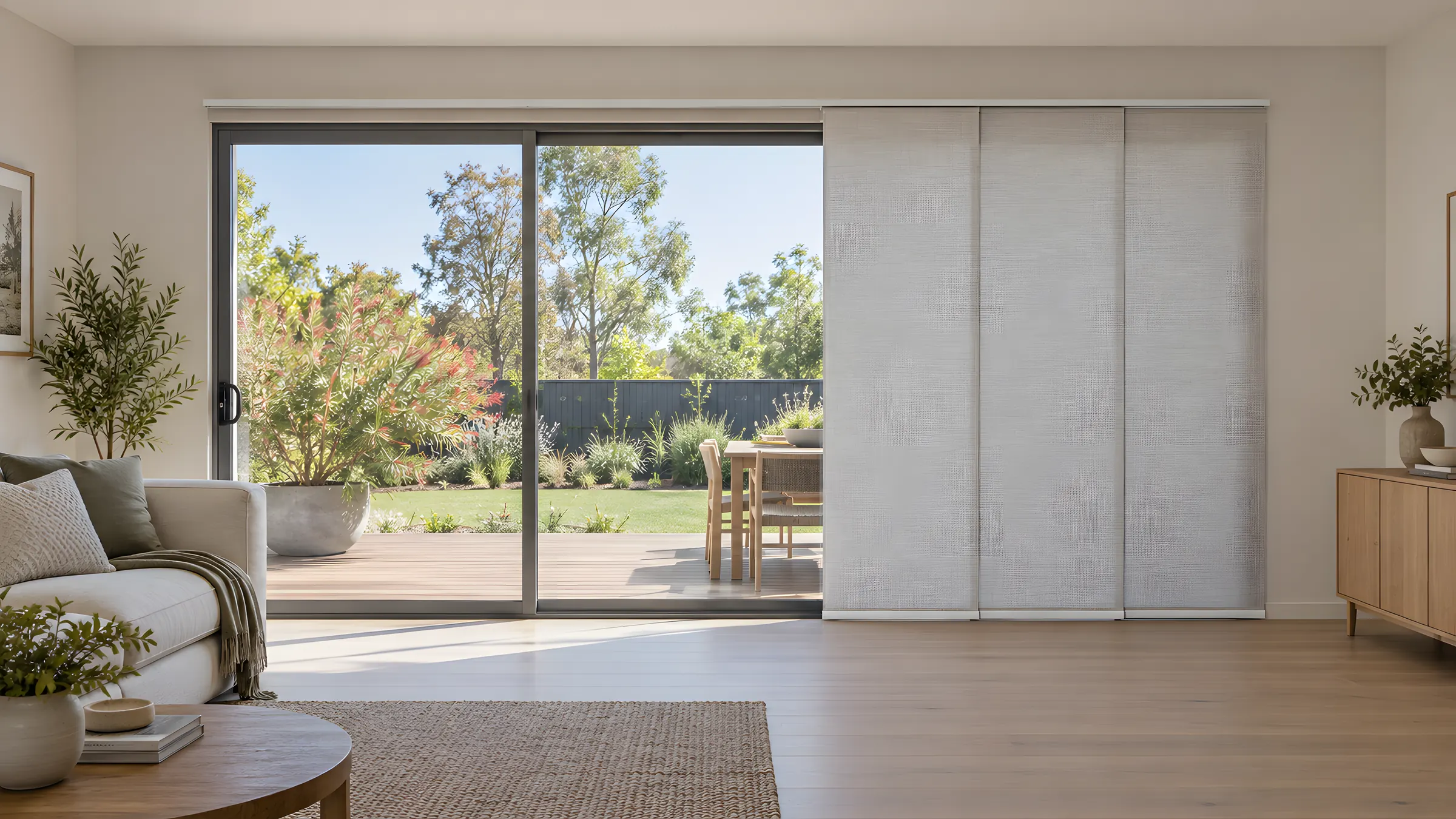
The best blinds for sliding doors are panel glide blinds, vertical blinds, linked roller blinds and curtains. Each one can cover a wide opening and move away from the part of the door you actually walk through. French doors need a different approach: front-roll roller blinds, vertical blinds or S Fold curtains that clear the handle and the swing of the door.
In short
- Wide sliding doors used every day suit panel glide blinds or vertical blinds, which draw aside instead of being raised.
- Linked roller blinds suit a door with a fixed glass panel beside the sliding one, or a door you open less often.
- Curtains give the softest look, but the track has to be longer than the opening so the stack does not cover the glass.
- French doors need a blind that clears the handle and the door's swing: a front-roll roller blind, vertical blinds or curtains.
- Most doors end up face fit, so check handle projection and stack space before you measure.
Why doors need different blinds from windows
A door opening is wider than a window, it is used every day and its hardware sits proud of the glass. Four things decide what works.
- Width. Sliding door openings are often two or three times the width of a standard window. A single roller blind tops out at 3000 mm wide, so anything wider needs linked blinds or a product built for width, such as panel glide.
- Daily use. You open and close a door many times a week. The covering should move out of your walking path rather than needing to be raised and lowered every time.
- Handles and locks. Sliding door pulls and French door handles stand out from the glass. A blind hanging close to the glass can catch on them.
- Movement. A sliding door travels along a track. A French door swings through an arc. The covering has to stay clear of both.
The best blinds for sliding doors compared
Here is how the four main choices compare. You can also start from our blinds for sliding doors page and build one online.
| Option | How it clears the door | Fabric options | Best for | Watch out for |
|---|---|---|---|---|
| Panel glide | Broad panels slide on a track and stack left, right or centre-open | Any roller blind fabric: blockout, Light Filter or Screen | Wide doors and stacker doors used daily | Needs stack space beside the door; face fit |
| Vertical | Vanes tilt, then draw left, right or split | Lakeside and Shade only | Daily use with adjustable light | Face fit is common; a recess needs room for the vanes to rotate |
| Linked roller | Two or three blinds on shared brackets; raise the one over the part you use | Blockout, SunScreen or Light Filter; ranges can differ per blind | A fixed panel beside a sliding one; lighter use | The blind must be raised to walk through; small join gap |
| Curtains | Draw to one side, centre or split | Sheers, blockout or both on two tracks | The softest look; layering for day and night | Stack-back needs wall space beyond the opening |
Panel glide blinds
Panel glide blinds are what most people mean when they search for panel blinds for sliding doors. Wide fabric panels run on a track, so the whole door can be uncovered in one movement. Panels are typically 500 to 1000 mm wide, the system is face fit, and any of our roller blind fabrics can be used: Blockout for night privacy, Light Filter to diffuse daylight, or Screen to keep the view.
Plan the stack before you order. Our guide has the track extend at least 300 mm on the stack side and at least 100 mm on the other, so the parked panels sit beside the door rather than in front of it. The panel glide measuring guide explains the rest, and the panel glide installation guide covers fitting.
The flat base rail can be White, Black or Silver at no extra charge, which lets you match the door frame. Our panel glide blinds explained guide covers channels and panel widths in detail.
Vertical blinds
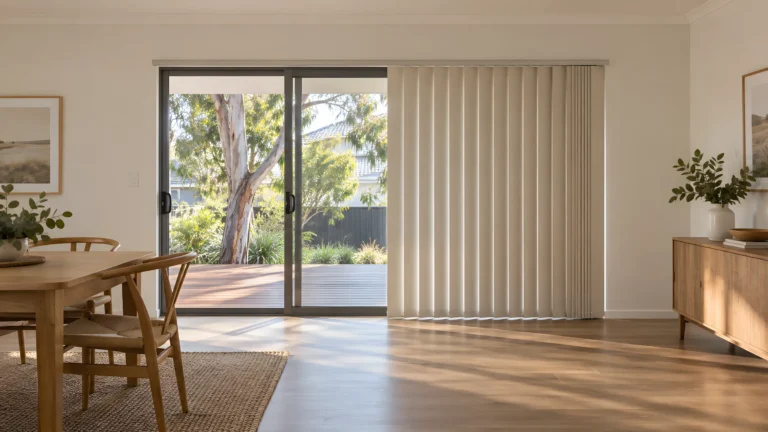
Vertical blinds hang as separate vanes that rotate for light and privacy, then draw to the left, right or split in the middle. Vane widths are 89 mm and 127 mm, and Lakeside and Shade are the fabrics available. Because the vanes tilt, you can angle them to let light in without drawing the blind back.
Face fit is the common choice. If you want a recess fit, the recess must be deep enough for the vanes to rotate without touching the glass or each other. Our vertical blinds guide covers vane widths, fabrics and stacking in more detail, Measure with the vertical blinds measuring guide and fit with the vertical blinds installation guide.
Linked roller blinds
Two or three roller blinds share brackets, so the join gap is about 17 mm, compared with 30 mm or more when blinds are butted side by side. Place the join over a mullion or the frame between glass panels so it disappears.
On a sliding door with one fixed panel and one sliding panel, the usual approach is one blind for each panel. You raise only the blind over the panel you use. Chain positions can be set per blind, in combinations such as LL, RR and LR (read left to right from inside), so the controls can sit away from the door handle. Battery motors are available in the LR configuration only, and ZeroGravity cordless blinds are available up to 3 m wide by 3 m drop.
Blinds wider than 2100 mm use the 50 mm tube automatically. A roller blind lowered over a door you use all day will get in the way, so this option suits doors that are opened less often, or a fixed panel beside the sliding one.
Curtains
Curtains are the softest option and can be layered: a sheer for daylight, a blockout on a second track for night. S Fold is our most popular heading. The catch is stack-back: on wall-to-wall doors a one-way stack-back takes about 30 per cent of the track width, and a centre opening about 15 per cent on either side. If the track only spans the door, the open curtains still cover roughly that share of your glass. Our guide to curtains for sliding and bifold doors covers the stack in more detail, and you can browse S Fold curtains directly.
Blinds for stacker doors and very wide openings
A stacker door slides two or more panels behind one another, so a large part of the opening can be used. That creates two questions: which panels move, and where do they stack?
Park the covering on the same side as the stacked door panels, not over the opening. The stacked glass is the part you do not walk through, so it is the natural place for a stack of vanes, panels or curtains to sit. Also check that the parked covering does not sit over the door handle or pull.
For very wide openings, the choices scale differently:
- Panel glide and vertical blinds are built for width and are the easiest to operate.
- Linked roller blinds can cover an opening in up to three sections. Hardwired motors can drive up to three linked blinds with a combined width of 6 m. Battery motors drive one blind each.
- Curtains can span the full width as long as the track and stack-back are planned.
| Your door | Start with |
|---|---|
| Wide stacker door used daily | Panel glide or vertical blinds, stacking on the side the door stacks |
| One fixed panel and one sliding panel | Linked roller blinds, one per panel |
| Door used rarely, view matters | Linked roller blinds in Screen fabric |
| Softer look, or a bedroom slider | Curtains on a ceiling-fit track, with a blockout layer if needed |
| Very wide glass wall | Panel glide, or curtains with a planned stack-back |
For more on wide glass, see blinds for large windows.
Plantation shutters are a common question for sliding doors. Our answer to can you put plantation shutters on sliding doors explains why the options above suit a door better.
Window coverings for sliding doors: fit and clearances
Door frames are rarely deep, so most sliding doors are face fit: the track or brackets mount on the wall or ceiling above and beside the frame.
- Rollers need a recess depth of 70 mm over roll or 45 mm under roll to sit inside the opening. If you do not have that, use a face fit.
- Under-roll is usually recommended for face fit. Choose a front roll only where a handle needs it.
- Vertical blinds in a recess need room for the vanes to rotate.
- Panel glide is always face fit and needs the stack allowance described above.
Decide where the bottom of the covering should finish before you enter the drop. Above the sill or track works for a roller. Just off the floor works for curtains and panel glide. Each product has its own measuring rules for width and drop, so follow the measuring guides rather than working from the glass size. For a roller, Venetian or similar blind fixed onto a French door or half-glass door itself, use our door blinds measuring guide.
Tip: Open the door fully and mark the handle, the door edge and any stacked door panels on the wall with masking tape. Anything you plan to hang has to stay outside those marks.
Blinds for French doors
French doors add a handle and an arc. Blinds for French doors have to clear both, and the direction the doors open makes the biggest difference.
| Situation | What works | Why |
|---|---|---|
| Doors open outward | Face-fit roller blind, curtains or vertical blinds | The doors swing away from the covering, so only the handle needs checking |
| Doors open inward | Curtains or vertical blinds drawn clear, or a roller raised before opening | The door sweeps into the room and would push into a blind hanging in front of it |
| Handle sits partway up the door | Roller blind with a front roll | The fabric sits farther from the glass and passes over the handle or winder |
| Narrow frame with no recess depth | Face fit above the architrave | Confirm the projection you need to clear the handle before measuring |
A front roll drops from the front of the tube, hides the roller and clears handles and winders. That makes it the standard answer to a handle. The trade-off is that the fabric sits farther from the glass, so a standard under-roll blocks a little more light. Our standard roll or reverse roll guide goes into the detail.
Vertical blinds let you choose the stack direction to match the side you open the door from, so the vanes park clear of the section you use most. For a softer finish, S Fold curtains work well, provided the track projection and stack-back are planned around the door's full swing. Our blinds for French doors page lists every option.
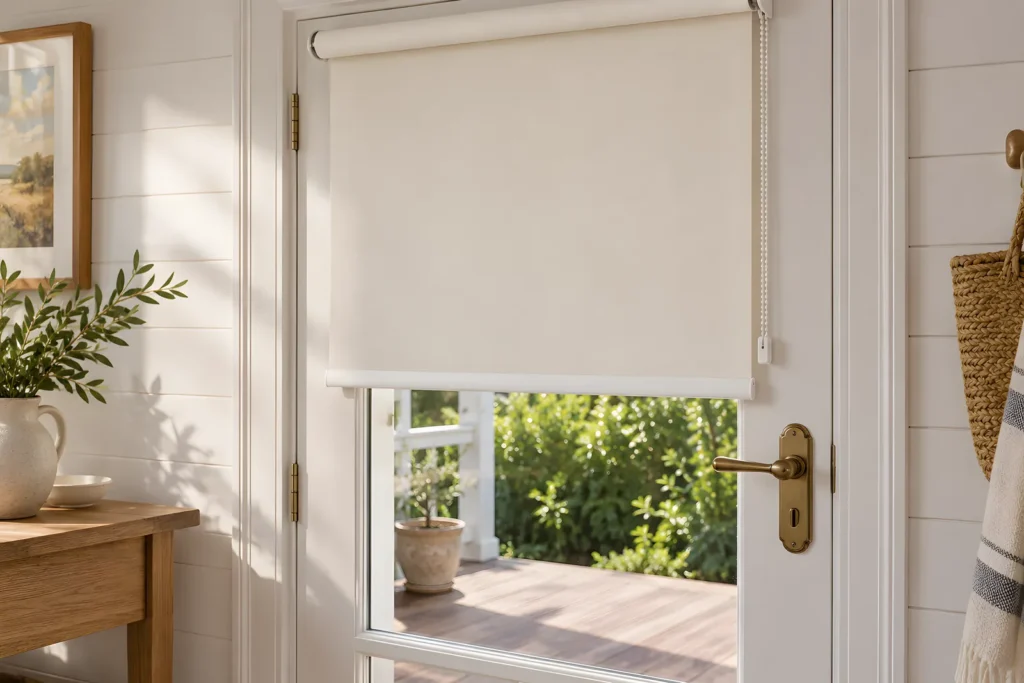
For privacy, choose the fabric for the time you need it. Light Filter diffuses daylight and obscures the view, but silhouettes may show at night when the room is lit. Blockout gives night privacy. Screen keeps the view, but is not a night-privacy fabric.
Front doors and narrow side windows
Glass beside a front door is usually narrow and shallow. Roller blinds can be made from 250 mm wide with a minimum drop of 300 mm, which suits narrow side windows. Light Filter keeps the hallway bright while obscuring the view from the street.
Check the depth of the recess against the 70 mm and 45 mm roller figures above. If the frame is too shallow, face fit above the trim.
Common mistakes to avoid
- Using the wrong measuring guide. A sliding door, a French door and a blind fixed onto a door each have their own guide, so pick the one that matches your fit before you measure.
- Leaving out samples. Order free samples and hold them against the frame, floor and walls in morning and evening light.
- Ignoring the chain. Keep chains out of reach of children, use the safety device supplied with SunBoss chain blinds, or consider cordless or motorised control in children's rooms.
Questions
What are the best blinds for sliding doors?
Panel glide blinds, vertical blinds, linked roller blinds and curtains are the four best options. Panel glide and vertical blinds suit doors you use every day, linked roller blinds suit doors with a fixed panel or lighter use, and curtains give the softest look.
Can I put a roller blind on a sliding door?
Yes. A single roller blind can be up to 3000 mm wide, and wider doors can use two or three linked blinds on shared brackets. You raise the blind over the part of the door you are using, so it suits doors that are not opened constantly.
What blinds work best for stacker doors?
Panel glide blinds and vertical blinds work well because they draw to one side or split, so the covering can park beside the opening. Choose a stack side that matches where the door panels stack and keep the handle clear.
Which blinds clear a French door handle?
A roller blind with a front roll sits farther from the glass and can pass over a handle or winder. Vertical blinds and S Fold curtains also work if they are drawn clear of the handle and the swing of the door.
Should blinds for sliding doors be recess or face fit?
Most sliding doors end up face fit, because door frames rarely have enough depth for a recess. Check the depth listed for the product you want before you decide.
Build blinds for your sliding door
Choose panel glide, vertical or linked roller blinds and see the price as you enter your measurements.
Keep reading
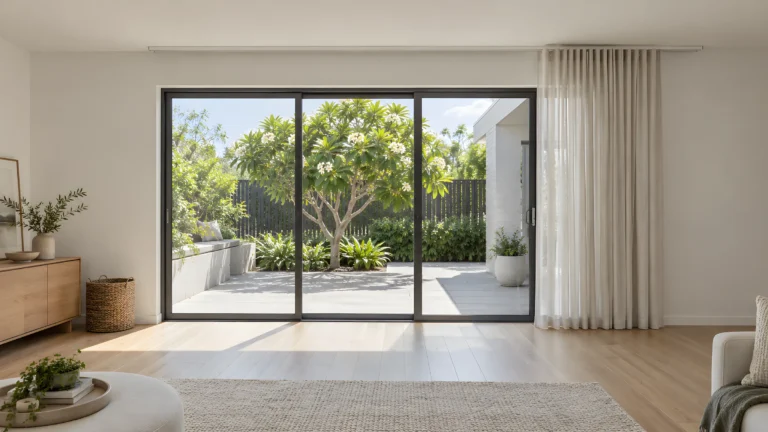 Room ideasCurtains for sliding and bifold doors: what to planCurtains suit sliding and bifold doors when the track is longer than the opening. Plan the stack-back, hem height and handle clearance before you order.
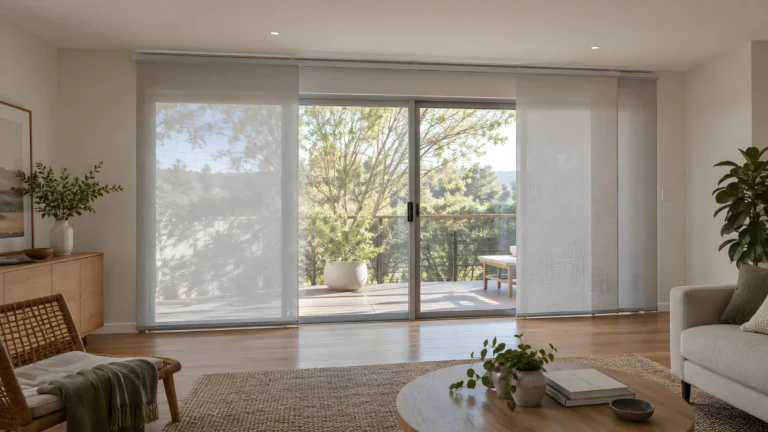 BlindsPanel glide blinds explained: panels, tracks and stackingBroad fabric panels on a track suit sliding doors and big windows. Here is how panel width, centre opening and stack space work, and which fabric to pick.
 BlindsAre vertical blinds outdated? A guide to modern vertical blindsVertical blinds are not outdated, but dated fabric and colour made them look that way. Here is how vane width, stacking and fabric decide the result.