
Blinds for large windows: linked, panel glide and motorised
A single roller blind stops at 3000 mm wide. Here is how linked blinds, panel glide, motors and curtains cover larger windows, with the size limits that apply.
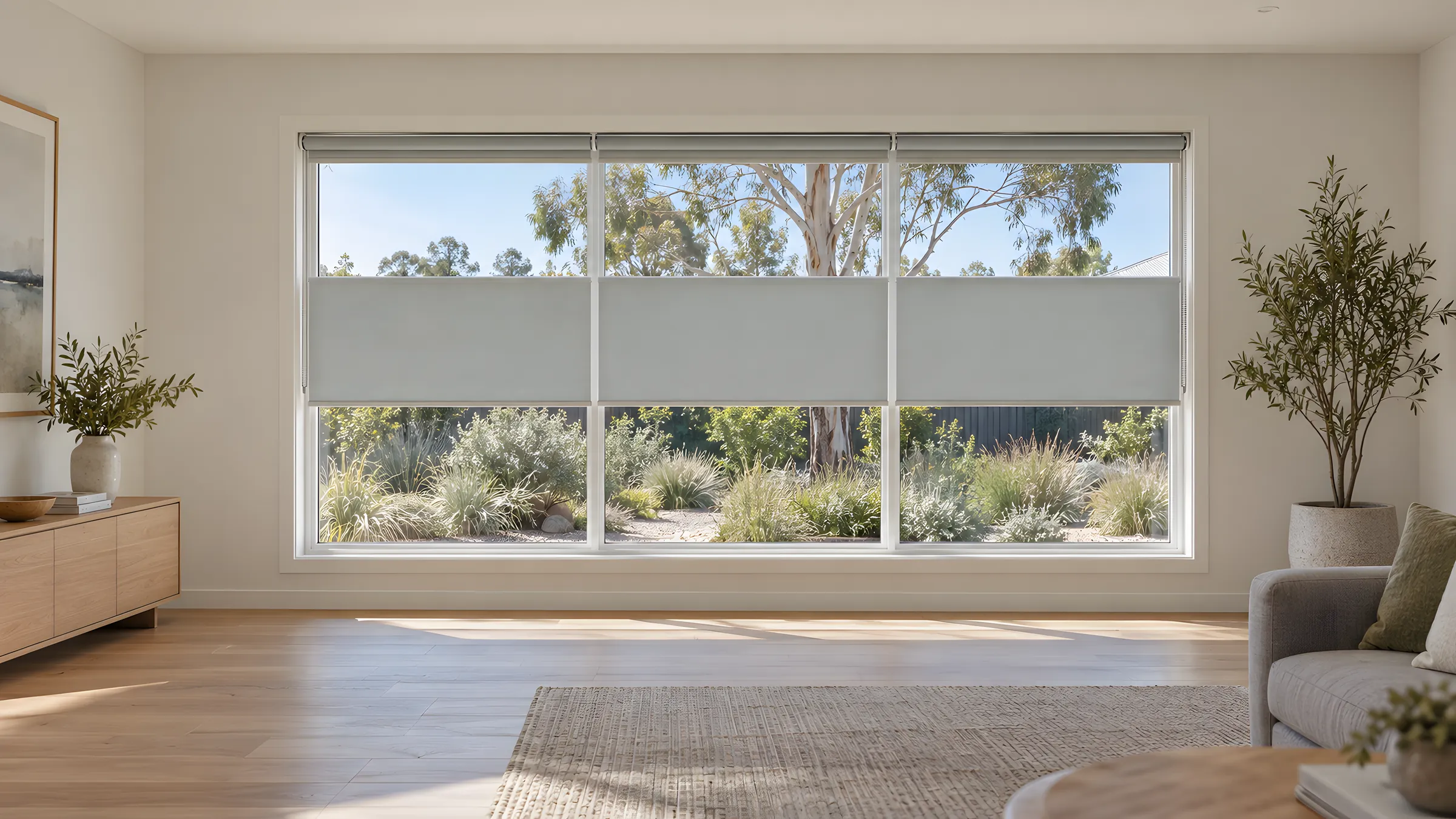
The best blinds for large windows are linked roller blinds, panel glide blinds, motorised roller blinds and curtains. A single roller blind stops at 3000 mm wide by 3000 mm drop, so wider glass is covered by linking two or three blinds or by choosing a system built for width. Bigger blinds carry more fabric and more load, so the tube, gear drive and control matter as much as the fabric.
In short
- A single roller blind is available up to 3000 mm wide and 3000 mm drop. Wider windows need linked blinds, panel glide or curtains.
- Blinds wider than 2100 mm use a 50 mm tube automatically, and blinds over 2500 mm wide get an upgraded gear-drive clutch at no extra charge.
- Linked blinds leave a join gap of about 17 mm, against 30 mm or more for blinds butted side by side. Put the join over a mullion.
- Panel glide suits glass walls and doors. Curtains need a planned stack-back beside the glass.
- Motorise any big blind you use often.
Size limits at a glance
These numbers decide what is possible before you choose a style.
| Product | Limit or rule | Notes |
|---|---|---|
| Single roller blind | 250 to 3000 mm wide, 300 to 3000 mm drop | Check the sizing rules in the measuring guide |
| Roller tube | 38 mm standard; 50 mm automatically above 2100 mm wide | Optional 50 mm upgrade to match a larger neighbour |
| Gear drive | Upgraded clutch above 2500 mm wide | No extra charge |
| ZeroGravity cordless | Up to 3 m wide by 3 m drop | Lifts by the base rail; no chain |
| Linked roller blinds | Two or three blinds on shared brackets | Join gap about 17 mm, against 30 mm or more when butted |
| Hardwired motors | Up to three linked blinds, combined width 6 m | Battery motors: one motor per blind |
| Panel glide | Panels typically 500 to 1000 mm wide | Face fit; stack allowance needed |
| Curtains | Planned by track width | Stack-back about 30 per cent one-way, 15 per cent each side for centre opening |
Choosing blinds for large windows: which option suits
| Your window | Best starting point | Why |
|---|---|---|
| One wide window under 3000 mm | A single roller blind | The neatest look; the 50 mm tube is used automatically above 2100 mm |
| Wider than 3000 mm, or divided by mullions | Linked roller blinds | Shared brackets, small join gap, joins hidden over the mullions |
| Full-height glass or a door opening | Panel glide blinds | Panels slide clear of the opening instead of rolling up |
| A big blind used daily | Motorised roller blinds | No hauling a wide blind by hand |
| A softer, layered finish | Curtains | Add sides, warmth and privacy layers |
Wide roller blinds: tubes and gear drives
A wide blind puts more load on the tube, brackets and drive. A single roller blind uses a 38 mm tube as standard. Above 2100 mm wide it moves to a 50 mm tube automatically, and above 2500 mm wide it also gets an upgraded gear-drive clutch, at no extra charge. The 50 mm tube is thicker and stiffer, which suits a longer span.
Match the tubes on a run of windows. If one blind in a row of windows tips over 2100 mm and the others do not, you will see the tube size change along the wall. Choose the optional 50 mm upgrade on the narrower blinds to match.
Check the fixings. Large blinds are heavier than small ones, so follow the roller blind installation guide for fixings that suit your wall.
Linked roller blinds
Two or three roller blinds share brackets in a linked set. Chain configurations are read left to right from inside the room: LL, RR, LR, LRR or LLR for chain drive, with LLL and RRR also available on hardwired and C-Bus systems. Battery motors are available as LR only.
- Join gap. About 17 mm on linked blinds, against 30 mm or more for blinds butted side by side.
- Mullions. Place the join over the centre of a mullion, so the gap is hidden.
- Ranges can differ. Each blind in the set can be Blockout, SunScreen or Light Filter, and ranges can differ per blind. That helps if one section catches the afternoon sun.
- Measure with the guide. Use our linked blinds measuring guide for linked sets and for how to label each blind.
Our guide to linked roller blinds explained covers the configurations in detail.
Panel glide for glass walls and big openings
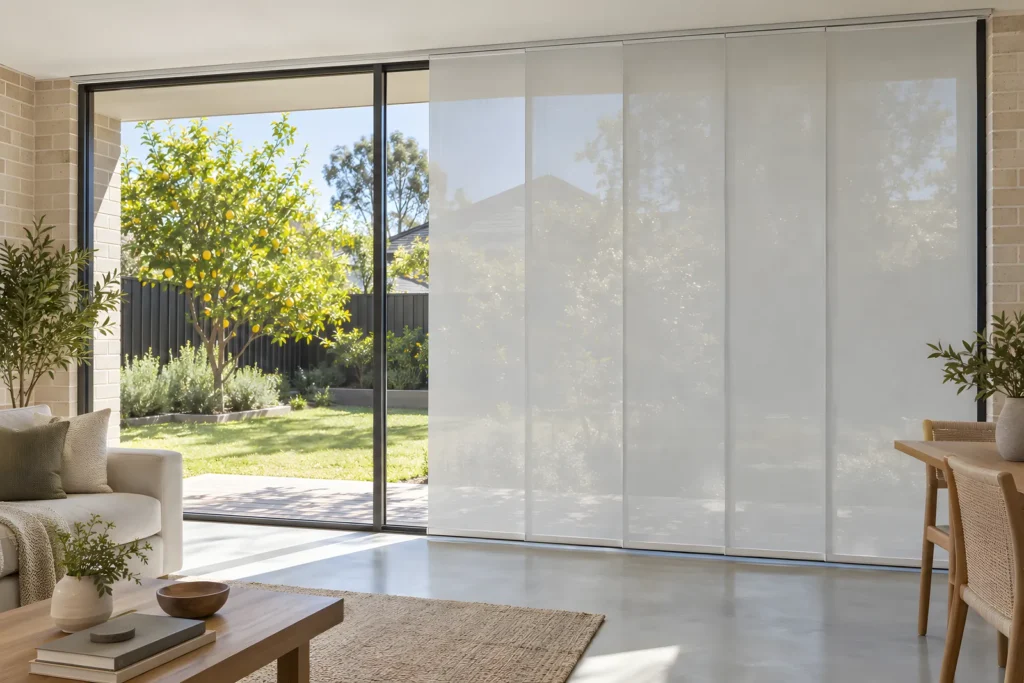
Panel glide blinds use broad fabric panels on a track. Panels are typically 500 to 1000 mm wide, and any roller blind fabric can be used, from blockout to Screen. They are face fitted, because the stacked panels take up a large part of an opening.
Plan wall space for the parked panels. Our guide has the track extend at least 300 mm on the stack side and at least 100 mm on the other, and it explains how to check the panel width before you order. Use the panel glide measuring guide for both.
Choosing fabric for a big piece of glass
A large window is often the main source of light and the main view, so the fabric choice shows more than it does on a small window.
- SunScreen cuts glare and keeps the view. It gives daytime privacy only when it is brighter outside, and is not a night-privacy fabric.
- Light Filter diffuses the daylight and obscures the view. Silhouettes may show at night when the room is lit.
- Blockout stops light passing through the cloth and gives night privacy, though a little light can still show around the edges.
- Day and night in one window. A double roller blind pairs a daylight layer (Screen or Light Filter) with a blockout layer on one set of dual brackets, each operated separately. It needs 90 mm of recess depth with both over-rolled, or 70 mm with both under-rolled.
Take samples to the window. A colour that looks calm in a small swatch can look much stronger across three metres of glass, so compare it against the walls, floor and frame.
Motorised control for big blinds
A big blind is heavy to lift by hand, so a motor takes the effort out of daily use.
- Battery (rechargeable). Needs no mains wiring and one motor drives one blind, so linked blinds need a motor each.
- Hardwired. Fitted by a licensed electrician. Up to three linked blinds, with a combined width of 6 m.
- C-Bus. For an existing C-Bus system, fitted by an electrician.
Remotes are 2-channel or 16-channel, and several motors on one channel move together, so a run of blinds lowers with one press. A compatible smart hub adds an app, scenes, timers and voice control. Our motorised blinds guide covers the options.
Curtains for large windows
Curtains can span a whole window, but they need room to stack. For wall-to-wall windows a one-way curtain stack-back takes about 30 per cent of the track width, and a centre opening about 15 per cent on either side. To frame a window, our guide has you add at least 30 per cent to the window width for the track, so the stacked curtain sits beside the glass rather than in front of it.
Many large windows use curtains alongside a blind. The blind handles daily light and privacy, and the curtain adds softness and covers the sides. Sheers outsell blockouts roughly three to one, so a sheer over a blockout blind is a popular pairing. If the window turns a corner, see curtains for bay and corner windows.
Common mistakes with large windows
- Joining over the glass. Put the join over a mullion, not the middle of a pane.
- Letting the curtain stack cover the glass. The track has to extend beside the window.
- Ordering a linked set without the guide. Follow the linked blinds measuring guide for labelling before you order.
- Judging fabric from a small swatch. Order free samples and look at them on the day and night side of the window.
Measuring a large window
Use the official guide for your product rather than a general method:
| Window or product | Measuring guide |
|---|---|
| Single roller blind | Roller blind measuring guide |
| Linked roller blinds | Linked blinds measuring guide (linked above) |
| Panel glide | Panel glide measuring guide (linked above) |
| Curtains | Curtain measuring guide |
| Any other product | All measuring guides |
SureFit measurement protection may apply where eligible. Ask us before you order if a window has an obstruction or an unusual shape.
Questions
How wide can a roller blind be?
A single roller blind can be up to 3000 mm wide and 3000 mm drop. Wider windows use two or three linked blinds on shared brackets, or a panel glide system.
Do large blinds need a 50 mm tube?
Blinds wider than 2100 mm use the 50 mm tube automatically. You can also choose the 50 mm upgrade on a narrower blind to match a larger neighbour.
Should I motorise a large blind?
It is worth considering for any big blind you use often, because a wide blind can be heavy to lift by hand. Blinds over 2500 mm wide get an upgraded gear-drive clutch at no extra charge, which also helps with manual use.
What can I use if my window is wider than 3 metres?
Linked roller blinds, panel glide blinds or curtains. Linked blinds cover up to three sections, panel glide moves across the whole opening, and curtains can span the width if you plan the stack-back.
Are curtains or blinds better for big windows?
Both work, and many large windows use both. Blinds handle daily light and privacy, while curtains add softness and cover the sides. Plan the curtain stack so it sits beside the glass.
Build blinds for your large window
Configure a linked, motorised or panel glide option and see the price as you enter your measurements.
Keep reading
 BlindsLinked roller blinds: covering wide windows neatlyTwo or three roller blinds on shared brackets cover wide windows with a much smaller join gap than butted blinds. Here is how layouts, mullions and fabrics fit together.
 BlindsPanel glide blinds explained: panels, tracks and stackingBroad fabric panels on a track suit sliding doors and big windows. Here is how panel width, centre opening and stack space work, and which fabric to pick.
 BlindsMotorised blinds explained: battery, hardwired and C-BusBattery, hardwired or C-Bus? A plain guide to how motorised blinds are powered, how remotes and hubs work, and what to check before you order.