
Vertical blind parts and repairs: slats, carriers and chains
Name the headrail, carriers, vanes and chain, find out why a vane will not turn or has fallen off, and decide whether to repair or replace.

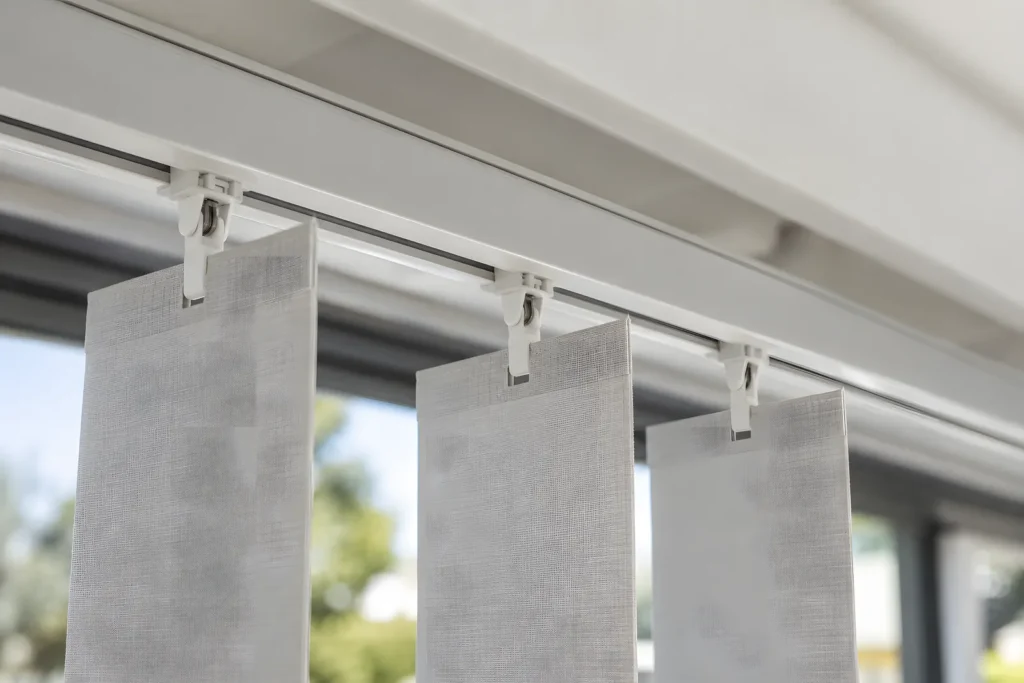
Vertical blind parts are simpler than they look: a headrail along the top, a carrier for each vane, a mechanism that turns and draws them, the vanes themselves, and a bottom chain or weights. Most faults come from a carrier that has slipped out of step, a torn hanger slot or a stiff control. One damaged vane is often fixable, but a bent headrail or many damaged vanes usually points to a new blind.
In short
- The main parts are the headrail, brackets, carriers, vanes (slats), a control, and a bottom chain or weights.
- Many faults come from a carrier out of step, a torn hanger slot or a stiff or disconnected control.
- A replacement vane must match the width, length, fabric and carrier fitting of the old one.
- We do not sell vanes or spare parts separately. If your blind came from us, contact us with your order details.
- Several damaged vanes, a faded blind or a failing headrail usually point to replacement.
Vertical blind parts and what they do
Vertical blinds look different from other blinds, but the working parts follow a pattern. The names vary between makers, and the exact hardware depends on your blind, so use this table as a guide.
| Part | What it does | What goes wrong |
|---|---|---|
| Headrail | The long channel across the top that holds the carriers | Bends, comes loose from its brackets, or fills with dust |
| Brackets | Fix the headrail to the wall, frame or ceiling | Pull out of the surface if the fixings were wrong |
| Carriers | Small sliders, one per vane, that travel along the headrail and rotate | Snap, stick, or fall out of step with the others |
| Vanes (slats) | The vertical fabric strips that turn and stack | Tear at the top, crease, curl or fade |
| Control | A wand, cord or chain that turns and draws the vanes, depending on the blind | Disconnects, jams or wears |
| Bottom chain or weights | Keep the vanes hanging straight and evenly spaced | Break, tangle or go missing |
Our vertical blinds come in Lakeside or Shade, with vanes 89 mm or 127 mm wide, and stack left, right or split. See vertical blinds for the range, or our guide to modern vertical blinds for how they compare with other blinds.
Common vertical blind faults and first checks
Start with the simplest explanation and work down. Stop if anything needs force.
| Symptom | Likely cause | First thing to try |
|---|---|---|
| One vane faces the wrong way | The carrier is out of step with the others | Turn all the vanes fully one way to line them up, then back |
| No vanes rotate | The control has come off or something is jammed | Check the control and the end of the headrail for a disconnected part |
| Blind sticks when drawn | Dust in the headrail, a snagged chain, or vanes catching | Clear dust, untangle the bottom chain and move the vanes by hand |
| A vane has fallen off | The hanger slot is torn, or the carrier has broken | Look at both. A torn slot means a new vane, and a broken carrier needs a replacement |
| A vane is torn at the top | The reinforced slot has failed | Replace the vane, because tape rarely holds under the weight |
| Vanes hang unevenly or curl | The bottom chain has broken, or a vane is creased | Reconnect or replace the chain, and check each vane |
| Headrail droops or leans | Fixings have loosened | Refit following the vertical blinds installation guide |
| Control is broken | A worn connection or snapped cord | Contact the supplier. Do not force it |
Dust in the headrail is a common cause of sticking and stiff carriers. Our guide to how to clean vertical blinds covers dusting the vanes and the track, and keeping the headrail dry.
Keep chains and cords out of children's reach. If a bottom chain or control cord has broken or hangs loose, fix or remove it before you use the blind again.
Vertical blinds replacement slats
Vertical blinds replacement slats are really replacement vanes. If a single vane is damaged and the rest are in good condition, swapping it can work, but only if the new one matches the old in four ways:
- Width. Ours are 89 mm or 127 mm, and a wrong width shows against the others.
- Length. Measure an existing vane from the top of the hanger slot to the bottom edge.
- Fabric and colour. Our vertical blinds use Lakeside or Shade. Older vanes fade in the sun, and Lakeside can vary slightly between batches, so a new vane may look different beside old ones.
- Carrier fitting. The top of the vane must hook onto your carriers.
Replacing one vane is usually straightforward. Methods vary, so follow the instructions for your blind, and use this outline as a guide:
- Draw the blind closed so you can reach the damaged vane, then turn the vanes to the position your instructions show for removing one.
- Disconnect the bottom chain from the damaged vane, if there is one.
- Unhook the damaged vane from its carrier. Hold the carrier steady so it does not turn.
- Hook the new vane on the same way round.
- Reconnect the chain, then rotate and draw the blind to check it runs evenly.
How to avoid most vertical blind repairs
Most of the damage to vertical blinds happens in ordinary use, and a few habits prevent it.
- Use the control, not the vanes. Pulling or pushing vanes by hand twists carriers and tears hanger slots.
- Turn the vanes open before you draw the blind. Drawing a blind with the vanes closed can make them catch on each other.
- Mind the door. Stack the blind on the side that keeps the vanes off the handle, and open a sliding door slowly so the vanes are not dragged.
- Calm the swing. Vanes sway in a breeze from an open door. A bottom chain, where fitted, keeps them in line.
- Keep the headrail clean. Dust and grit in the track make carriers stiff.
- Check the fixings now and then. A headrail that starts to lean has often lost its grip on the surface behind it.
Vertical blinds spare parts and repairs
We do not sell vanes, carriers or other spare parts separately. If your blind came from us, contact us with your order details and photos of the headrail ends, the control and the damaged vane, and tell us which window it is on. We will advise what is possible for your blind.
It helps to have this ready before you write:
- photos of both ends of the headrail, the control, one carrier close up and the top of a damaged vane
- the width of a vane, its length and its colour
- the stack direction and the window the blind is on
- your order number, if you have it
For a blind from another supplier, that supplier or a local blind repairer is the best source of matching parts. Take a photo of the carrier and the top of a vane with you. Parts that look alike often fit differently.
Vertical blinds repair or replacement
A vertical blinds repair is sensible when the problem is one vane, one carrier, a tangled chain or a loose bracket. Replacement makes more sense when:
- three or more vanes are damaged or torn
- the blind has faded unevenly and new vanes would never match
- the headrail is bent, or several carriers are failing
- the control keeps jamming or breaking
- the blind looks dated and you want a fresh start
Replacement vertical blinds, made to measure, are a small project, and the result is a blind in a current fabric, with matching vanes along the full width. Measure the opening again rather than copying the old blind, because windows and fittings change. Our vertical blinds measuring guide walks through the steps, and the vertical blinds installation guide covers fitting. You can also order free samples before you commit, because Lakeside and Shade look quite different in daylight.
Questions
What are the parts of a vertical blind?
A headrail along the top, brackets that fix it, a carrier for each vane, the vanes themselves, a control that rotates and draws them, and a bottom chain or weights.
Can I replace a single slat on a vertical blind?
Often yes, if you can get a vane that matches the width, length, fabric and carrier fitting. Older vanes fade, so a new one may look slightly different beside them.
Do you sell vertical blind spare parts?
We do not sell vanes or other spare parts separately. If your blind came from us, contact us with your order details and photos and we will advise what is possible.
Why will my vertical blind not rotate?
The control may have come disconnected, a carrier may be jammed, or the headrail may be dirty. Check the control and the end of the headrail, and do not force it.
When should I replace vertical blinds instead of repairing them?
Replace them when several vanes are damaged or faded, when the headrail is bent or the mechanism is failing, or when the style is dated. A new made-to-measure blind is often simpler.
Replace your vertical blinds
Choose Lakeside or Shade, pick your vane width and stack direction, and see the price before you order.
Keep reading
 BlindsAre vertical blinds outdated? A guide to modern vertical blindsVertical blinds are not outdated, but dated fabric and colour made them look that way. Here is how vane width, stacking and fabric decide the result.
 Care & cleaningHow to clean vertical blinds (on or off the track)Clean vertical blinds in place with a soft cloth and damp sponge, or take the vanes off for heavy build-up. Step-by-step, with mould tips.
 Room ideasThe best blinds for sliding doors and French doorsPanel glide, vertical, linked roller blinds or curtains? Compare the best blinds for sliding doors and French doors, with the clearances that decide what works.