
How to black out a home theatre or media room
The darkest home theatre setup pairs blockout fabric with a full cassette, curtains over the top and a motor. Here is how each layer works and what still leaks.
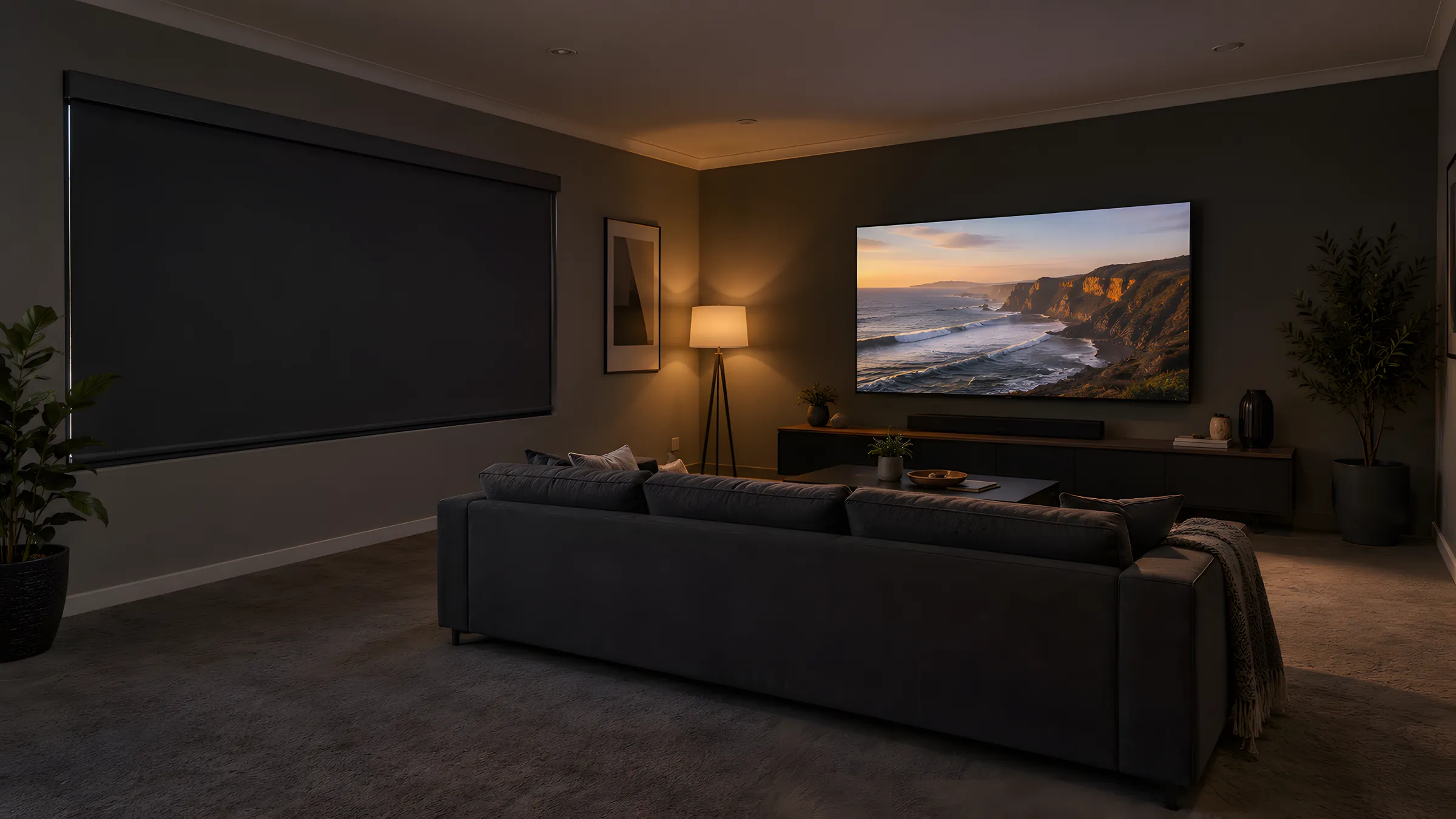
The best home theatre blinds work in three layers: a blockout fabric that stops light passing through the cloth, a full blockout cassette that closes the gaps around the edges, and motorised control so you can lower everything from the couch. This combination gets you closest to a fully dark room. Many people search for "blackout blinds"; it means the same thing as blockout.
In short
- Start with a blockout fabric. Light Filter and SunScreen let light through the cloth, so they are the wrong choice for a theatre.
- A full blockout cassette closes most of the side, top and bottom gaps that a standard blind leaves. It must be ordered with a compatible blind and cannot be retrofitted.
- Curtains over the top cover what the blind misses. Extend the track past the window on both sides.
- A motor lowers the blinds without leaving your seat. Battery motors need no mains wiring.
- Order free samples and view them with the room lights turned down.
Where the light in a media room comes from
Before you choose a product, work out which light you are fighting. Sit in the room at the time you normally watch and look at the window.
| Light path | Why it happens | What fixes it |
|---|---|---|
| Through the fabric | Light Filter and Screen fabrics let light pass | Blockout fabric |
| Around the edges | A recess-fit roller blind leaves small gaps at the sides, about 20 mm on the chain side and 10 to 20 mm at the pin end | Face fit, or a full blockout cassette |
| Between linked blinds | Linked blinds leave a join gap of about 17 mm | A single blind where the window is under 3000 mm wide, or curtains over the join |
| Reflections inside the room | A pale fabric on the room side bounces screen light | A darker colour on the room side |
| Other sources | Door glass, hallway lights, standby LEDs | Curtains, door coverings or a repositioned screen |
Blockout describes the fabric only. Even a well-fitted blind and cassette can leave a little light at the edges, so plan for a very dark room rather than a pitch-black one.
Not every window matters equally. Start with the windows that face the screen or sit beside it, because their light lands on the picture and their glare shows up first. Windows behind the seating matter less for a television, though a bright projector needs the whole room dimmed. If you can only cover one window well, choose the one that causes the most glare at the time you watch.
Blockout fabric for home theatre blinds
We make nine blockout ranges: Shade, Serene, Serene II, Ultra, Array, Allure, Elegance, Lakeside and Opulence. Ranges with LF in the name, such as Serene LF and Ultra LF, are Light Filter fabrics and are not the ones to choose for a theatre. Read more on our blockout roller blinds page.
Colour matters more than most people expect. A dark fabric on the room side reflects less light from the screen or projector back into the room. Array Jet, Elegance Obsidian, Serene Pitch and Serene II Charcoal are dark choices in the range.
Watch the backing. Serene, Ultra, Array, Allure, Elegance and Opulence have a white backing. With a standard roll, the backing shows at the top of the roll, so a dark fabric can finish with a pale strip at the top. Shade has the same colour on both sides, and Serene II and Lakeside have a colour-coordinated backing, so they avoid that strip.
Roll direction. A standard (under) roll drops from the back of the tube, closer to the glass, and blocks more light than a front roll. Choose it unless a handle or winder forces a front roll.
Full blockout cassette
A full blockout cassette adds a headbox, side channels and a bottom channel around a compatible under-roll blockout blind. It is offered as a full four-sided or a three-sided enclosure. Our cassette roller blinds page shows the options.
There are rules to plan around:
- The cassette and blind are ordered together and matched by dimensions and window name.
- It cannot be retrofitted to an existing blind.
- A front roll is not possible, so it cannot clear a handle by rolling over the front.
- It needs 50 mm of clear depth.
- Measure with our cassette roller blind measuring guide, which covers recess fit, face fit on architraves and face fit without architraves.
Here is how the setups compare:
| Setup | Light control | Notes |
|---|---|---|
| Blockout roller, recess fit | Fabric blocks light; gaps at the sides | Neatest; most edge light |
| Blockout roller, face fit | Covers more of the opening and cuts the gaps | Good compromise; under-roll recommended |
| Blockout roller with a fascia | Hides the hardware | Not a cassette; does not remove every light gap |
| Full blockout cassette | Enclosed top, sides and bottom | Best control from the blind itself; needs 50 mm depth |
| Cassette plus blockout curtains | Curtains cover remaining leaks | The darkest setup |
Curtains over the blind
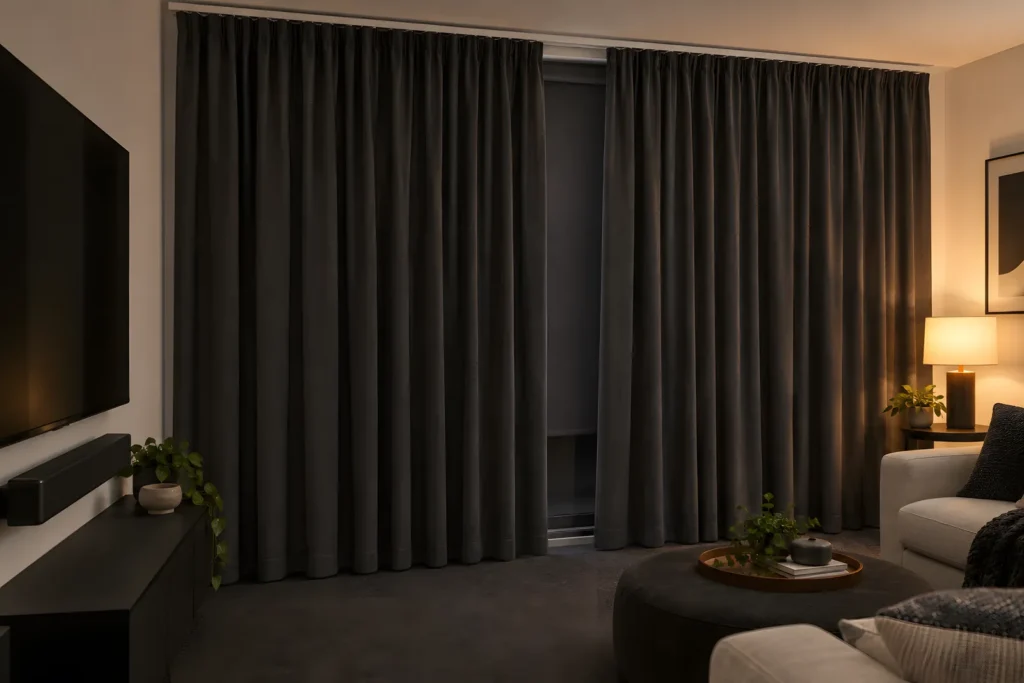
Curtains catch what the blind cannot. Our blockout fabrics are Galaxy, the heaviest and coated, and Epic, which is three-pass coated. Both are opaque, so the track matters more than the fabric.
- Extend the track past both sides of the window so the curtain overlaps the wall. The curtain measuring guide explains how to size a track that frames a window.
- Use a ceiling-fit track so the curtain hangs from ceiling height and closes the gap above the window.
- Consider a pelmet. A box pelmet above the track hides the hardware and helps cover the gap above the window.
- Choose the layers. Blockout curtains on their own, or lined curtains, where a blockout lining is sewn behind a sheer so both move together on one track.
Control without leaving your seat
A theatre is used the same way every time, which is why motorisation suits it. Silent Glide motors come in three types:
- Battery (rechargeable). Needs no mains wiring and suits DIY installation. One motor drives one blind, and linked blinds need a motor each. You will need the charger.
- Hardwired. Fitted by a licensed electrician. Can drive up to three linked blinds, with a combined width of 6 m.
- C-Bus. For an existing C-Bus system, fitted by an electrician. It does not use the RF remote or the hub.
Remotes come in 2-channel and 16-channel versions, with a range of up to 30 m indoors. Several motors on one channel move together, so all the blinds in the room can lower with one press. A compatible smart hub adds an app, scenes, timers and Alexa or Google Home voice control, so a single "movie" scene can lower every blind at once. See motorised roller blinds for the full options.
Tip: If you want a completely automated room, ask your electrician about hardwired or C-Bus motors before the walls are lined. Battery motors are easier if the room is already finished.
Small details that show in a dark room
Once the room is dark, bright hardware stands out. Brackets come in white, grey, ivory, latte and black, and the deluxe oval base rail comes in Anodised, White, Black or Cream. Chain colours include Grey and Black. Choose black or grey hardware so it disappears against a dark wall, and match the side covers if you use them.
If your window is on a wall you will be looking at during a film, a face fit with a fascia can give a cleaner line than exposed brackets. Remember that a fascia is a cover for the hardware, not a cassette, so it does not close the edge gaps.
Common mistakes
- Skipping the depth check. The cassette needs 50 mm of clear depth, so check it against the cassette measuring guide before you commit.
- Trusting a linked run. The join gap lets a thin strip of light through. Use one blind where you can.
- Ignoring the door. Glass doors need their own plan: our guide to blinds for sliding doors and French doors covers them.
- Judging colour in daylight. View blockout samples with the lights turned down, because that is how you will use the room.
- Forgetting the wall space for curtains. A track that extends past the window needs wall or ceiling space either side, so check before you order.
For more on closing edge gaps, read how to reduce light gaps around roller blinds, or see the full home theatre blinds range.
Questions
Can you make a home theatre completely dark?
Not with blinds alone. Blockout fabric stops light passing through the cloth, and a full cassette closes most of the gaps around it, but light can still find a way in. Curtains over the top and covering other light sources get you closest.
Do I need a cassette for a home theatre blind?
It is the best way to reduce light at the edges if screen glare is a priority. A standard blockout blind with a face fit is a good compromise if you do not have the 50 mm of clear depth a cassette needs.
What colour blockout blind is best for a media room?
A darker colour on the room side reflects less screen light back into the room. Array Jet, Elegance Obsidian, Serene Pitch and Serene II Charcoal are dark options, and you should view samples with the lights turned down.
Is a motorised blind worth it for a home theatre?
It suits a room that is used the same way every time. A remote or smart hub scene lets you lower the blinds before a film without getting up, and battery motors need no mains wiring.
Build your home theatre blind
Configure a blockout roller blind, full cassette and motor and see the price as you enter your measurements.
Keep reading
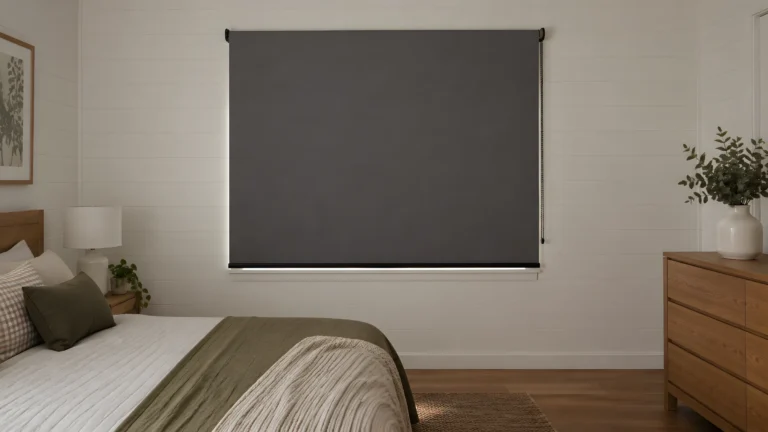 BlindsHow to reduce light gaps around roller blindsLight gaps come from fit, not just fabric. Compare face fit, under-roll, side channels, linked blinds and layering to get the darkest room a roller blind allows.
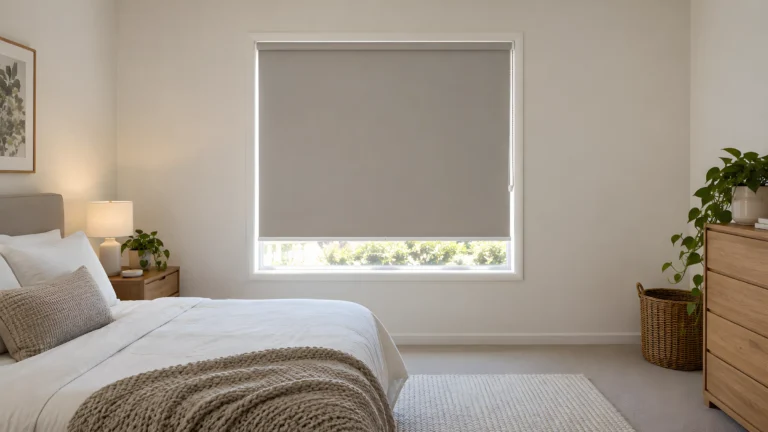 ComparisonsBlockout vs blackout blinds: is there a difference?Blockout and blackout are two names for the same fabric type. Here is what it does, where light still leaks in and how to fit it for a darker room.
 BlindsMotorised blinds explained: battery, hardwired and C-BusBattery, hardwired or C-Bus? A plain guide to how motorised blinds are powered, how remotes and hubs work, and what to check before you order.