The best window coverings for privacy, day and night
Most window coverings give privacy by day, but only some do at night with the lights on. Here is what each option really hides, and how to fit it.
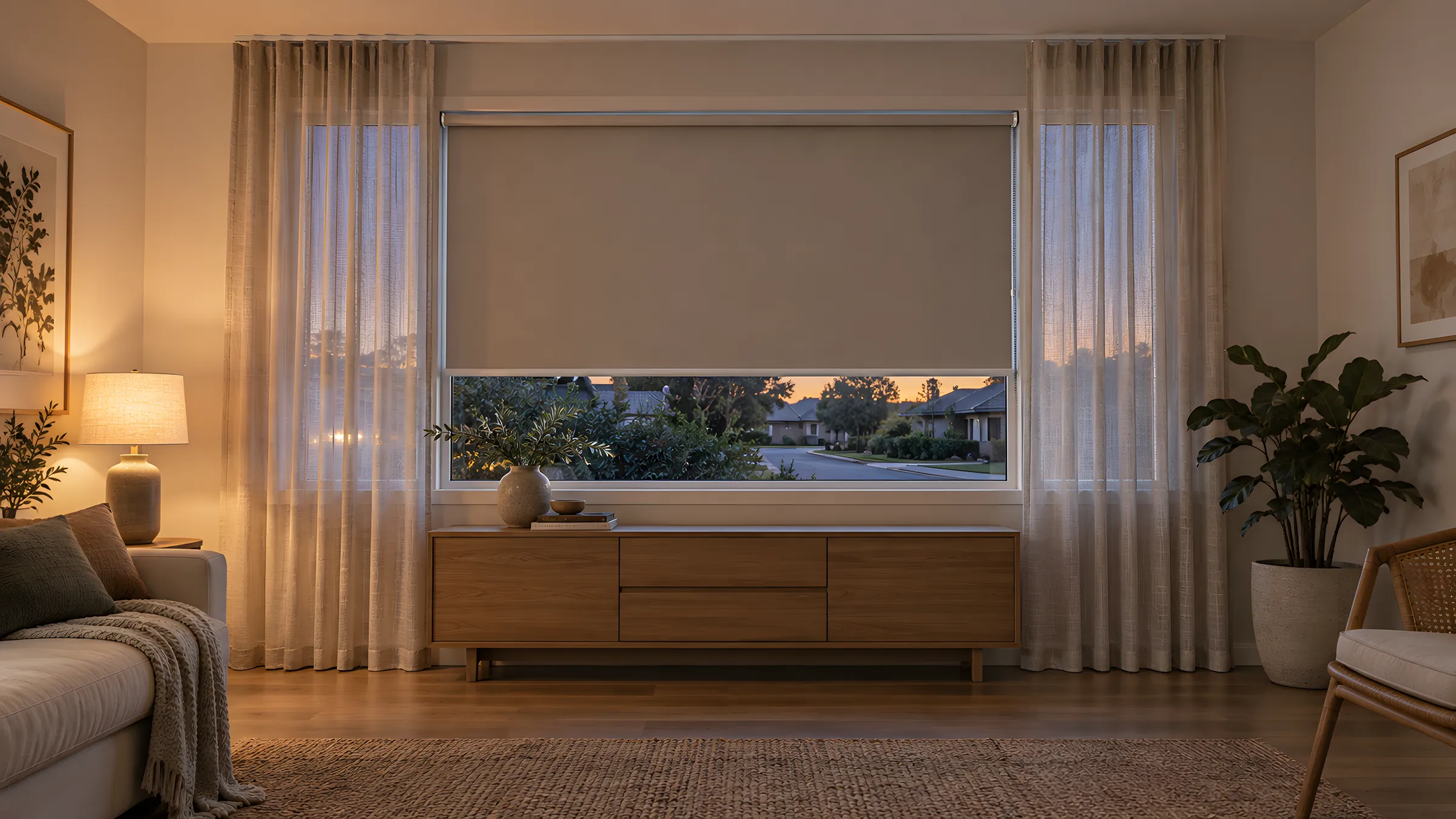
Privacy blinds work in two different ways, and most people only think about one of them. By day, almost any covering hides the room because it is brighter outside than in. At night, with the lights on, only a covering that stops light passing through the fabric keeps people outside from seeing in. That is blockout, and it is the fabric to choose for any window you want private after dark.
In short
- Blockout fabric gives night privacy. Light Filter, SunScreen and sheer curtains do not, even though they work well by day.
- SunScreen roller blinds keep the view and give daytime privacy only when it is brighter outside than in.
- Sheer curtains hide a room by day but show shapes at night; add a blockout layer for after dark.
- Double roller blinds, double curtains and lined curtains give both a daylight layer and a night layer.
- Test any fabric from outside, at night, with the lights on before you commit.
Why privacy changes between day and night
The side with more light can see into the side with less. That one rule explains almost every privacy question about windows.
In daylight, the outdoors is much brighter than your room, so people outside see reflections and glare rather than detail. You can see out through a light or open-weave covering, and they cannot see in. After dark with a lamp on, the situation reverses. Your room is the bright side, the street is the dark side, and anything translucent becomes a lit screen.
This is why a window that felt private all afternoon can feel exposed at 7pm. It is also why the most useful setup is usually two layers, one for daylight and one for night.
Privacy blinds and curtains compared
Here is what each option does.
| Option | Daytime privacy | Night privacy (lights on) | Keeps the view | Things to know |
|---|---|---|---|---|
| Blockout roller | Yes, when lowered | Yes | No, while lowered | Light still shows at the edges of a conventional blind |
| Light Filter roller | Obscures the view | Silhouettes may show when lit | Limited | Diffuses daylight softly |
| SunScreen roller | Only when brighter outside | No | Yes | Cuts glare; not a night privacy fabric |
| Sheer curtains | Some | No | Softened | People outside can see in at night with lights on |
| Lined curtains | Some by day | Yes | Softened when open | Blockout lining sewn behind a sheer, one track |
| Double curtains | Sheer by day | Yes, with the blockout drawn | Yes, with the blockout open | Two tracks, drawn separately |
| Double roller blind | Daylight layer by day | Yes, with the blockout layer down | Yes, with the SunScreen layer down | Blockout plus Screen or Light Filter |
| Vertical blinds | Rotate vanes as needed | Good when closed | Partly, when rotated | Suits sliding doors |
| Venetian blinds | Tilt to hide the view | Good when closed | Yes, when lifted | Aluminium, timber or fauxwood |
| Plantation shutters | Tilt blades to hide the view | Good when closed | Yes, when open | D-mould blocks the view between panels |
Read across the "night" column and the pattern is clear. Anything translucent needs a second layer behind or in front of it if the window faces a street, a neighbour or a footpath.
Do sheer curtains provide privacy?
By day, yes, mostly. In a bright room facing a street, a sheer softens the outline of everything behind it and reflects enough light that people outside see little detail. But sheers are designed to let light through, and that works in both directions.
At night with the lights on, people outside can see in. You will not be recognisable, but movement and shapes will show. Our sheers come in three fabrics: Cassis (a soft, natural linen-look polyester), Cassis Volume (the same fabric in whites and greys) and Bali (the lightest linen-look sheer). The lighter the fabric, the more shows through at night.
There are three ways to fix it:
- Double curtains: a blockout on the rear track and a sheer on the front track, each drawn separately.
- Lined curtains: a blockout lining sewn behind the sheer, so both move together on one track.
- A blind behind the sheers: a blockout roller blind lowered at night and rolled up by day.
For the first two, see how to layer sheer and blockout curtains. If you would rather keep things simple, a blockout roller behind sheers is the least fussy setup.
Blinds that let you see out but not in
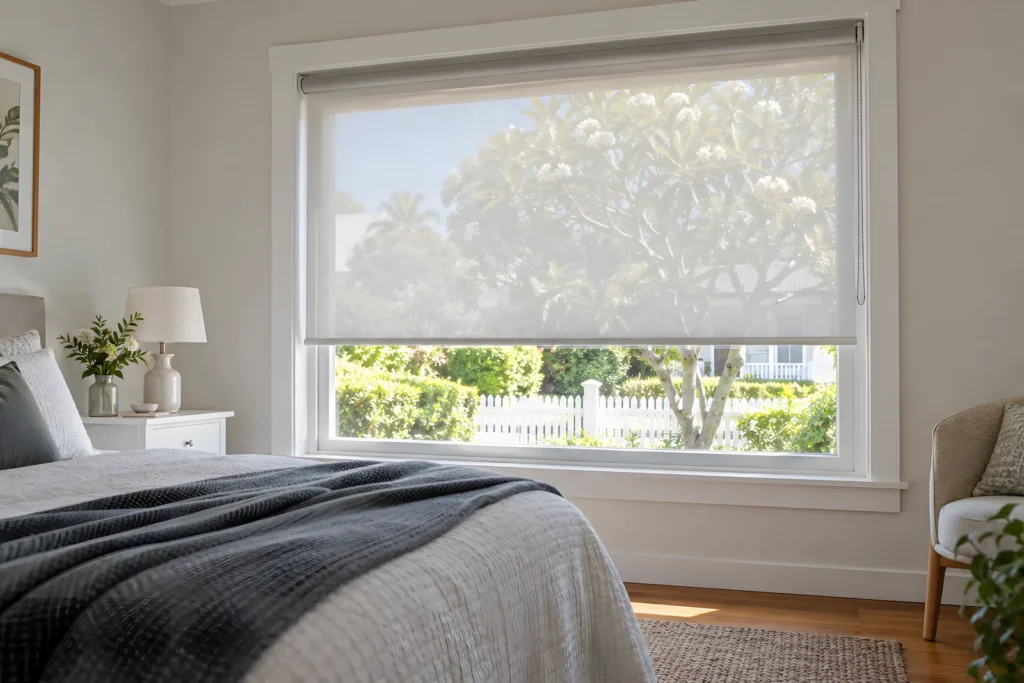
This only works in daylight. A SunScreen roller blind has a woven, open construction that cuts glare and keeps your view of the garden or street while making the room hard to see into when it is brighter outside. That is why it suits living areas and home offices.
It is not a night privacy fabric. Once the lights are on and it is dark outside, the effect reverses. Two ways to deal with this:
- Use a double roller blind. The SunScreen layer stays down by day, and the blockout layer comes down at night. One window, two jobs.
- Add curtains. Lined or blockout curtains on a track over the SunScreen blind take over after dark.
Venetian blinds and plantation shutters can also work as see-out privacy in daylight. Tilt the blades part-closed and the angle limits sight lines from the street while light still comes in. How well it works depends on the angle and on how far away and how high up the viewer is, so check it from outside. At night with the lights on, close them fully.
Tip: A Light Filter roller obscures the view, so you lose most of your own outlook as well. It is good for a bathroom or a footpath-facing window, but if you want to look out you need SunScreen, venetians or shutters.
Privacy room by room
Street-facing living room. A Light Filter or SunScreen roller by day, plus lined curtains or S Fold curtains with a blockout layer for evenings. A double roller works if you prefer blinds.
Bedroom. A blockout roller, ideally face fit, or a double roller. Blockout also gives a darker room. See blockout for better sleep for how to close the light gaps.
Bathroom. Light Filter or Blockout rollers and PVC plantation shutters are the usual choices. Roller fabric is not waterproof, so keep it out of direct spray. Read more in our guide to blinds for bathrooms.
Sliding and French doors. Vertical blinds and panel glide blinds suit sliding doors. For French doors, front-roll rollers, vertical blinds and S Fold curtains keep clear of the handles.
Ground-floor and corner windows. These see the most foot traffic. Treat them like a bedroom: a blockout layer that you can close after dark, plus a daylight layer if you want the view.
Fit matters as much as fabric
A private fabric with gaps around it is not fully private. Three fitting choices make a real difference.
- Face fit over recess fit. A recess-fitted blind leaves small gaps at each side. A face-fit blind covers the frame and cuts those gaps.
- Roll direction. A standard (under) roll drops from the back of the tube, closer to the glass, and blocks more light than a front (over) roll.
- Overlap. For curtains, let the track run wider than the window and choose fullness that meets in the middle with no gap.
Accurate measuring makes all three work. Use our roller blind measuring guide and follow the product-specific guide from our measure guides for anything else.
Common privacy mistakes
- Forgetting the small windows. A narrow window beside a front door or next to a bathroom is often the one people look through. Cover it with the same care as the big one.
- Leaving venetians or shutters tilted open after dark. Close them fully, or the room shows through the gaps.
- Measuring for a recess fit and expecting face-fit coverage. A recess blind leaves side gaps by design. If privacy or darkness matters most, choose face fit.
- Judging a sample in daylight only. Hold it up at night with the lights on as well.
Can people see through blinds and sheers at night?
Yes, for most blinds and sheers, once the lights are on inside and it is dark outside. Only a closed blockout layer keeps the room private after dark. The covering that hid the room all afternoon becomes a lit screen at night because your room is now the brighter side.
What shows through each covering at night
Whether you can see through blinds at night depends on the fabric:
- Blockout roller blinds: No. Blockout stops light passing through the cloth, so nothing shows through it.
- Light Filter roller blinds: The view is obscured, but silhouettes may show when the room is lit.
- SunScreen roller blinds: Yes. SunScreen gives daytime privacy only, when it is brighter outside than in.
- Sheer curtains: Yes. People outside can see shapes and movement with the lights on, and the lighter the fabric, the more shows.
- Venetian blinds, vertical blinds and plantation shutters: Closed fully, they hide most of the room. Tilted or rotated open, people outside can see through the gaps.
Privacy curtains that let light in
Curtains that let light in and keep the room private at night need two layers, because one fabric cannot do both jobs. A sheer on the front track lets daylight in and softens the view from outside by day. A blockout on the rear track closes after dark. That is the idea behind double curtains, and you can draw each layer separately: sheer only by day, blockout as well at night. A sheer in front of a blockout roller blind works the same way.
A five-minute privacy test
Do this once you have a fabric sample or a made-up product.
- Close the covering at dusk and switch on the room lights you normally use.
- Walk to the footpath or street and look at the window from about three positions: straight on, from the side and from across the road.
- Look for shapes, silhouettes and light leaking at the edges.
- Repeat in daylight to check the view out, standing at the window.
- If shapes still show, add a blockout layer, or move to face fit.
To check fabrics in your own light before ordering, order free samples and test them the same way.
Questions
Do sheer curtains provide privacy?
By day they usually do, because the room is darker than outside. At night with the lights on, people outside can see in, so add a blockout layer or choose lined curtains.
Can you see through sheer curtains?
Yes, more than most people expect once the lights are on inside. The lighter and more open the weave, the more shapes show through at night.
Can you see through blinds at night?
Usually, yes, once the lights are on inside. Light Filter can show silhouettes, SunScreen and sheers show the room, and only a closed blockout layer keeps it private after dark.
Which blinds let you see out but not in?
SunScreen roller blinds do this in daylight, when it is brighter outside than in. At night with the lights on the effect reverses, so pair them with a blockout layer.
What is the most private window covering at night?
A closed blockout layer: a blockout roller blind, blockout or lined curtains, or a double system with a blockout layer. Plantation shutters and venetians closed are also good.
Test privacy in your own home
Order free samples and check them from the street at night with the lights on.
Keep reading
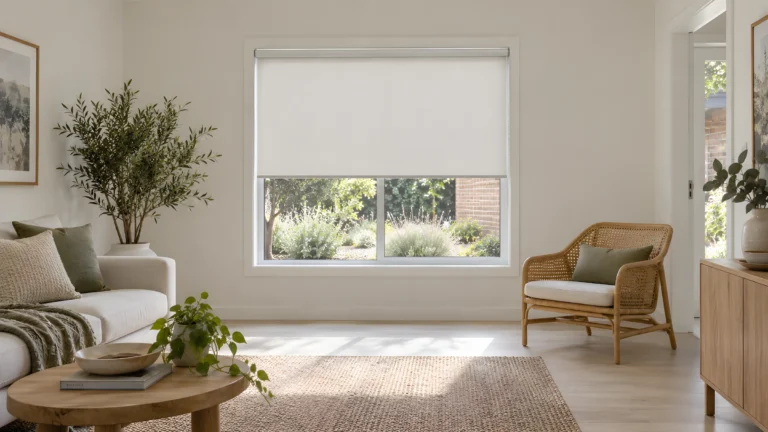 ComparisonsBlockout, light filter or SunScreen? Choosing roller blind fabricWhat each roller blind fabric does with light, view and privacy by day and night, and which one suits each room in your home.
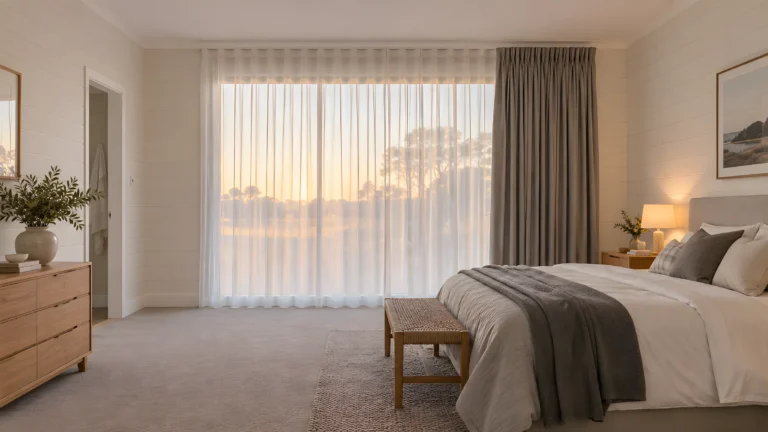 CurtainsHow to layer sheer and blockout curtainsHang the sheer at the front and the blockout behind on a double track, or choose a lining. Here is how to pick fabrics, headings, colours and depth.
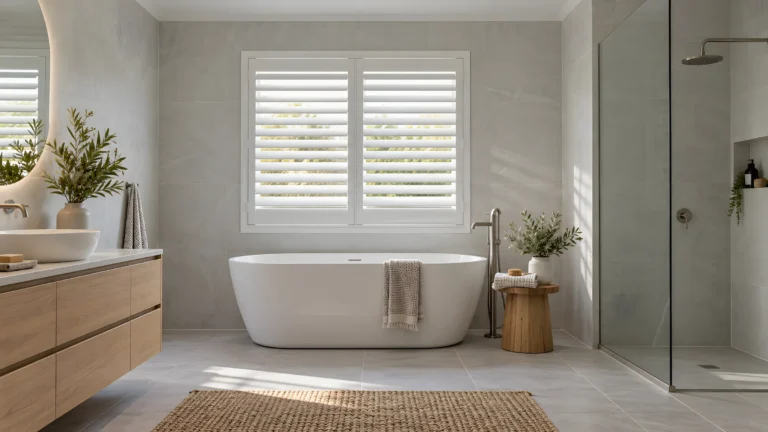 Room ideasThe best blinds and shutters for bathroomsPVC shutters, fauxwood venetians and aluminium venetians suit bathrooms best, with roller blinds for windows out of the spray. Privacy, moisture and fit explained.