
Types of curtains: fabrics, headings and linings explained
Every type of curtain we make, from sheer and blockout fabrics to lined and double layers, headings and tracks, with a room-by-room guide to choosing.

The main types of curtains come down to four choices: the fabric (sheer or blockout), the layering (single, lined or double), the heading at the top, and the track and opening that decide how the curtain hangs and moves. Get those four right and the rest is detail. This guide covers each type we make, explains the words you will see on other sites, and shows which type suits which room.
In short
- Fabric: sheers filter daylight and soften the view; blockouts stop light passing through the cloth and give privacy day and night.
- Layers: a single curtain, a lined curtain (one track) or a double curtain (two tracks, drawn separately).
- Heading: S Fold, pencil pleat, double pinch pleat, triple pinch pleat or inverted pleat.
- Track, opening, finish and control complete the choice, from ceiling or wall fit to a wand or a motor.
- Curtains and drapes are the same thing in everyday Australian use.
Curtain types at a glance
Every made-to-measure curtain is a combination of the choices below. You make these choices in the curtain configurator, so the table works as a checklist for your order.
| Choice | What you can pick | What it changes |
|---|---|---|
| Fabric | Sheer: Cassis, Cassis Volume, Bali. Blockout: Galaxy, Epic | Light, privacy and weight |
| Layers | Single, lined or double | Night privacy and how many tracks you need |
| Heading | S Fold, pencil pleat, double pinch pleat, triple pinch pleat, inverted pleat | How the fabric folds and how far it projects |
| Track and fit | Designer, Half Moon or Motorised; ceiling (top) or wall (face) fit; straight or curved | How it fixes, and what suits corners and bays |
| Opening | Left, right, centre or up to two splits | Where the fabric stacks when open |
| Finish | Just off the floor, touching or puddled | Length and how the hem meets the floor |
| Control | Wand, drawing by hand, or motorised | How you open and close it |
Types of curtains by fabric
Fabric is the first decision because it sets how much light and privacy you get.
Sheer curtains
Sheer curtains are translucent. They filter daylight, soften the view and give some privacy by day. At night, with lights on inside, people outside can see in, so a sheer on its own is not a night-privacy fabric.
We make three sheers, all linen-look polyester rather than linen itself:
- Cassis has a soft, natural texture in warm neutrals: Sand, Linen, Fawn and Pewter. (Linen is a colour name here, not a material.)
- Cassis Volume is the same sheer in whites and greys: Snow, Pearl, Driftwood, Silver, Ash and Charcoal.
- Bali is our lightest linen-look sheer, with an airy drape, in Blush, Cobblestone, Gardenia, Onyx, Pearl, Smoke, Snow, Taupe, Black, Thunder and Ash.
Sheers are hand wash only, in warm water, with no bleach, rubbing or wringing.
Blockout curtains
Blockout curtains are coated, opaque and stop light passing through the cloth. Many people search for "blackout curtains", and it means the same thing. A little light can still show at the edges, top and bottom, and a track that extends beyond the frame, or a pelmet above the track, reduces it.
We make two blockouts, both with a white backing:
- Galaxy is our heaviest blockout, coated, in a wide colour range that includes Mars, Earth, Comet, Mercury, Luna, Venus, Pluto, Twilight, Halley, Saturn, Neutron, Dusk, Aurora, Nebula and Bianca.
- Epic is coated in three layers (three-pass), in Chalk, Cloud, Smoke, Putty, Pewter, Cobblestone, Ash and Ebony.
Blockouts need more careful cleaning than sheers. They cannot go in a washing machine, so read how to clean blockout curtains at home before you choose a colour you will need to keep pristine.
Tip: Colour and texture vary slightly between fabric rolls and samples. Order free samples and look at them in your own light, in the morning and at night, against your walls and floor.
Sheer or blockout: how to decide
Three questions usually settle it:
- Do you need the room dark? For a bedroom, a nursery or a screen room, choose blockout, lined or double curtains.
- Can people see in at night? On a street-facing window or one close to a neighbour, a sheer alone will not give night privacy once the lights are on. Add a blockout layer.
- Do you want to keep the light and the view? A sheer softens daylight without shutting it out, which is why living rooms and dining rooms often start there.
If the honest answer to more than one is yes, you want both fabrics, which is what lined and double curtains are for.
Types of curtains by layers: single, lined and double
The layering decides whether one pair of curtains has to do everything, or whether you get separate day and night settings.

Single curtains
A single curtain is one fabric on one track. It is the simplest option: a sheer for soft daylight in a living room, or a blockout where you want privacy and a dark room.
Lined curtains
Lined curtains have a blockout lining sewn behind a sheer, so the two open and close together as one curtain on one track. The lining stops light coming through the cloth and adds body. Lined curtains are sold as their own product.
Double curtains
Double curtains hang a sheer and a blockout on two tracks, with the blockout on the rear track and the sheer at the front. You draw them separately, so you can have the sheer across during the day and add the blockout at night. Double curtains typically project 220 mm to 250 mm from the wall, including the track and fabric, and built-in pelmet cavities need 250 mm of depth.
| Single sheer | Single blockout | Lined | Double | |
|---|---|---|---|---|
| Tracks | One | One | One | Two |
| By day | Soft, filtered light | No light through the cloth | No light through the cloth | Sheer alone, blockout alone or both |
| At night | People outside can see in with lights on | Private | Private | Private with the blockout drawn |
| Moves | On its own | On its own | Both layers together | Each layer separately |
Our post on how to layer sheer and blockout curtains explains how to set up a double curtain, and the choice between a double and a lined curtain in more detail.
Types of curtain headings and styles
The heading is the stitched top of the curtain, and it decides how the fabric folds. We make five, and a heading can be chosen with either a sheer or a blockout fabric.
- S Fold gives continuous, regular waves. It is our most popular heading, has the deepest profile of the five and is used with a ceiling (top) fit. You may also see it sold as ripplefold or wave curtains.
- Pencil pleat has fine, closely gathered folds across the top and is often used as the rear layer behind an S Fold front.
- Double pinch pleat and triple pinch pleat gather the fabric into pinched groups with two or three fabric fingers in each. They are our most traditional, tailored headings.
- Inverted pleat has a flat front with the fullness folded in behind it. Like pencil pleat, it suits the rear layer of a double curtain.
Our guide to curtain headings explained compares them side by side. Eyelet and tab top curtains, common in shops, are not part of our range.
Curved, box and bay tracks take S Fold, pencil pleat or pinch pleat only.
Curtain fullness: how much fabric goes into the fold
Fullness is how much fabric is used compared with the finished width of the curtain, and it changes the look more than most people expect. We offer about 2.0, 2.2, 2.25, 2.4, 2.5 and 2.5 to 2.75 times the finished width.
At about 2.0 the folds sit flatter for a simpler, less bulky look. Around 2.4 is a good middle-ground choice for many headings. At the top of the range you get the deepest folds and the fullest drape. You do not multiply your track width yourself: you enter the track width, choose the fullness, and the fabric width is worked out for you.
Drapes vs curtains: what is the difference?
The drapes vs curtains question comes up often, and in Australia the answer is simple: they are the same thing and the words are used interchangeably. Some shops use "drapes" for heavier, lined or floor-length curtains and "curtains" for lighter, unlined panels, but there is no fixed rule and both words are used for the same product.
What matters is the fabric, the lining and the heading, which are the choices in this guide. If you see a product called "drapes", check those three details rather than relying on the name.
Drapes meaning and drapery meaning
The drapes meaning is simply curtains, most often the heavier kind that fall in deep folds. Drapery is the wider word: fabric that hangs in folds. You will see "draperies" used for curtains and drapes together, so drapery meaning and curtain meaning overlap almost completely.
Different kinds of drapes
Whatever name a shop uses, the different kinds of drapes map onto the same types of curtain covered above:
- Sheer drapes are sheer curtains: Cassis, Cassis Volume or Bali.
- Heavy or blockout drapes are blockout curtains in Galaxy or Epic.
- Lined drapes are lined curtains, with a blockout lining sewn behind a sheer.
- Layered drapes are double curtains, a sheer on the front track and a blockout on the rear track.
- Pleated drapes are pinch pleat, pencil pleat or inverted pleat headings, while S Fold gives the continuous waves.
Types of curtain tracks and fitting
The track is what the curtain hangs from and slides along, and it sets how far the curtain sits from the wall.
- Designer is a plain, straight profile.
- Half Moon has a curved front edge and costs a little more than Designer.
- Motorised is the track built for a motor. See the motorised section below.
- Colours: silver, black and white, chosen separately from your fabric.
You can fix any track to the ceiling (top fit) or the wall (face fit). A ceiling fit suits straight-edge ceilings and also works inside a cornice, and it takes the fabric high for a taller-looking room. A wall fit is worth considering when a large cornice leaves a big gap between a ceiling-fixed curtain and the window, or when you want to clear a window handle.
Curved tracks for corners, bays and boxes
If your window turns a corner, a curved curtain track follows it. Curved tracks come in Designer and Motorised only, with up to two 90 degree bends online, and each bend either fits into the corner or wraps around it. Box and bay windows use 45 and 90 degree tracks, and you send a photo and a plan sketch so the track can be made to suit. See box and bay curtains for that arrangement. For a full comparison, read our post on curtain tracks explained. If you are weighing tracks against rods, curtain rods vs curtain tracks sets out the differences.
Types of curtains by opening, finish and control
Opening
You can open curtains to the left, to the right, from the centre, or with up to two splits so that separate sections move independently. Splits are useful on sliding doors, where you may only want part of the opening clear.
Every opening needs wall space to stack, so leave clear wall on the side or sides where the curtain opens.
Finish
The bottom finish sets how the hem meets the floor. Just off the floor ends 5 to 10 mm short of your drop, touching skims the floor by up to 5 mm, and puddled gathers about 20 mm of extra fabric on the floor. Puddled is worth considering if your floor or ceiling is slightly uneven, because the extra fabric hides the difference. Our post on the curtain size guide covers length in detail.
Control
Curtains are drawn by hand or with a wand of 910 mm or 1520 mm, and you can also choose no wand. The alternative is a motorised track, with a battery or hardwired motor and a remote. Motorisation is not available with free-flow tracks or multiple openings. Read motorised curtains explained to plan power and controls.
Pelmets for curtains
A pelmet is a fitted cover across the top of the window that hides the track. We sell box pelmets for curtains, and Bonded Pelmets: fabric-covered pelmets that hide the roll or track and frame the window. The flat-stitched headings (pencil, pinch and inverted pleat) suit curtains hung behind a pelmet, and a double curtain with a built-in pelmet cavity needs 250 mm of depth.
Combining curtains with blinds
Curtains do not have to work alone. A common pairing is a sheer curtain in front of a roller blind: the sheer softens the room while the blind is up, and the blind gives you light control or privacy when you need it. Our blockout roller blinds suit a bedroom behind a sheer.
Check clearance before you order. The curtain track needs to sit far enough out to clear the blind's brackets, chain and base rail, so check the clearance against both products' guides.
Care at a glance
The fabric and lining you choose decide how the curtain is cleaned, so it is worth knowing before you buy.
| Type | Everyday care | Deeper cleaning |
|---|---|---|
| Sheer (Cassis, Cassis Volume, Bali) | Vacuum gently with a soft brush attachment | Hand wash only, in warm water. No bleach, rubbing or wringing. Drip dry by the hooks in the shade. Warm iron, no hotter than 150 degrees C |
| Blockout (Galaxy, Epic) | Spot clean with care and test a hidden part first | No washing machine. Professional wet cleaning is recommended, or hand wash at 40 degrees C at most. No tumble drying. Iron the fabric side only. Fabric can shrink by up to 3 per cent |
| Lined | Cleaned as one piece | Follow the care for the coated lining |
Four mistakes to avoid when choosing a curtain type
- Expecting a sheer to give night privacy. With lights on inside, people outside can see in. Add a blockout layer.
- Choosing a double curtain without checking depth. Two tracks project 220 mm to 250 mm from the wall. Check window handles, sills and radiators first.
- Forgetting the stack. Open curtains take wall space. Plan the side that stays clear of doors and windows you use often.
- Choosing on a photo alone. Fabric colour and texture vary slightly between rolls and samples, so order samples first.
Which type of curtain suits which room?
| Room | Suggested type | Why |
|---|---|---|
| Bedroom | Blockout, lined or double curtains | Stops light passing through the cloth; a double curtain adds a daytime sheer |
| Living room | Sheers, often with S Fold | Soft daylight and a relaxed look; add a blockout layer if you want night privacy |
| Dining room | Lined curtains | Sheer look with a blockout lining on one track |
| Home theatre or media room | Blockout, ideally motorised | Cuts glare on the screen |
| Sliding, stacker and French doors | Curtains with a planned stack-back; S Fold suits French doors | Keeps the doorway clear when open |
| Large windows | Curtains with a planned stack-back | Wide spans are easy to cover with a long track |
| Kitchen, bathroom and laundry | Blinds or shutters rather than curtains | Better suited to moisture and splashes |
For a kitchen, see our page on kitchen blinds. If you are torn between the two products in another room, our post on blinds vs curtains compares them room by room.
How to choose your curtains: six steps
- Decide the light and privacy you need. Sheer for soft daylight, blockout for a dark, private room, lined for one track, double for both.
- Choose ceiling or wall fit. Check for cornices and what is behind the plaster. Ceiling battens are the easiest fixing.
- Pick a heading. S Fold for regular waves, pinch pleat for a tailored look, pencil or inverted pleat for a rear layer.
- Plan the opening and stack. Choose the side that stays clear of doors and windows you use often, and leave wall space for the stack.
- Order samples. For a double curtain, order both fabrics and hold them together in your own light.
- Measure. Follow the curtain measuring guide, or the double curtain measuring guide if you are layering. For bay and box windows use the box and bay curtains measuring guide, and for fitting see the curtain installation guide.
Questions
What are the main types of curtains?
Curtains differ by fabric (sheer or blockout), layers (single, lined or double), heading (S Fold, pencil pleat, pinch pleat or inverted pleat) and track (ceiling or wall, straight or curved). Opening, length and control complete the choice.
What is the difference between curtains and drapes?
In Australia the two words mean the same thing and are used interchangeably. Some shops use drapes for heavier, lined or floor-length curtains, but there is no fixed rule.
What does drapery mean?
Drapery means fabric that hangs in folds, and draperies is another word for curtains or drapes. In everyday Australian use, drapery and curtains describe the same product.
Which type of curtain is best for a bedroom?
Blockout curtains, lined curtains or a double curtain with a sheer and a blockout all suit a bedroom, because the blockout stops light passing through the cloth.
What is the difference between lined and double curtains?
Lined curtains have a blockout lining sewn behind a sheer and move together on one track. Double curtains hang a sheer and a blockout on two tracks so you can draw them separately.
Build your curtains
Choose your fabric, heading, track and opening, and see the price before you order.
Keep reading
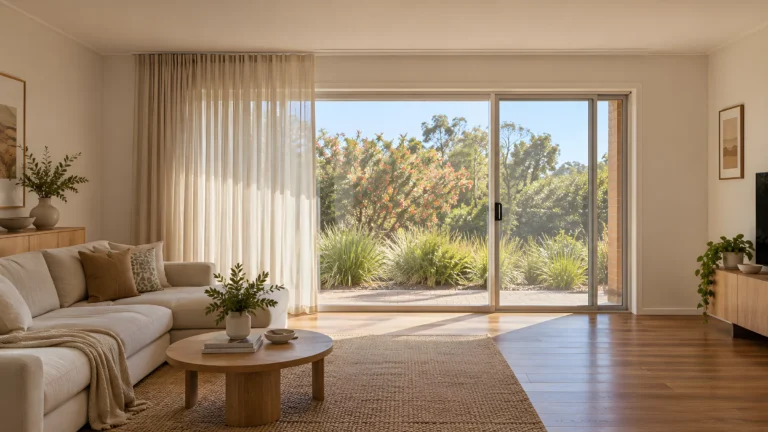 CurtainsCurtain headings explained: S Fold, pencil, pinch and invertedHow S Fold, pencil pleat, pinch pleat and inverted pleat headings look, hang and stack, with a comparison table to help you choose the right one.
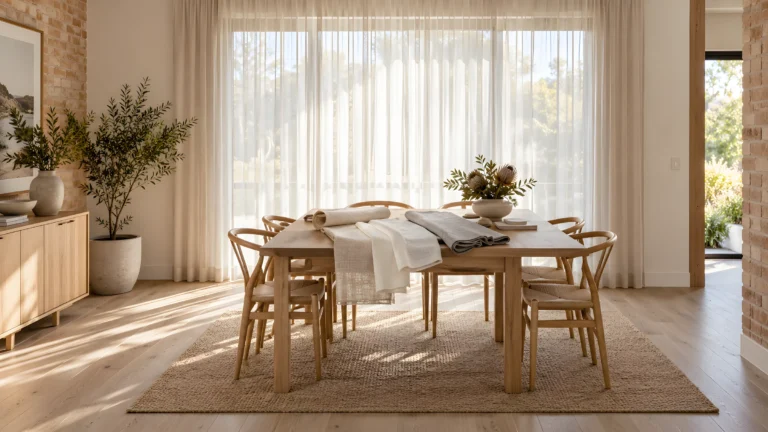 CurtainsCurtain fabrics explained: sheer, blockout and linen-lookOur sheers are linen-look polyester and our blockouts are coated fabrics. Here is what each does, how to care for it and how to choose.
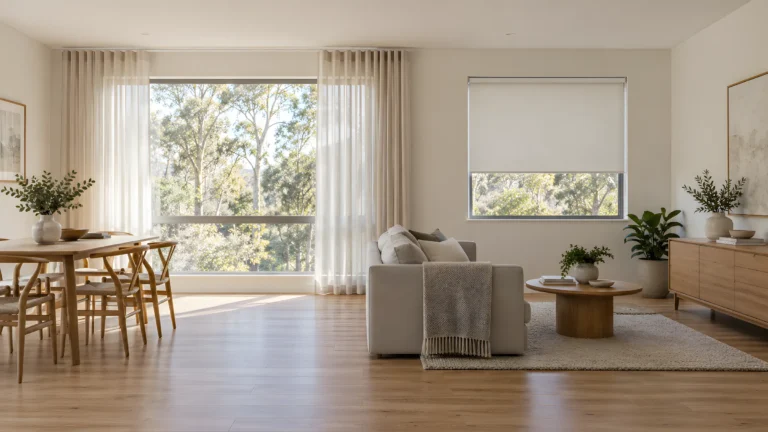 ComparisonsBlinds or curtains? How to choose for every roomBlinds suit small, practical and wet-area windows. Curtains suit wide windows, doors and soft living spaces. Here is how to decide room by room, and when to use both.