
Types of blinds explained: a complete buyer's guide
The main types of blinds are roller, double roller, vertical, panel glide and venetian. Here is how each works, what suits which room, and how to choose.
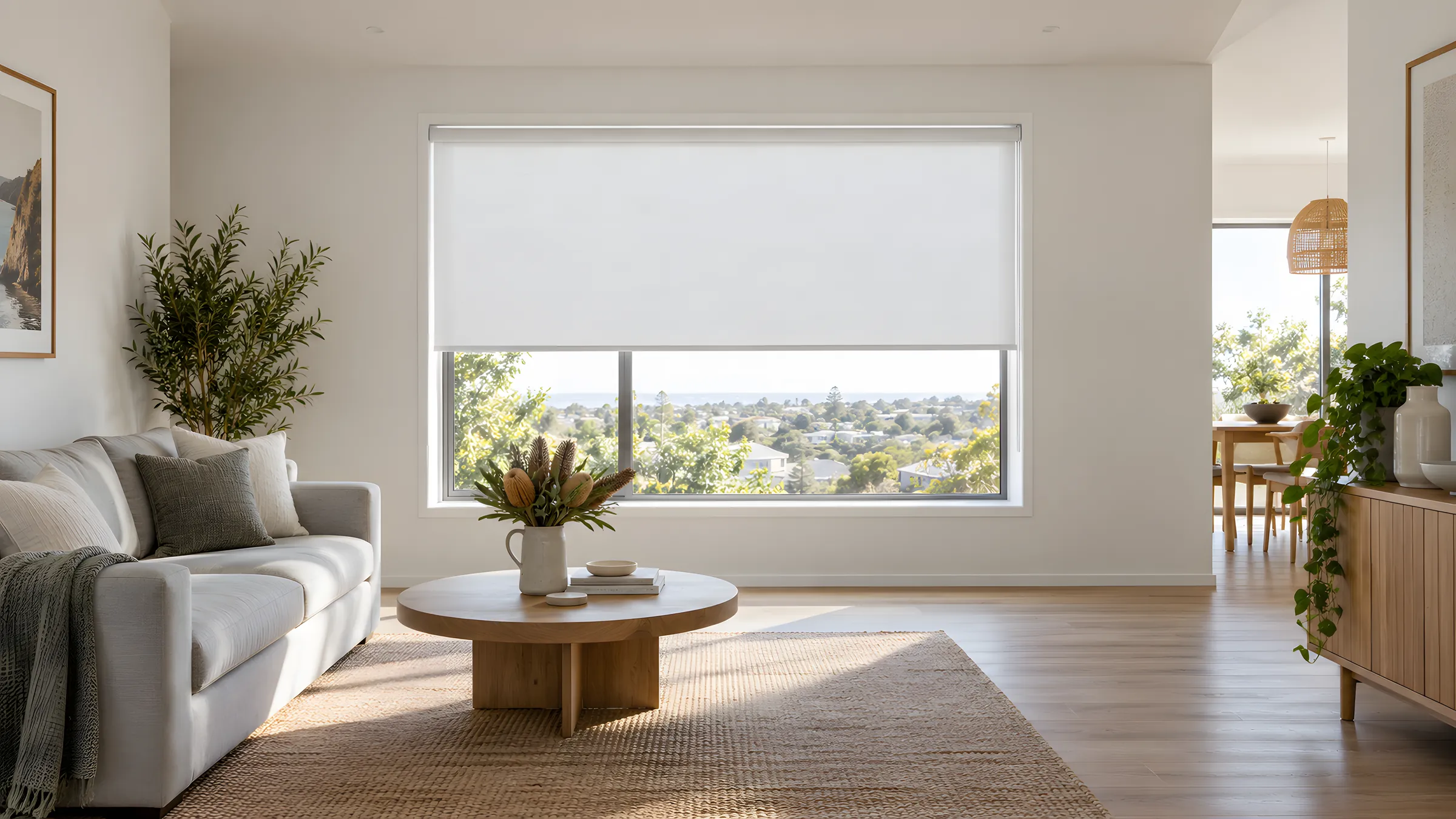
The main types of blinds for windows are roller blinds, double roller blinds, vertical blinds, panel glide blinds and venetian blinds. Roller blinds suit most rooms, double rollers give you separate day and night layers, vertical and panel glide blinds suit sliding doors and wide openings, and venetians give you fine control over light in kitchens and offices. All of these are indoor blinds, made to your measurements and ordered online.
In short
- Five main blind types: roller, double roller, vertical, panel glide and venetian (timber, fauxwood and aluminium).
- Roller blinds are the most flexible: blockout, light filter or SunScreen fabric, with chain, cordless or motorised control.
- Choose by the job: night privacy, glare, view, door width, moisture and who uses the room.
- Curtains and plantation shutters are alternatives, not blinds, and both are covered further down.
The main types of blinds at a glance
Each type moves differently, and that movement decides what it does best. Use this table for a first shortlist, then read the section for each type.
| Type | How it works | Best for | Watch out for |
|---|---|---|---|
| Roller blinds | One piece of fabric rolls around a tube | Most rooms, from bedrooms to kitchens | Small light gaps at the edges of a conventional blind |
| Double roller blinds | Two fabrics on one set of dual brackets | Rooms that need daylight and night privacy | Needs more recess depth |
| Vertical blinds | Hanging vanes rotate and slide to one side or split | Sliding doors, French doors, wide openings | Only Lakeside and Shade fabrics; not for kitchens |
| Panel glide blinds | Broad fabric panels slide along a track | Large windows and doors | Face fit; not for kitchens |
| Venetian blinds | Horizontal slats tilt for light and lift for the view | Kitchens, bathrooms, home offices | Slat material matters in wet areas |
Roller blinds
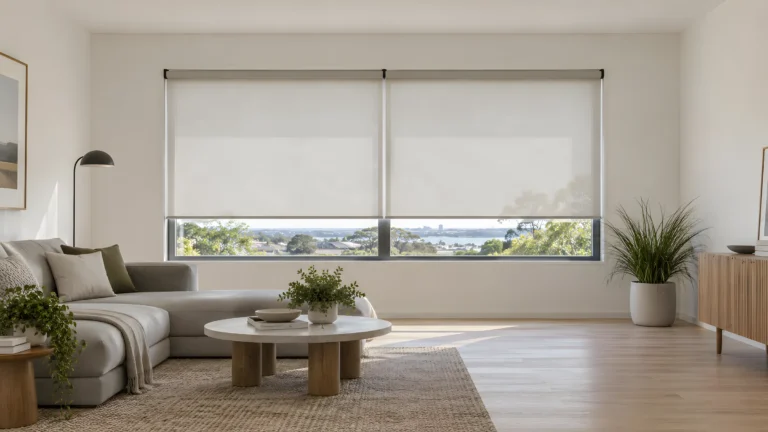
A roller blind is a single piece of fabric that winds around a tube at the top of the window. It is the most flexible blind we make, and our roller blinds are made in Australia. The choices that matter are fabric type, control, fit and extras.
Fabric types
Roller blind fabric does one of three jobs:
- Blockout stops light passing through the cloth and gives night privacy. Light still enters around the edges of a conventional blind. Many people search for "blackout", and it means the same thing.
- Light filter diffuses daylight and obscures the view. At night with the lights on, silhouettes can show.
- SunScreen is a woven fabric in our Screen range that cuts glare and keeps the view. It gives daytime privacy only when it is brighter outside, so it is not a night-privacy fabric.
We offer nine blockout ranges (Shade, Serene, Serene II, Ultra, Array, Allure, Elegance, Lakeside and Opulence), four light filter ranges (Serene LF, Ultra LF, Array LF and Opulence LF) and the Screen range in seven colours. Colours run from whites such as Shade Ice and Ultra Cool White to darker choices such as Array Jet and Screen Charcoal. Most blockout ranges have a white backing, while Shade is the same colour on both sides and Serene II and Lakeside have a colour-coordinated backing.
Our comparison of blockout, light filter and SunScreen explains the differences in more detail, and free samples show you the colours in your own light.
Controls
Roller blinds come with three control systems:
- SunBoss chain drive. The chain hangs on the left or right, with spring assistance on larger blinds. A chain safety device is supplied. Keep chains out of reach of children.
- ZeroGravity cordless. A spring-balanced blind you lift by the base rail. It holds at any height, has no chain and goes up to 3 m wide by 3 m drop.
- Silent Glide motorised. A battery motor is DIY-friendly and needs no mains wiring. A hardwired motor needs a licensed electrician, and C-Bus, for an existing C-Bus system, needs one too. Remotes come in 2-channel and 16-channel versions, and a compatible smart hub adds app control, scenes, timers and voice control through Alexa and Google Home.
For a children's room, a cordless or motorised control is the better choice. See our roller blind controls guide, which also covers motorised options.
Fit and roll direction
A roller blind can be recess fitted, inside the window opening, or face fitted, on the wall or trim around it. Some sites call these inside mount and outside mount. Recess fit looks neat but leaves small light gaps at the sides. Face fit covers more, reduces light gaps and clears obstructions.
Roll direction matters too. A standard (under) roll drops from the back of the tube, close to the glass, and blocks more light. A front (over) roll hides the tube and clears handles and winders but sits farther from the glass. A single blind needs 70 mm of clear depth for a front roll or 45 mm for a standard roll. Our guide to recess fit or face fit helps you decide.
Sizes, tubes and extras
Single roller blinds are made from 250 to 3000 mm wide and 300 to 3000 mm drop. The tube is 38 mm as standard, and blinds wider than 2100 mm use a 50 mm tube automatically. Over 2500 mm wide, the blind gets an upgraded gear-drive clutch at no extra charge.
You can also choose bracket colours (white, grey, ivory, latte or black), chain options including stainless steel, which we recommend for coastal homes, and a base rail in deluxe oval or flat.
Cassette and linked roller blinds
Two variations solve specific problems:
- The Full Blockout Cassette adds a headbox, side channels and a bottom channel to a compatible under-roll blockout blind. It needs 50 mm of clear depth and cannot be retrofitted. It reduces light around the edges.
- Linked roller blinds put two or three blinds on shared brackets for wide windows. The join gap is about 17 mm, compared with 30 mm or more for blinds butted side by side.
Double roller blinds
A double roller blind carries two independently operated fabrics on one set of dual brackets. The daylight layer is Screen or light filter, and the second layer is blockout. That gives you filtered daylight or a fully closed blockout layer for the evening, without changing the blind.
Double rollers use chain, cordless or motorised control, depending on the dimensions. They need more depth than a single blind: 90 mm with both blinds front rolled (the recommended recess setup), or 70 mm with both standard rolled. A curved double fascia can hide the hardware, in a matching aluminium finish or a fabric-wrapped front. If your recess is too shallow, two single blinds, one recess fitted and one face fitted with an under roll, is an alternative.
Double rollers work well in bedrooms, living rooms and dining rooms. Our guide to double roller blinds explained covers pairings, depths and controls.
Vertical blinds
Vertical blinds hang as a row of vanes that rotate to control light and privacy, and stack to the left, right or split. They suit sliding doors, French doors and wide windows because the vanes move sideways, out of the way of foot traffic.
Our vanes are 89 mm or 127 mm wide. Fabric choices are Lakeside and Shade, which are the only ranges available on vertical blinds. Face fit is common, and a recess needs enough room for the vanes to rotate.
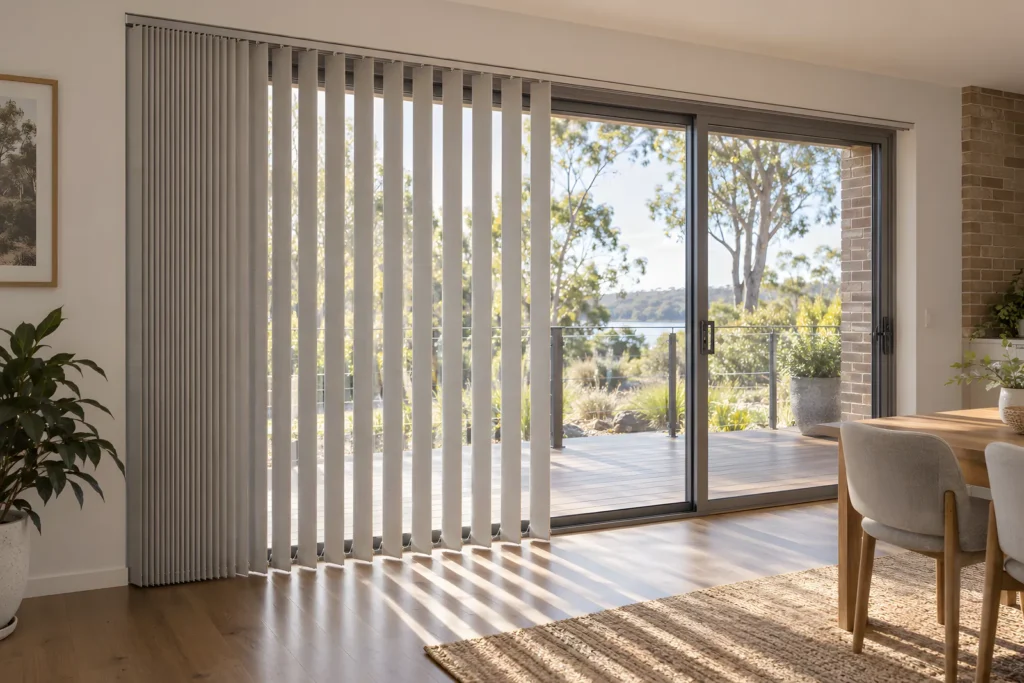
Vertical blinds are not used in kitchens. If you want a modern look on a wide opening, compare them with panel glide blinds below. For more current looks across every blind type, see modern blinds: styles and colours that look current.
Panel glide blinds
Panel glide blinds use broad fabric panels that slide along a track. They suit large windows and doors, and they give a cleaner, flatter look than vanes.
- Fabric. All roller blind fabrics can be used on panel glide blinds.
- Fit. Face fit.
- Panels. Panels are typically 500 to 1000 mm wide.
- Opening. A centre opening always has an odd number of panels: a 3-channel track has 5 panels and a 5-channel track has 9.
- Base rail. A flat base rail is available in White, Black or Silver at no extra charge.
Panel glide blinds are not used in kitchens. Track and stack allowances matter on a wide opening, so use the panel glide measuring guide before you order.
Venetian blinds
Venetian blinds have horizontal slats that tilt for light and lift for the view. They give the finest control of daylight of any blind, which is why they suit home offices, kitchens and bathrooms.
We offer three kinds:
- Timber venetian blinds have 50 mm slats and a natural look.
- Fauxwood venetians give the timber look in a faux wood slat and suit kitchens and bathrooms.
- Aluminium venetian blinds come in Cool White, Brilliant White, Warm Pure Silk, Ebony and Sterling, and suit kitchens and home offices.
Fauxwood and aluminium venetians suit kitchens because they are waterproof. Our timber, fauxwood or aluminium venetians guide compares them in detail.
Other window coverings, and what is not in our range
Fascias and pelmets
A roller blind fascia is a blind pelmet. It conceals the hardware, comes with matching brackets and side covers, and is a face-fit system. It is not a cassette and does not remove every light gap. A fabric-wrapped fascia cannot be made in Screen or Shade fabric, and a double roller fascia wraps in the blockout layer's fabric. Bonded pelmets are fabric-covered pelmets that hide the roll or track and frame the window. Our guide on what is a pelmet explains the differences.
Curtains
Curtains are the main alternative to blinds. We make sheer curtains (Cassis, Cassis Volume and Bali, all linen-look polyester) and blockout curtains (Galaxy and Epic), in S Fold, Pencil Pleat, Double Pinch Pleat, Triple Pinch Pleat and Inverted Pleat headings. Our guide to types of curtains covers the choices.
Plantation shutters
Plantation shutters come in timber (paulownia) and PVC. PVC is for interior use only and suits wet areas, but it is not for continual direct soaking. D-mould, the overlap lip that blocks the view between panels, is standard on every panel at no extra charge.
Types that are not part of our range
Some blinds you may see elsewhere are not part of our range: roman blinds, which fold into pleats as they lift; honeycomb (cellular) blinds, built from layers of cells; zebra blinds, which use alternating bands of sheer and solid fabric; and outdoor blinds for patios and cafes.
How to choose the right type of blind
Start with the job the blind must do, then the room, then the window.
Choose by need
| If you need | Consider |
|---|---|
| Night privacy and a darker room | Blockout roller blinds, a Full Blockout Cassette or a double roller |
| Glare control with the view kept | SunScreen roller blinds |
| Soft daylight with some privacy | Light filter roller blinds |
| Daylight and night privacy in one window | Double roller blinds |
| A sliding door or wide opening | Vertical blinds, panel glide blinds or linked roller blinds |
| Fine control of light | Venetian blinds |
| A hard-to-reach window | Motorised roller blinds |
| No chain, for a children's room | ZeroGravity cordless or motorised blinds |
Choose by room
| Room | Options that suit |
|---|---|
| Living room | Light filter, SunScreen, double roller, S Fold curtains |
| Bedroom | Blockout, cassette, double roller, face fit |
| Kitchen | SunScreen, light filter, fauxwood or aluminium venetians, PVC shutters |
| Bathroom | Light filter, blockout, fauxwood venetians, PVC shutters |
| Laundry | Light filter, blockout, PVC shutters |
| Nursery | ZeroGravity cordless, blockout, cassette |
| Home theatre | Blockout, Full Blockout Cassette, motorised |
| Home office | SunScreen, light filter, aluminium venetians |
| Dining room | SunScreen, double roller, lined curtains |
| Sliding doors | Vertical, panel glide, linked rollers, curtains |
| French doors | Front-roll rollers, vertical blinds, S Fold curtains |
Day and night: what each type does
Light and privacy change through the day, so it helps to compare types at both ends of it.
| Type | In daylight | At night |
|---|---|---|
| Blockout roller | Stops light passing through the cloth | Gives night privacy |
| Light filter roller | Diffuses daylight and obscures the view | Silhouettes can show when the room is lit |
| SunScreen roller | Cuts glare and keeps the view | Not a night-privacy fabric |
| Double roller | Filtered daylight from the Screen or light filter layer | Close the blockout layer for night privacy |
| Full Blockout Cassette | Blockout with a headbox and side channels | Reduces light around the edges |
| Vertical and panel glide | Vanes rotate or panels slide to set the light | Depends on the fabric; only Lakeside and Shade are available on vertical blinds |
| Venetian | Tilt the slats to set light and privacy | Tilt the slats closed for privacy |
| Plantation shutters | Tilt the blades to set light | Close the blades for privacy; some light shows around them |
The best type of blinds for a living room
Living rooms usually need to balance daylight, view and privacy through the day. Light filter roller blinds soften daylight and obscure the view. SunScreen roller blinds cut glare and keep the view, but they do not give night privacy. A double roller blind gives you both, and S Fold curtains add softness. Choose the layer that matches what the room does at night.
In the kitchen and bathroom
For kitchens, PVC plantation shutters, fauxwood venetians and aluminium venetians all suit, being waterproof. Roller blinds are fine as long as they do not get drenched, and SunScreen and light filter are the usual fabrics. Check taps and handles before you choose the fit, because a front roll can clear a handle. Cassette systems, curtains, vertical blinds and panel glide blinds are not used in kitchens. In bathrooms, keep roller blind fabric clear of direct spray; PVC shutters and fauxwood venetians are the sturdier choices where the window gets wet.
Fit and depth by type
Depth is what often rules a type in or out for a recess. This table pulls the figures together.
| Type | Usual fit | Depth or clearance to check |
|---|---|---|
| Single roller blind | Recess or face | 70 mm for a front (over) roll, 45 mm for a standard (under) roll |
| Double roller blind | Inside or outside fit | 90 mm with both front rolled, 70 mm with both standard rolled |
| Full Blockout Cassette | Recess fit | 50 mm of clear depth |
| Vertical blinds | Face fit is common | A recess needs room for the vanes to rotate |
| Panel glide blinds | Face fit | Allow room for the panels to stack; the panel glide measuring guide gives the allowances |
| Venetian blinds | Check the guide for your venetian type | Check the guide for your slat type |
| Plantation shutters | Inside Z-frame, inside L-frame or outside L-frame | 60 mm for a Z-frame, 70 mm for an inside L-frame, about 65 mm projection for an outside L-frame |
Fit and measuring
Whatever type you choose, decide between recess fit and face fit first, then use the official guides for that product. Every product has its own method, so do not carry a measurement from one type to another.
| Type | Measuring guide | Installation guide |
|---|---|---|
| Roller blinds | Roller blinds | Roller blinds |
| Double roller blinds | Double roller blinds | Double roller blinds |
| Full Blockout Cassette | Cassette roller blinds | Cassette |
| Vertical blinds | Vertical blinds | Vertical blinds |
| Panel glide blinds | Panel glide blinds | Panel glide blinds |
| Timber venetians | Timber venetians | Timber venetians |
| Aluminium venetians | 25 mm aluminium | Aluminium venetians |
| Plantation shutters | Plantation shutters | Plantation shutters |
The measure guides and installation guides pages list the rest, including bay windows, corner windows and doors.
Tip: Order two or three samples for each room and hold them against the window in the morning and the evening. The same fabric can look different beside a white wall and beside a timber floor.
Questions
What are the main types of blinds?
The main types of indoor blinds we make are roller blinds, double roller blinds, vertical blinds, panel glide blinds and venetian blinds. Roller blinds also come as cordless, motorised, linked and cassette versions.
What is the best type of blind for a living room?
Light filter roller blinds, SunScreen roller blinds and double roller blinds all suit a living room, and S Fold curtains are a popular alternative. Light filter softens daylight and SunScreen cuts glare while keeping the view.
Which blinds suit a kitchen?
SunScreen and light filter roller blinds, fauxwood and aluminium venetians and PVC plantation shutters all suit kitchens. Cassette systems, curtains, vertical blinds and panel glide blinds are not used in kitchens.
What is the difference between blockout, light filter and SunScreen?
Blockout stops light passing through the cloth and gives night privacy. Light filter diffuses daylight and obscures the view, and SunScreen is a woven fabric that cuts glare and keeps the view but is not a night-privacy fabric.
Which is better for sliding doors, vertical or panel glide blinds?
Both suit sliding doors. Vertical blinds have adjustable vanes for light and privacy, while panel glide blinds use broad fabric panels for a cleaner look, and linked roller blinds or curtains are other options.
Find your blind
Start with the roller blind builder, or order free samples to compare fabrics in your own light.
Keep reading
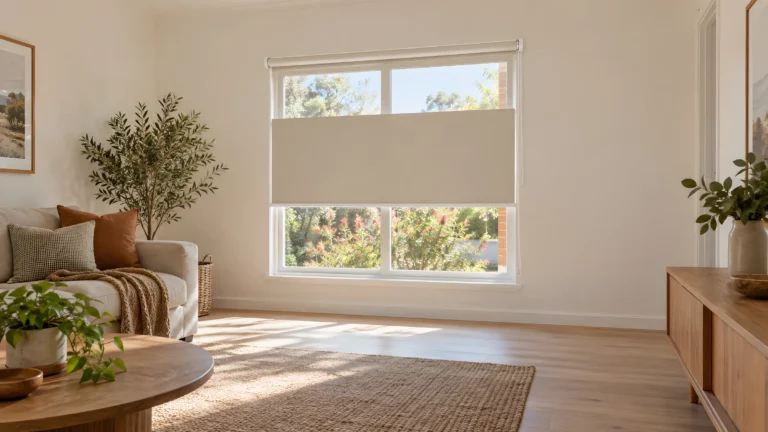 BlindsRoller blinds: the complete buyer's guideFabric, colour, controls, fit, roll direction and special formats: every decision in ordering a made-to-measure roller blind, in the order you make it.
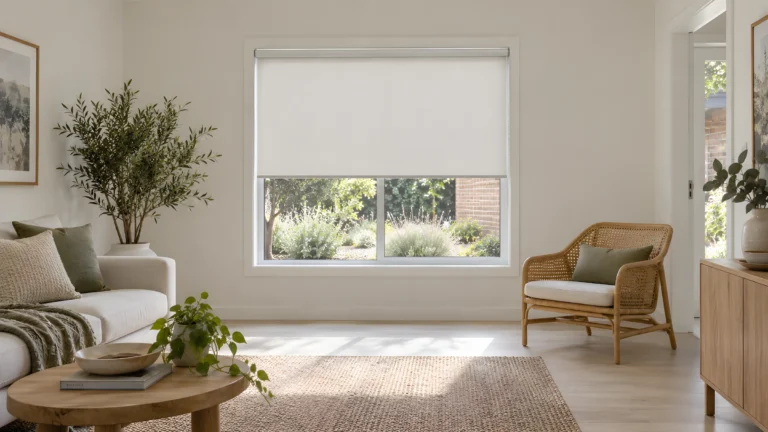 ComparisonsBlockout, light filter or SunScreen? Choosing roller blind fabricWhat each roller blind fabric does with light, view and privacy by day and night, and which one suits each room in your home.
 BlindsModern blinds: styles and colours that look currentWhat makes blinds look modern: concealed hardware, matte fabric, restrained colour and a tidy fit, with ideas for rollers, venetians, sliding doors and black blinds.